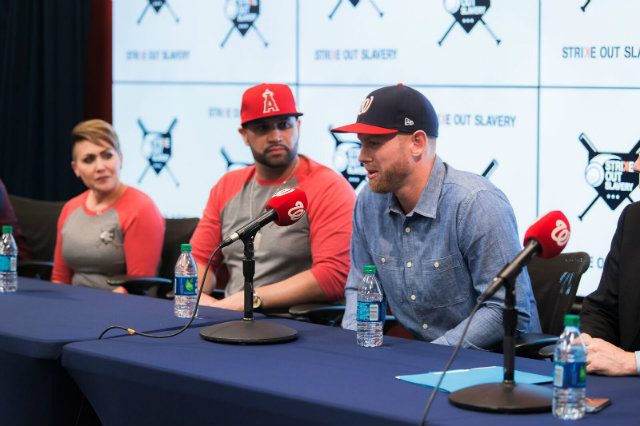
 Stephen Strasburg discusses plans to raise awareness about the issue of human trafficking with Deidre and Albert Pujols. (Photo by Paul Kim, courtesy of Strike Out Slavery)
By DCist contributor Julie Depenbrock
Stacy Jewell Lewis was walking home one night on Minnesota Avenue in Southeast, being followed by a group of men, when an older gentleman pulled over and offered her a ride.
She thought the man in the car, who looked to be about 70, was the better of two bad options.
But the man had been paid by traffickers. Lewis, 19 at the time, was taken from her home in Washington D.C. to New York City and forced into sex slavery.
Now telling her story as a survivor of slavery, Lewis has found an ally in, of all things, baseball. The “Strike Out Slavery” campaign, debuting this August in Washington, is aimed at educating fans of America’s pastime about human trafficking—and how terribly common it is.
While estimates vary greatly among advocacy organizations, the Global Slavery Index estimates that 40.3 million people around the world live in modern slavery, trafficked either for labor or sex. In the United States, the group estimates that close to 403,000 people are being trafficked right now.
“As I traveled the world, I began to see that human trafficking affects the whole planet,” said Deidre Pujols, who founded the organization last year with her husband, Angels first baseman Albert Pujols. “And I began to think about our platform in baseball. I felt like this issue was so tremendous that we should take it to Major League Baseball.”
They did, first to the Angels Stadium in Anaheim in 2017—and now to the Washington Nationals this August.
On a panel Monday at Nationals Park, the Pujols sat alongside Lewis, Nats pitcher Stephen Strasburg, singer Nick Jonas, and Polaris Project director Bradley Myles, whose organization works to put a stop to modern slavery.
“One of the biggest myths we combat every day is that trafficking isn’t happening here in the U.S.,” Myles said.
The Polaris Project reports that calls and texts to its national hotlines have increased steadily over the past few years. Still, less than 1 percent of trafficking victims are rescued, according to A21, an advocacy group for “abolitionists of the 21st century.”
After two years, Lewis was able to escape her captors when neighbors intervened. But her case is the exception.
“Vulnerable populations are everywhere,” Lewis said, and cultivating awareness is key.
To Deidre Pujols, the ballpark offers the perfect launchpad, so families can take this information and discuss around the dinner table—and then keep their eyes open.
“Baseball has 162 games a season, packing millions of people into its stadiums across the country,” she said. “This is an enormous platform.”
The key, Pujols added, is to get the message across in a friendly, “palatable” way. “It is a dark thing, but there is a way to talk about it.”
So far this year, Polaris has responded to 21 percent more trafficking cases than in 2017, Myles said. He contributes the uptick to the public’s increasing awareness, survivors’ speaking out, and frontline professionals’ learning to look for signs of trafficking. Everyone from bank tellers to flight attendants and health care providers is receiving training to spot signs of human trafficking and respond appropriately, Myles said.
The Nationals, led by Strasburg and his wife, Rachel Lackey, are the second team (behind the Angels) to take up the mantle of “Strike Out Slavery.”
Strasburg first became involved with the nonprofit International Justice Mission in 2015. That’s where he began hearing stories directly from trafficking victims.
“It gave me a lot of perspective, and really a call to action,” Strasburg said.
On Thursday, August 23, there will be an awareness festival before the ballgame at Nats Park where fans can learn about NGOs combating the trafficking trade, browse safety information, and participate in family-friendly games and give-a-ways.
After the show, Jonas will perform a free concert.
“This year, coming back and doubling down here in D.C., and Anaheim again, is going to be really special,” Jonas said. “I’m hopeful that we can continue to create some awareness and prevent this from happening. It’s our responsibility.”
The Pujols hope the nonprofit will expand further, and are in talks with other baseball teams to do just that.
“We need to wipe that myth away that this isn’t happening here,” Deidre Pujols said. “It absolutely is.”
Report tips, seek services, or ask for help by calling the National Human Trafficking Hotline at 1-888-373-7888 or texting BeFree (233722) for round-the-clock assistance.
Strike Out Slavery’s awareness festival and post-game concert will take place on August 23, when the Nats play the Phillies.