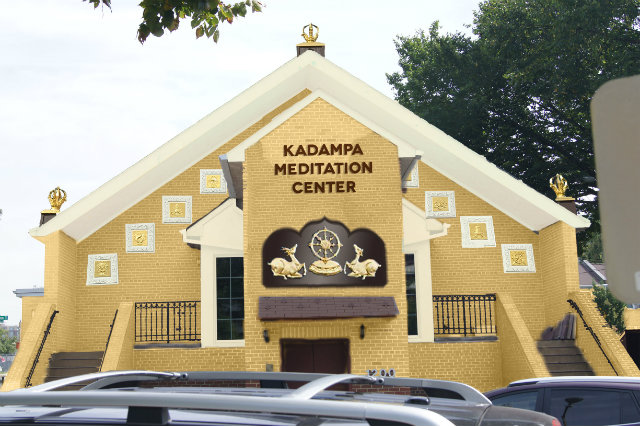
 A rendering of the new temple. (Courtesy of the Kadampa Meditation Center)
When the renovations are complete, a former church in Southwest will hold an 8-foot Buddha in its main hall, with space for more than 200 people to pray and attend meditation classes.
The Kadampa Meditation Center, a Buddhist center that’s been in D.C. for more than 20 years, recently moved into its first permanent home, at 1200 Canal St SW. It is in the midst of renovating the building, which dates back to 1979 per city records, into the “Buddhist Temple for World Peace and Meditation Center.”
The philosophy behind the center’s teachings is to help people, even with busy schedules, develop a meditation practice, Christian Gauthier, the center’s educational program coordinator, told DCist in a phone interview. “It’s not like you can only be successful at meditation if you’re a monk that lives in a cave.”
The space is rather modest right now. While the upstairs is under construction, classes are being held in a downstairs community room, which holds about 60 people. There’s a kid’s room for children’s classes, complete with a Buddhist shrine (and offerings of Goldfish crackers and Play-Doh, which Gauthier promises are “not traditional”).
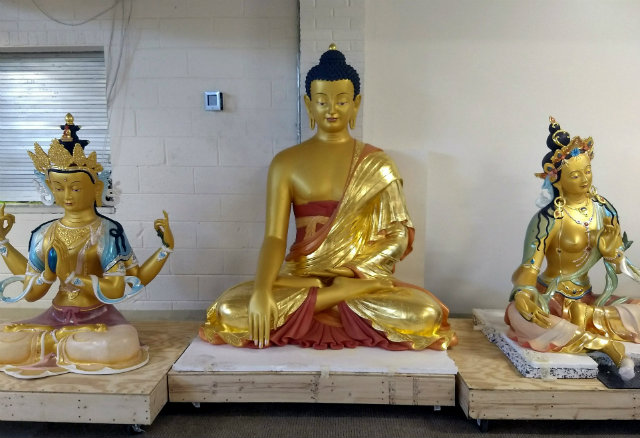
When the space is complete, however, it will be fairly remarkable. The top floor will hold, in addition to the 200 students, multiple, larger-than-life statues of the Buddha, which practitioners will fill with thousands of mantras written on paper, a ritual designed to “invite the Buddhas to stay in the statue,” Gauthier says.
You don’t have to be Buddhist to attend meditation classes, and in fact many of the people who visit the center are not Buddhist (although center staff don’t exactly poll people at the door). All classes except for the center’s teacher training sessions are open to people of all religions (or none at all).
Gen Kelsang Demo, a Westerner who became a Buddhist nun almost two decades ago, teaches many of them.
Expect a class to include a basic breathing meditation, then a teaching portion or “some form of Buddhist philosophy,” Gen Demo says, “and then a second meditation based on the topic of the class, and sometimes some discussion or a Q&A to finish.” The school focuses on “the understanding that the mind has a very big role in determining our experience.”
Topics vary from week to week; recently, the center has been doing a series on anger.
“Everybody knows outside what’s bothering them, what they find provocative or who they find irritating,” Gen Demo says, “but this is looking at what, inside, is the process I go through before I get angry, and are there things I can do with my mind to begin to reduce the amount of anger I have, or the intensity of it, or the frequency of it? That’s when you’d look at Buddhist teachings on patience or acceptance and passion as a technique to begin reducing anger.”
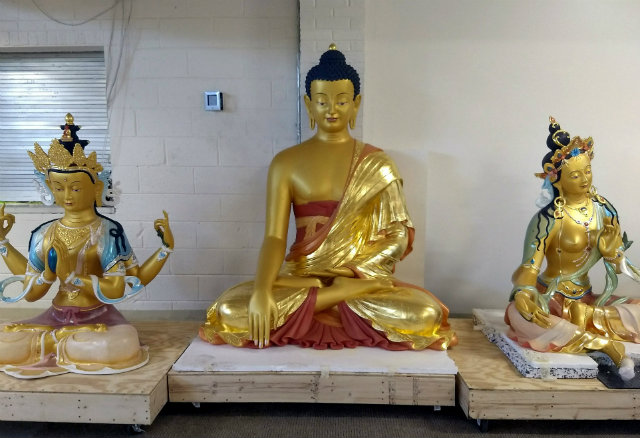 An 8-foot Buddhist statue will stand at the center of the main meditation hall at a new Buddhist temple in Southwest once renovations are complete. (Photo by Rachel Kaufman)
The center has had a presence in D.C. since 1994, renting space in Adams Morgan and Dupont Circle before purchasing its first building in January. In addition to classes, the temple will also provide housing for the center’s full-time staff.
The $600,000 renovation and $1.6 million cost of the building is being paid for out of a “temple fund” from the center’s parent organization, Gauthier says.
Every Buddhist center that is part of the New Kadampa Tradition (there are 1,200 around the world) pays profits above and beyond operating expenses into a fund. The Kadampa Meditation Center in D.C. got a grant from this fund to build its temple; once the renovations are done, they’ll begin paying back into it so another group can build or renovate their center, according to Gauthier.
The New Kadampa Tradition (or NKT) is somewhat controversial. The sect of Buddhism was founded by a Tibetan monk, Kelsang Gyatso and draws on a draw on a tradition that the Dalai Lama has disowned. Followers of that tradition have gone on to vigorously protest the Dalai Lama at his appearances (including when he met with President Obama at 2015’s National Prayer Breakfast in D.C.) and it isn’t entirely clear where the wealthy group’s funding comes from.
Georgetown professor Brandon Dotson, who specializes in Buddhist studies, says that the roots of the inter-religious conflict go back to the 17th century in Tibet. After a civil war, there was a debate over whether Buddhism should be more open to differing schools, or more “pure.” It’s complicated, but essentially the hardliners’ leader “died under mysterious circumstances, suffocated by a ceremonial scarf,” according to Dotson.
Some Buddhists then believe that he came back as a deity called Dorje Shugden, whose mission was to protect the purity of Buddhist teachings, he says. Some began worshipping Shugden as a “protector” spirit who policed the borders of “pure” Buddhism.
That brings us more or less to 1991, when Kelsang Gyatso founded the New Kadampa Tradition. NKT members, who are largely Westerners, worship the spirit; previously it was mostly Tibetan Buddhists, and a minority at that, who undertook the practice.
Meanwhile, says Dotson, the current Dalai Lama, who has a more ecumenical view of Buddhism, “felt he was being harmed by Shugden, and so he asked that people stopped doing it” in 1996 (the Dalai Lama has said that he worshipped the spirit himself until the early 1970s, before giving up the practice).
“There’s a lot of dispute about what happened then,” Dotson says, but NKT says that it led to Shugden worshippers being harmed. Some supporters claim to have heard of beatings and vandalism directed at Shugden worshippers, but these claims have been hard to substantiate.
The Chinese government appears to have exploited the rift to further its campaign against the Dalai Lama, devoting significant resources to temples and leaders of sects that worship Shugden. “On the ground, “evidence abounds that Beijing has thrown its weight behind Shugden devotees,” Reuters reports.
NKT leaders have strenuously denied being funded by the Chinese government. But exactly how their coffers are filled remains unclear.
A 2015 Foreign Policy story speculates about several alternatives:
“Suzanne Newcombe, who has researched the NKT at the London School of Economics, said that “the evidence is they rely heavily” on volunteering, as well as charging members and nonmembers for classes and retreats. Robert Thurman, a professor of Indo-Tibetan Buddhist studies at Columbia University, claimed that the money for the Shugden organization comes from worshippers ‘selling their apartments and houses’ and giving the money to the organization. [William] Fettig, [a] NKT monk, said he has ‘no idea’ whether people high up in the organization have gotten rich.”
I asked Gen Demo about the controversy. She said that while NKT opposes the Dalai Lama and her personal feelings are that she does not want to be associated with the leader because of the “human rights abuses” being perpetrated against Shugden worshippers, the meditation center as a whole does not take political stances and would never, for example, invite students at a meditation class to protest the Dalai Lama. When I asked her and Gauthier if they were funded by the Chinese government, they both burst into laughter.
Gauthier says NKT’s aim is to create a “modern Buddhism for people of the modern day world,” one that can be applicable to everyone.
Dotson says some of the students in his Introduction to Buddhism course visit NKT centers as part of their class projects. “I caution…not to sensationalize the controversial side of it,” he says. “A lot of people are just going there to meditate.”
The Kadampa Meditation Center is having an open house for the curious on September 3; check their website for more details. Or drop in for a meditation class; Sunday mornings and Thursday evenings are both open and $12 per person.