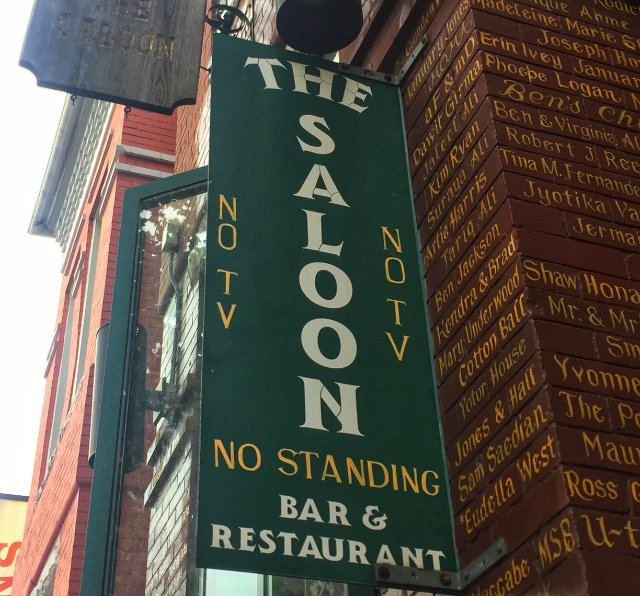
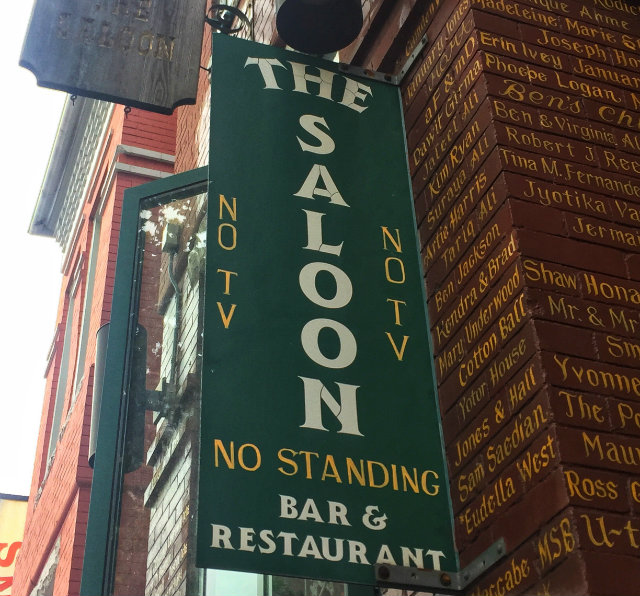
 The Saloon is located at 1205 U Street NW (photo by Sriram Gopal).
If you want to grab a drink at the quiet, no-nonsense watering hole The Saloon soon, you’re out of luck. The bar is shut down for the month of August as owner Kamal “Commy” Jahanbein travels to Sierra Leone to supervise the building of a school. Since he opened the bar on U Street in 2000, it’s become an annual tradition for him—he says this will be the 21st school he’s built over the past 18 years.
It started in 1994, when Jahanbein closed down The Saloon’s location in Georgetown and took some time off to travel. He came back a few years later, ready to reopen The Saloon in a new U Street location—”far away from the maddening crowd”— and—motivated in part by what he saw during his travels—with a new mission: to build schools, clinics, and homes around the world.
Jahanbein says he helped build his first two schools in Abadan, Iran—a city that suffered major damage during the Iran-Iraq war—using money that came out of the bar’s earnings. He’s followed that same model ever since. After paying expenses and staff salaries (including his own) at The Saloon, Jahanbein says he funnels additional income into the Kamal Foundation, a non-profit entity he created for his work in 2007. Additionally, a small percentage of each beverage sale goes to the foundation, and patrons are also welcome to donate. Those who give $150 or more get their name painted on one of the building’s bricks.
Ravi Garg, the foundation’s finance director, says he and Jahanbein pay for much of the foundation’s limited operational expenses (it doesn’t even have a website) and their travel out their own pockets, ensuring that nearly 100 percent of the money raised goes into the projects.
“[The foundation] is supported by volunteers only, including Commy, myself, and board members. There is no paid staff,” Garg says.
Building a new school starts at The Saloon. Patrons who want to suggest a location for the next project buy a brick for a consultation with Jahanbein, in which they make a pitch for a certain community’s needs. Jahanbein says all the ideas for where to build the next school come from The Saloon’s customers.
Jahanbein avoids using the word “charity” to describe his work—it’s more of a team effort. In each community where he builds a school, he says he operates under two basic principles: First, everyone in the village must save one day’s worth of income per month for six months and donate it to the project. Second, community members must commit to working on building the school for one day per week during its construction. According to Garg, it usually adds up to about 10-15 percent of the construction’s cost.
“It shows us who is serious and who is looking for a handout,” Jahanbein says.
He says parents pay a small fee—10 to 25 cents per month—as a reserve for repairs, and the local government pays to furnish and supply the school, and to employ at least one teacher. Jahanbein coaches the community on forging those connections along the way, and visits the site in person each August to finalize the plan.
Jahanbein generally does not visit the schools after they are completed, as at that point it becomes the community’s responsibility.
“That [project] becomes their baby,” he says.
Still, Jahanbein stays up-to-date on his projects’ successes: He describes his schools in Uganda whose graduates are excelling beyond the country’s average students, or the small town in El Salvador whose school produced the hamlet’s first high school graduate.
He’s not slowing down, either. Jahanbein says he’s collaborating with the children’s advocacy group The Bradley Center in Pittsburgh to fund classes and the purchase of supplies, marking the Kamal Foundation’s first effort in the United States. He says the Kamal Foundation also established a program in early 2016 called Living Above The Dirt, following concerns with students’ living conditions. In three countries where the foundation has already built schools—Guinea, Uganda, and Madagascar—Jahanbein says his foundation has provided concrete flooring to more than 4,000 families.
“It has a a huge medical and mental impact,” Jahanbein says.
Jahanbein may not have avoided the “maddening crowd” by moving to U Street, but he runs a purpose-driven venture with tangible impact.
“I have no intention to go anywhere. I’m going to operate as the same quiet neighborhood bar,” he says. “This has become the office of the foundation now.”