Jacob Fenston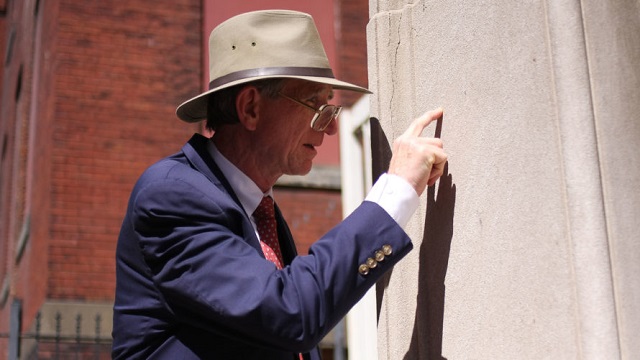
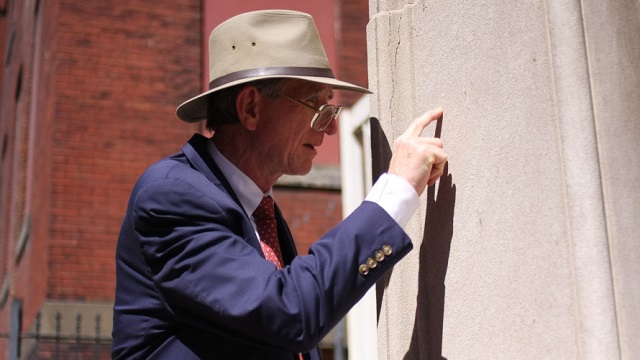 (Photo by Jacob Fenston/WAMU)
More than 30 million people a year visit Washington’s museums, but how many know about the city’s “accidental museum”? Its “exhibits” are on display all around us, but most people walk by them without noticing.
“No, I wasn’t looking down,” says Shawn Jenkins, after stepping over a large white spiral embedded in the black marble floor at the National Portrait Gallery. When he does look down, he sees it: “It looks like a snail almost.” Jenkins came to the gallery to see the portraits of the Obamas, not to look for fossils, accidentally displayed in floor stones.
“It’s accidental, because, with a couple of possible exceptions, no one was thinking about the fossils when they put the building in,” says Christopher Barr. You could call him the curator of the accidental museum. It’s not actually a museum at all, but Barr’s term for the dozens of buildings and structures around the city where fossils can be clearly seen embedded in stone. Architects choose particular types of stone for their color, or how durable or lightweight they are. “There are a lot of factors they look at. Fossils are not typically one of them.”
There’s a secret museum in D.C. and it’s right beneath our feet! pic.twitter.com/USVKhURlcV
— Jacob Fenston (@JacobFenston) August 2, 2018
Barr identified the snail at the National Gallery as Maclurites magnus, a prehistoric snail that lived and died 470 million years ago, near what’s now Lake Champlain in Vermont.
“They’re beautifully preserved here,” says Barr.
Evidence, like this, of prehistoric life, can be found all over the city.
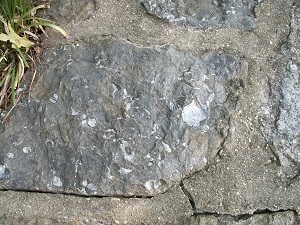 The rocky retaining wall at Mitchell Park. (dcfossils.org)
“In fact, I really got interested in it when I noticed there were great fossils near a park my children used to play in.” Barr saw what looked like clam shells in a stone wall at Mitchell Park, in Kalorama. He wanted to know what they were.
“I thought, well, surely somebody’s written this up.”
Nobody had. Barr is a lawyer by trade, not a paleontologist. But he knew how to do research. He consulted experts and books. He found out the wall at Mitchell Park was sandstone, and the shells were from brachiopods that likely lived about 400 million years ago. He researched the history of the particular hill where the park is located, dating back to when it was a colonial manor in the mid-1700s. He looked at newspaper accounts of the creation of the park in the 20th century. He consulted with city officials about its renovation in the 1980s, and with the West Virginia Geological Survey. Eventually, he created a website (“a guide to washington’s accidental museum of paleontology”) and wrote up what he’d found.
“Unintentionally, the city’s repair work installed a striking hillside display of organisms from the distant Paleozoic — an unlikely successor to the grounds of the grand colonial mansion that stood nearby and hosted the high society of the early Republic,” he wrote.
He started researching Mitchell Park 16 years ago. Now, he’s catalogued more than 50 fossil sites across the city, ranging from a church in Columbia Heights, to the headquarters of the International Finance Corporation. He has lived in the city since 1979 and spends a lot of time walking its streets. Looking for fossils, and learning about their origins and history, made those walks even more enjoyable.
While many examples are found in grand buildings, like the National Gallery of Art, others are in the most unexpected of places.
Barr leaves the Portrait Gallery and walks past street performers and crowds outside Gallery Place, then inside the shopping center, past ticket takers at the movie theater, and diners at a restaurant. He stops by a bank of elevators and looks down at the floor — green with little white speckles.
“Floors are awkward particularly this kind of place. This is especially the kind of place security personnel may become concerned with people crawling around on the floor,” he says.
Sometimes it requires some explaining. But that can make it even more awkward. “The explanation that you’re looking at fossils isn’t always viewed as being a very plausible cover story.”
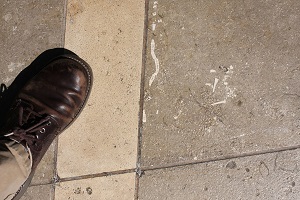 The white, spine-like shape is the column of a crinoid. (Jacob Fenston/WAMU)
Luckily, the fossils at Gallery Place aren’t only in the floor. They’re also in a wall around the corner, by an escalator heading down to Bed Bath and Beyond. This one he still hasn’t been able to identify. His first step is to try to find out where the stone is from.
“I’ve tried communicating with the owners, which constantly change, and the original architects, but I haven’t gotten anywhere,” he says.
Once he knows where a stone was quarried, it’s relatively easy to find out what formation it’s from, what era, and what sorts of creatures were fossilized.
Back outside, Barr walks by a parking garage with nondescript beige panels. He stops and leans in, his glasses almost touching the wall. Up close, there is texture like tiny crushed bones. It’s Indiana limestone, made up of masses of dead creatures.
“To the extent people are thinking about fossils, they think dinosaurs, think of them as something unimaginably long ago, and something you only see at the museum.”
You won’t see a T. rex in the walls of a parking garage, but Barr says every era of life on earth is represented in the buildings of Washington.
“You can see, you can reach out and touch shells that were alive 3, 4, 5 hundred million years ago.”
Barr says he plans to keep expanding the accidental museum, including a website reboot. As new buildings go up, he checks them out: the National Museum of African American History and Culture, The Museum of the Bible, The Wharf. But he’s often disappointed.
“A lot of new buildings don’t use natural stone. They use a lot of steel and glass.”
One example is at the corner of 10th and G, Northwest, an ultra-modern building next to the MLK library.
Barr came to inspect the building after it was finished (it replaced an old brick and limestone church). At first, he was disheartened to see the glass and brick facade. But one day, he happened to walk by in the rain. He took a closer look at the walkway by the entrance. At first it looks like concrete. Slick with rain, it had higher contrast and he noticed something.
“Wait. This isn’t concrete. In fact it’s got something in it. And what it has in it are fossils.”
It’s a fossilized sea creature called a crinoid. In the stone, its stems are clearly visible, in a column almost like a spinal cord.
Even as construction cranes loom over much of the city, as new replaces old, if you stop to look, you may find yourself surrounded by ancient life.
This story was originally published on WAMU.