 Photo by Daimon Eklund.
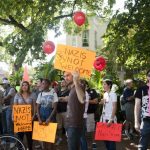
Two George Washington University students are trying to thwart a white nationalist march by turning it into an “involuntary walkathon” to fight hate.
Junior Allison Herrity and senior Kendall Keelen are running a virtual, mock sporting event to fight the aims of Unite the Right 2, a so-called “white civil rights rally” set for Sunday evening at Lafayette Park near the White House. For every step white nationalists take during the march, donors can pledge money to support the Southern Poverty Law Center, a nonprofit advocacy organization that tracks, exposes, and fights hate groups.
With school not in session until late August, they’re aiming to give out-of-town classmates a platform to “fight back” against the rally, Keelen says. “It’s a way for us to protest in a very peaceful way and away from any violence that might ensue.”
GW students, faculty, and staff are bracing for Unite the Right 2 demonstrators, who are slated to march through the school’s Foggy Bottom campus. Protesters will travel from Vienna to the Foggy Bottom Metro station on Sunday, according to the event’s website. They’ll then march to Lafayette Square, where the rally will begin. (D.C. police chief Peter Newsham said on Thursday that there is a “strong likelihood” the route will change.)
By Herrity and Keelen’s count, it will take about 1,500 steps for demonstrators to march from Foggy Bottom station to Lafayette Square. Walkathon donors can pick how much to donate to SPLC for each of those steps, ranging from a penny to 10 cents (or they can type in a custom amount). The students are collecting the donations through a crowdfunding platform.
By publication, Herrity and Keelen had raised more than $900 for SPLC through their walkathon. They got the idea from a New York Times opinion piece, Herrity said, and plan to keep the fundraiser open until the end of August.
“The reason that we set it up prior to the event was so that, if it does catch people’s attention, which we obviously hope it does, is that it’ll be used as a way of letting these nationalists know, that are coming in, that they’re not welcome here,” Keelen said.
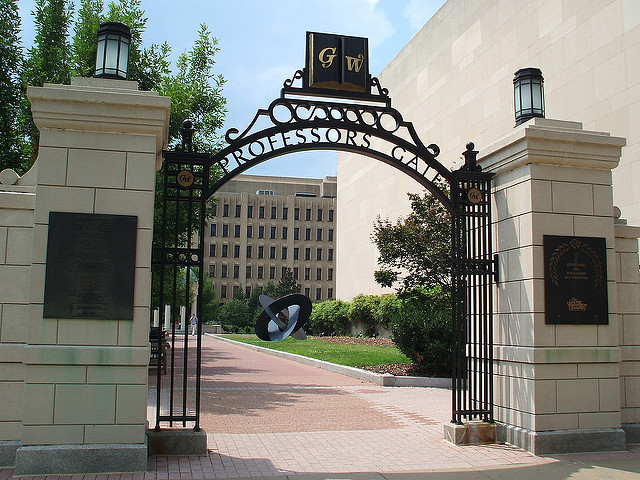
On their way to Lafayette Square, demonstrators could walk past GW’s academic buildings and dorms, which dot the walk from the station to the White House. The University announced Tuesday that it will close three campus buildings on Sunday, in addition to closing roads, putting up security barriers, and adding “a significant law enforcement presence,” according to a campus safety advisory. They added more buildings to the list of closures on Thursday.
The Student Association hasn’t planned any gatherings in response to the rally, student body president Ashley Le told DCist. If she does decide to host a gathering to support students disturbed by the rally, Le says she will wait until after the weekend to decide details. The school’s NAACP chapter has similarly opted not to host a counter event, president Adria Carter says, because classes resume in late August, and most students aren’t on campus yet.
The school’s College Republicans chapter released a statement Wednesday morning condemning the nature of the rally.
“We are vehemently condemning this group and want to make it clear that we do not support racist ideologies in any way,” Caroline Hakes, a sophomore and the director of public relations for the College Republicans chapter, told DCist.
GW College Democrats followed with their own statement denouncing the demonstration.
The university has not made an official statement about the rally’s white nationalist message. Instead, Lindsay Hamilton, GW’s executive director of media relations, referred DCist by email to GW President Thomas LeBlanc’s statement about the 2017 Unite the Right protest in Charlottesville, Virginia.
That’s fine with Le, the student body president. “I think that if there’s anything we need the most right now, it’s to tell students that we care about their physical wellbeing rather than the content of someone who are not affiliated with our institution,” Le says.
Nikki Usher, an associate professor at GW’s School of Media and Public Affairs, told DCist that she hopes the school will provide students with mental health support during the rally, like a crisis hotline, in addition to added physical security.
“This is fundamentally disturbing,” Usher says. “The school needs to let students know that they support an inclusive environment.”
The school houses summer interns and students taking classes at GW throughout the summer, according to the general summer housing website. Summer residents who don’t attend GW must move out of the dorms by Saturday. However, GW students can stay longer, meaning those who do will be on campus on Sunday, according to the website.
The urban campus is often in the crosshairs of political events and rallies, like the presidential inauguration and Women’s March in January 2017, because the school is within walking distance of the White House, National Mall, Kennedy Center and State Department, according to Google Maps.
James Harnett, a GW junior who represents parts of the school on the Foggy Bottom and West End Advisory Neighborhood Commission, said he hasn’t seen this significant of a security boost on campus since he enrolled. Herrity, however, said she remembers officers stationed outside her dorm during President Donald Trump’s inauguration.
GW’s move to close buildings and add police presence should signal to students that they should take the rally seriously, Harnett said.
“They’re not rallying for anything concrete,” said Ophir Cohen-Simayof, a sophomore majoring in political science and religion. “They’re just rallying because they hate people that are different.”