 Mikaela Lefrak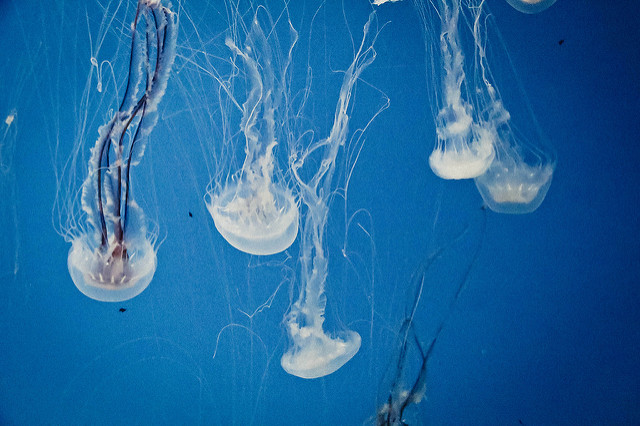
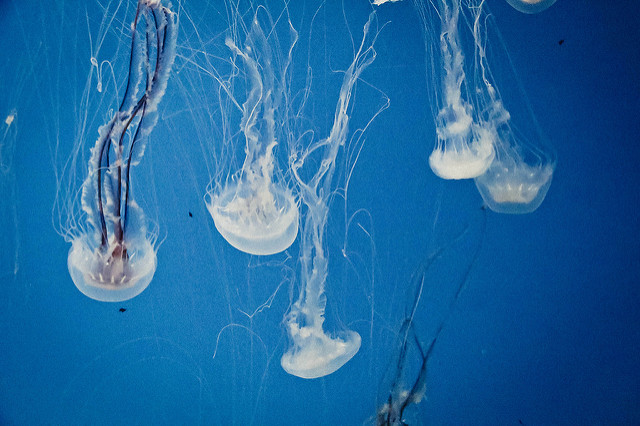 Sea nettles have no brains, but they’re dominant predators in the Chesapeake. (Photo by Lindley Ashline)
What’s good for humans isn’t always good for nature. Take the case of this summer’s missing Atlantic sea nettles.
Marine scientists have tried to find them. Buoys set up by the National Oceanographic and Atmospheric Administration (NOAA) have tried to measure them. But they’re not where they’re supposed to be.
“We tried very, very hard to find sea nettles in lots of different places around the Bay,” said Denise Breitburg, a marine ecologist with the Smithsonian Environmental Research Center. “They so far have not been spotted in Solomons, in Cambridge on the Eastern Shore, or in the lower Patuxent River where they’re normally really abundant. This is a real decline in numbers over a large area.”
Sea nettles are a type of jellyfish known for their delicate tentacles and painful sting. They’re typically abundant in the middle parts of the Chesapeake Bay during the summer, when ocean currents push saltwater up from the Atlantic to the Eastern Shore (these jellyfish like their water salty). Each summer, they ride the currents inland to feast on zooplankton, small fish, worms and crustaceans in the warm waters.
They also sting humans who accidentally swim into their tentacles. “It really hurts!” Breitburg said.
But this summer, massive rain storms have drastically lowered the salinity levels in the Bay, and sea nettles have become oddly hard to find in Maryland waters. A NOAA buoy in Annapolis predicted a 2 percent chance of encountering sea nettles, down from 10-20 percent in early July.
This July was the wettest on record in the Baltimore region since 1870, when the data was first collected. From July 1-30, 16.67 inches of rain fell at Baltimore-Washington International Thurgood Marshall Airport. Average rainfall for July is about 4 inches, according to the Baltimore Sun.
While swimmers might thrill at the prospect of sting-free waters, the changes to the Bay’s ecosystem could hurt other animal populations. Sea turtles, for one, typically swim in from the ocean to eat the jellyfish.
“They may be feeding on floating plastic bags instead of jellyfish,” said Doug Myers, the Chesapeake Bay Foundation’s senior scientist for Maryland. He worried that the storm waters have dumped more plastic waste into the Bay than usual, which sea turtles have been known to accidentally eat.
Oysters could also pay a price. Jellyfish help protect baby oysters in their floating larval stage by eating comb jellies, which prey on oyster larvae during the summer months.
Myers said that sea nettles are still showing up in farther south, in Virginia. They also could have swum deeper down in the Bay to get to saltier waters. He also said that scientists won’t know the final effects of the population decline until fisheries are surveyed later on.
“For now,” he said, “we just know that it changed things.”
This story originally appeared on WAMU.