Martin Austermuhle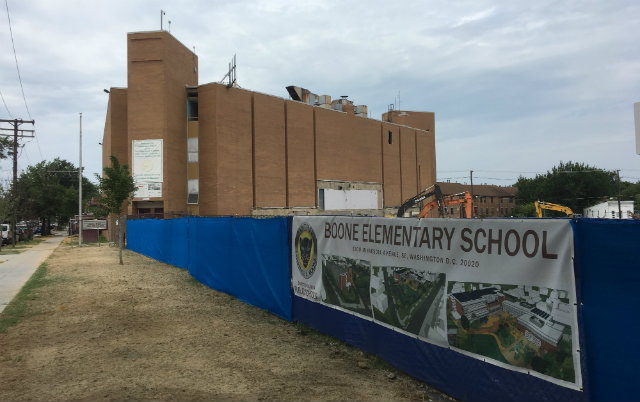
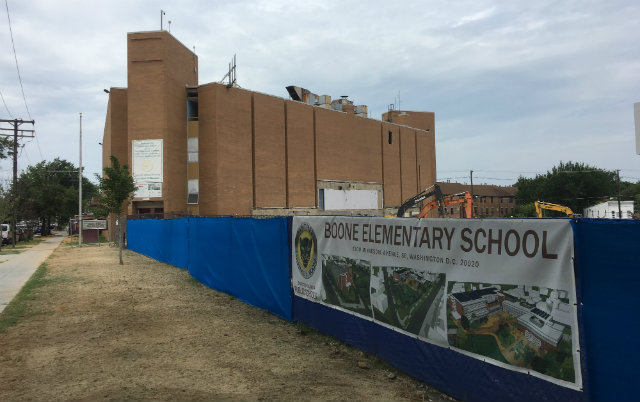 Since the early 1970s, Orr Elementary, named after Washington’s fourth mayor, has been housed in an imposing brick building on Minnesota Avenue. But starting this school year, the 400 students will be in a brand new building next door—and will now attend Lawrence Boone Elementary School. (Photo by Martin Austermuhle / WAMU)
Do any research on Benjamin Grayson Orr, and you’ll quickly learn the Virginia-born, one-time Georgetown grocer served as D.C.’s fourth mayor, elected to a two-year term in 1817. He is credited with grading the streets and establishing the volunteer fire department, as well as creating a lottery to help pay for a jail and city hall.
But when the young students who attend his namesake D.C. elementary school started looking into his background a few years ago, they made a more troubling discovery: Orr was also a slave holder.
“It was kind of a shocker. It was kind of heavy,” recalls Kelly Jones, a special education teacher at Orr, which is located on Minnesota Avenue Southeast. Almost all of the 400 enrolled students—including Jones’s daughter—are black.
“As students and as faculty and as people involved in the school, we were like, ‘Well, as a predominantly black school, could we have that name represent us, our student body?’ And the students were just like, ‘No, that’s not right,’” says Jones.
The discovery spurred a years-long campaign to rename the school, the fruits of which were on display this week when students arrived to a brand new building — one that is now known as Lawrence Boone Elementary School, after the school’s first black principal, who served from 1970 until 1995.
The name change at the D.C. school comes as cities, counties and states across the country — largely in the South — continue to grapple with the names and symbols they have chosen to commemorate with street signs, building names, statues and memorials. And in some local cases, moves have been made to remove names linked to Confederate leaders.
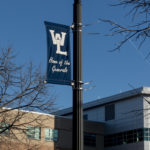
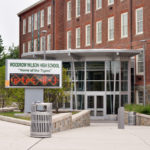
Last year, the Fairfax County School Board voted to change the name of J.E.B. Stuart High School to Justice High School; the name change took effect this July. And earlier this summer, the Alexandria City Council approved a name change for the Jefferson Davis Highway; it will be known as the Richmond Highway as of next January. A plan in Arlington to rename Washington-Lee High School was approved by the County Board, but is now facing a lawsuit filed by a group of students opposed to the move.
But the name change at Orr attracted little notice and almost no controversy, largely because the effort was spurred on by the school community and invoked Lawrence Boone, a towering figure in the school’s history and icon in the surrounding neighborhood.
“He was family. You never really thought you were actually coming to school. You thought you were going to a grandparents’ house. That’s pretty much how he made you feel,” says Eric Hodges, Jr., who attended Orr in the early 1990s, prior to Boone’s retirement.
Boone was born in Washington in 1936, and along with his 10 siblings was raised in a two-bedroom home in the Barry Farm area of Ward 8. After graduating from Dunbar High School and attending college in Texas, he returned to the city to attend Miner’s Teacher College, where he also played football. He turned down an offer to play professional football and instead started teaching in D.C. schools, moving from Madison-Taylor (now Ludlow-Taylor Elementary) to Lafayette Elementary, becoming one of the first black teachers in the majority-white school. During the Civil Rights movement, he transferred to Truesdell Elementary in Brightwood Park.
It was in June 19730 that he was made principal of Orr Elementary, the first black principal in the school’s history. Founded in the early 1900s to serve white students in the Fairlawn neighborhood, by the time Boone arrived at the school the student demographics had flipped — and it had moved into a new and imposing brick building on Minnesota Avenue.
Littyce Boone, Lawrence Boone’s only child and a former D.C. schools teacher herself, says that he focused not only on what happened inside the school — like introducing uniforms and establishing its first computer lab — but also outside of it.
“He became the community father,” she says. “You can go outside right now and ask anyone across the street that’s sitting there and ask them, ‘What about Mr. Boone?’ And they will give you a whole story about how Mr. Boone helped them.”
In a memoir he wrote before he died of cancer five years ago, Boone said of his time at Orr: “I knew that this was God’s plan for me. I felt that I belonged in this environment. I loved the children and the community.” After he passed, his daughter says so many people wanted to pay their respects that two funeral services had to be held.
Littyce Boone says that the effort to rename Orr after her father took shape both when the students uncovered the former mayor’s slave-owning past — Orr leased an enslaved man named Plato to James Madison for five years at a cost of $250 — and when D.C. officials told the community that they planned on demolishing the 1970s-era building and constructing a new one next door for the school. The school community started a petition, and earlier this year teachers, alumni and current students went to the D.C. Council to testify in favor of the bill to rename the school.
Boone says that while the name change comes at the a time of wider discussion around how certain historic figures have been memorialized, the true intention was merely to commemorate someone who had contributed so much to the school’s recent history.
“For the most part, the school and the community selected him to have this name on the school not necessarily because what’s going on around the country but because of the accomplishments he made,” she says.
Kelly Jones, the special education teacher whose daughter also attends the school, says the name change ties into what the school aspires to be.
“We talk about the kids’ names. They learn to write their names, they learn what their names mean, we learn about history. And so now we are kind of redefining our history, and saying, ‘You know what? Look at what this man has done for us and this community, now let’s define ourselves in that way and train us up in that same way,” she says.
The new $52 million school building opened to students on Monday, and over the weekend took in a stream of visitors from the community, including alumni, neighbors, teachers, and Mayor Muriel Bowser, who cut the ribbon on the newly minted Lawrence Boone Elementary School. Alumni marveled at what they said was a vast improvement over the school’s former building, which had few windows and an open-space design with no permanent walls.
Littyce Boone spent Saturday morning welcoming friends and family to the new building, all the while holding a memoir her father wrote and gave her shortly before he passed away. She says having his name on the school is the best way he could be commemorated.
“I’ve gone over to the cemetery,” she says. “I was like, ‘Daddy, we did it. Your name, your legacy, everything is carrying on.’”
This story originally appeared at WAMU.