Rachel Kurzius
 (Photo by Keith Ivey)
A challenge filed to the D.C. Board of Elections alleges that more than half the signatures on a D.C. Council candidate’s petition are invalid, which would make her ineligible for inclusion on the ballot.
At-large Councilmember Elissa Silverman submitted a review of challenger S. Kathryn Allen’s nominating petitions that claims 3,906 of the 6,075 names included have signatures that do not match the person in question, are duplicates, are not registered to vote at the listed address, or other flaws. Candidates need 3,000 valid signatures to gain access to the ballot.
A statement from Allen’s campaign says it “fell victim to a petition circulating service that was supposed to enhance our collection efforts,” but that it has verified more than 4,000 signatures and are confident Allen will make it on the ballot. Campaign members have not replied to several requests for comment.
Another candidate in the race for the independent at-large slot, Traci Hughes, ultimately opted not to submit her nominating petitions after her campaign determined thousands of signatures weren’t up to snuff. She placed the blame on Strategies for Change Group, a vendor she hired to help with the petition process.
So what exactly is going on here?
Who are the players?
Come November, D.C. residents will elect two at-large councilmembers, and only one of them can be a Democrat.
Silverman was elected to the D.C. Council in 2014 as an independent. She has been a strong advocate of D.C.’s paid leave law, which Allen has said motivated her to throw her hat in the ring.
The co-chairs of Allen’s campaign are former D.C. Mayor Anthony Williams and former At-large Councilmember David Catania. Allen, a first-time candidate, worked as a banking commissioner in Williams’ administration and has backing from members of D.C.’s business community.
Hughes, meanwhile, served as the first director of the D.C. Office of Open Government before her controversial outster this spring. Her campaign emphasized good governance and transparency.
Strategies for Change Group is headed up by Khalil Thompson, a management analyst and special assistant to Department of General Services Director Greer Gillis who previously worked with Mayor Muriel Bowser when she was a Ward 4 councilmember, the District Dig reports. Thompson told The Washington Post that Strategies for Change did not work with Allen’s campaign, though granted that some petition gatherers who worked for him may have assisted Allen separately.
What was the first shoe to drop?
Hughes sent out an email on August 10 announcing she was dropping out of the race. “When Strategies for Change Group handed over the signatures they collected right before this week’s deadline, thousands of them were determined to be fraudulent by the campaign,” the email read. “As a campaign focused on open, transparent, and accountable government, the campaign could not in good conscious turn these signatures in to the D.C. Board of Elections.”
But what does that have to do with Allen?
Silverman tells DCist that her campaign has offices in the same co-working space as Thompson, of Strategies for Change, and had observed petition gatherers for both Hughes and Allen heading inside.
“When Traci announced she wasn’t turning in her petition because there was petition fraud, it put a question in my mind whether there might be fraud in Allen’s,” Silverman says. “I did not plan on doing a challenge—I’m an incumbent. We did a campaign plan. This was not in it.”
Nevertheless, Silverman’s campaign pulled Allen’s petitions and started looking them over.
So what did Silverman’s campaign find?
Silverman says the fraudulent signatures were immediately apparent. Before she became a public official, she had been a reporter who covered signature fraud during the 2002 re-election campaign of Williams, now serving as Allen’s campaign co-chair.
“I knew what to look for,” she says. “Similar handwriting, you look for people you know, you look for dates that look strange … I spotted the name of my legislative director [Sam Rosen-Amy]. He was not in there once, but twice.”
Rosen-Amy is one of 13 people who have filled affidavits stating that the signatures appearing on Allen’s petitions did not belong to them.
Bryan Weaver, an ANC commissioner, says that he was in Guatemala on the date listed next to his name on Allen’s petition.
I had missed the Katheryn Allen petition signature issue this summer…but I was informed tonight that my name & address were on a petition. After a quick review this evening I can say this is not my signature…and furthermore I was in Huehuetengo, Guatemala on July 21st. pic.twitter.com/19KWOgW1zQ
— Bryan Weaver (@BryanWeaverDC) August 20, 2018
Here’s a breakdown of what the Silverman campaign found, according to the submitted complaint:
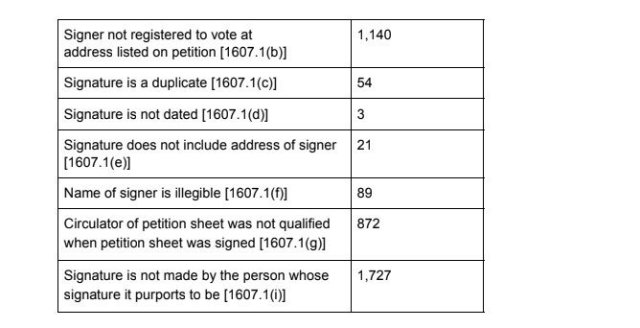
Moreover, Silverman’s complaint alleges that they found defects in some of the petitions circulated by Allen’s campaign director, Kevin Parker. They’re calling for all of his petitions to be ruled invalid.
What is Allen saying about all this?
After the District Dig first reported that Silverman was planning to challenge Allen’s petitions, Parker came out swinging in a statement that said, “S. Kathryn Allen will be on the ballot in November. Period.” It characterized a forthcoming challenge as “frivolous,” because “our campaign collected more than 6,000 signatures through hard work and organization.”
But after Silverman filed the complaint on Monday, a new statement from the Allen campaign acknowledged the use of a petition circulating service, while maintaining that friends, family members, and campaign staff “collected the vast majority of our 6,000 signatures.”
The Allen statement says that it has verified more than 4,000 signatures, while determining that it had used “two to three of the circulators from the service whose practices did not meet our campaign’s standards.” (Silverman’s challenge names four circulators with defects “that we assert render their entire petitions invalid,” including Parker, Allen’s campaign manager.)
Still, the Allen team said it had “full confidence that once [the D.C. Board of Elections] complete[s] their review, our candidate will be certified to be on the ballot.”
It did not comment on Parker’s petitions.
Now what?
The D.C. Board of Elections will hold a pre-hearing on the submitted challenges. “A lot of challenges have been filed,” says Rachel Coll, DCBOE spokesperson, though the agency doesn’t make public the number of challenges. The registrar determines whether the signatures are valid. (Unless someone brings a challenge, the agency does not verify signatures in candidate races. That process differs from ballot initiatives, where DCBOE will proactively check each signature.)
If a resolution isn’t reached between the two parties, a public hearing comes next and the board will decide whether ballot access is appropriate or not.
Silverman says that she is prepared to go to court over the alleged forgeries. “This isn’t, to me, about meeting the signature requirement,” she says. “This is a bigger issue about running honest campaigns in our city … If you don’t have an honest approach to campaigning, that’s a key indication of your integrity and how you would approach elected office.”
This post has been updated to reflect that Silverman has an office in the same co-working space as Thompson, not Hughes.