Jacob Fenston
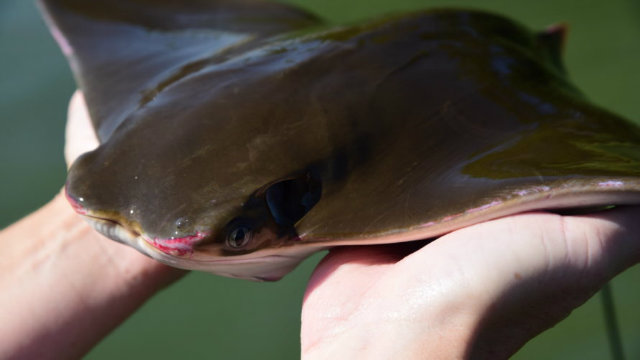 Cownose rays are migratory animals that come into the Chesapeake in summer and swim to Florida for the winter. (Photo by Jay Fleming / Smithsonian Environmental Research Center)
Cownose rays are a native species that can be found throughout the Chesapeake Bay and its tributaries, including the Potomac. A new study shows they may be in need of more protection.
Rays in the Chesapeake have been much maligned. They’ve been hunted en-masse in bowfishing contests. Watermen (and one scientific study in 2007) have blamed them for bingeing on oysters and crabs, causing population decline.
“Subsequent research has shown that while they do eat those things, they’re not responsible for those declines,” says Matt Ogburn, a marine ecologist at the Smithsonian Environmental Research Center, referring to research that came out in 2016. Now, he has co-authored a new study that, for the first time tracks rays on their yearly migration from Florida to the Chesapeake. He found that the same rays return to the same spots in the bay each summer — meaning that if too many are killed in one area, they may never come back. While there are many rays migrating up and down the Atlantic each year, only a small subset come into the Chesapeake.
Starting in 2014, Ogburn and other researchers worked with commercial fishers to catch a total of 36 rays, which were tagged and released. The team then used acoustic tag detection to track the rays’ movement up and down the coast, from Long Island, New York, to Port St. Lucie, Florida.
They found that all the tagged rays spent winters in the same area, offshore of Cape Canaveral, Florida, but most (75 percent) parted ways and returned back to their separate summer homes in the Chesapeake.
Ogburn says that has implications when it comes to managing the harvest of rays in the bay.
“You could be harvesting from a pretty small segment of the population that could be impacted pretty easily.”
Cownose rays became a political issue in Maryland when videos surfaced a few years ago of bloody bowfishing contests, killing masses of the creatures. Now, Maryland is the first state to work on a plan to manage the fishing of rays.
Ogburn says he hopes Maryland takes a balanced, but conservative approach to the number of rays that can be harvested.
This story was originally published on WAMU.