Rachel Kurzius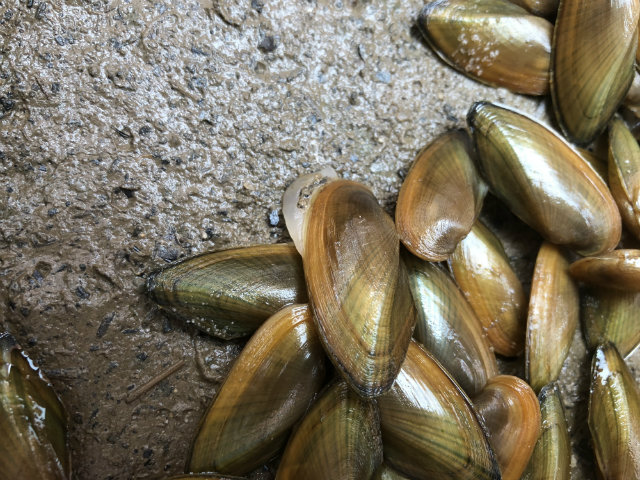
If you’ve got 5,600 freshwater mussels, you could serve about 280 steaming plates of moules marinières. Or, you could deposit the bivalves in the Anacostia River.
The Anacostia Watershed Society has opted for the latter as part of a larger effort to clean the river and renew the mussel population. Last week, staffers and volunteers with the nonprofit placed the creatures in 28 floating baskets at seven sites along the Anacostia River—six in D.C., and one in Maryland—with varying microhabitat conditions.
Jorge Bogantes Montero, the organization’s natural resources specialist, has already checked on one of the baskets, all of which have swimming pool noodles to keep them afloat and covered tops to protect the mussels from predators.
“They look great,” he says of the mussels in the baskets by the Anacostia Watershed Society’s floating office on Water Street SE.
How does he know? He peeked into the baskets and saw mussels with two little holes, which he calls an innie and an outie (one of which is filtering water and the other is secreting waste). “I could see pairs of holes all over the bottom, so I know they are working,” says Montero. “If you see slits open, that’d be a bad sign.” The next checkup will happen in late September, about a month after their deployment.
Much like oysters, mussels can filter large quantities of water (between 10-20 gallons daily) and they eat bacteria like E. coli. But that’s just one of their benefits to the ecosystem, says Montero. “They are providing a lot of ecosystem services even beyond filtration,” he says, like depositing sediment at the bottom of the river. Other critters also use their shells as places for shelter or nesting.
They’re also bio-indicators, who act as the canary in a coal mine for aquatic ecosystems. “If they die, that’s a pretty bad sign,” says Montero. “If they don’t reproduce, that’s bad, too. The fact that we see young mussels in the Anacostia is a great sign. Mussels are out there, reproducing, and that’s what we want these [deployed] mussels to do.”
This is the second use of mussels in the Anacostia to improve water quality in the river, following a Fish and Wildlife Service study that began in June and wraps up this week. That study found that, during the first three weeks in the river, the mussels doubled in size, says Montero.
“They used a different species, but we expect growth to be similar,” he says. The Anacostia Watershed Society is using two kinds of mussels: the Eastern pondmussel and the Alewife floater. Both are natural to the region and listed by the state of Maryland as being in need of conservation.
The mussels that’ve been deployed actually began their life cycles in the Anacostia. But they’ve had a circuitous route to get back there.
Montero helped collect pregnant females from the river in the spring, which were taken to the Harrison Lake National Fish Hatchery, a site in Charles City, Va. run by the U.S. Fish and Wildlife Service, because mussels require fish to reproduce. When females release their larvae, they attach to the bodies of fishes and eat their bodily fluids. Then, they drop off into the riverbed and start growing as tiny mussels as small as a grain of salt. They can live between 20-30 years.
The mussels released into the Anacostia last week are about a half inch to an inch long, and they’ve already started the process of biofiltration. They’ll remain in the baskets for about a year. If all goes according to plan, the Anacostia Watershed Society will then release them into the river and track their growth and survival rates.
“If these mussels respond well, then that would be great because we can start doing more augmentation efforts to increase the numbers and biomass of mussels,” says Montero.
It’s all part of a bigger scheme to make it possible to swim and fish in the Anacostia by 2025. For the first time in a decade, the waterway didn’t flunk its “State of the River” report card this year. And that’s using 2016 data, before the completion of a tunnel that prevents the overflow of sewage into the river.
Montero says he’s heartened by how intrigued people seem by the project. “For some reason, the public is really interested in mussels. Who knew?” he says. But he has a guess as to why. “This seemingly insignificant animal is doing an amazing job cleaning water.”