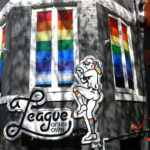
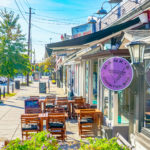
 Opening night at A League of Her Own (Photo by John Gallagher/John Jack Photography)
By DCist contributor Maddie Poore
When David Perruzza tapped Jo McDaniel to run the bar for LGBTQ+ women he planned to open below his new gay bar, Pitchers, she asked why he was interested. After the 2016 closure of landmark queer women’s bar Phase 1, he told her, women came to the gay bar he used to manage, JR’s, and asked where they could find a space to hang out.
“We’re the nation’s capital, one of the biggest cities in the country—we should have a place for you,” McDaniel recalls Perruzza saying.
This summer, there are two new places for queer women to hang out in D.C.
First, on July 22, the space above Shaw’s Al Crostino opened as XX+, the cozy, self-described “queer womxn’s lounge and bar.”
Three weeks later came A League of Her Own, managed by McDaniel, a casual sports bar for queer women in the basement below Pitchers.
“What’s so cool is that our goals are so similar and what we offer is so different,” McDaniel says of the two spaces. She says the teams behind her bar and XX+ have joked, “You go to XX+ for a sexy date and if it works out, the next morning you come here and eat tater tots and watch football.”
It’s significant growth for the LGBTQ+ scene in the District. In the two years since the closure of the Barracks Row dive Phase 1, pop ups, parties, and other events created by and for queer women have sprung up to fill the gap it left. But a permanent spot like Phase 1, which was the oldest lesbian bar in the country, was important in that it was open any night of the week and was specifically for LGBTQ+ women.
Often, these spaces also became a gathering spots for non-binary and trans patrons and tend to be more welcoming than traditional gay bars that cater to predominately cis male clientele.
“Knowing I can have a place to come and relax in a place with a diverse group of folks who know how to respect you in terms of pronouns and which bathroom you can use” is important, says Brooke Baxa, a non-binary trans person who spoke to DCist at XX+ on a recent Saturday night.
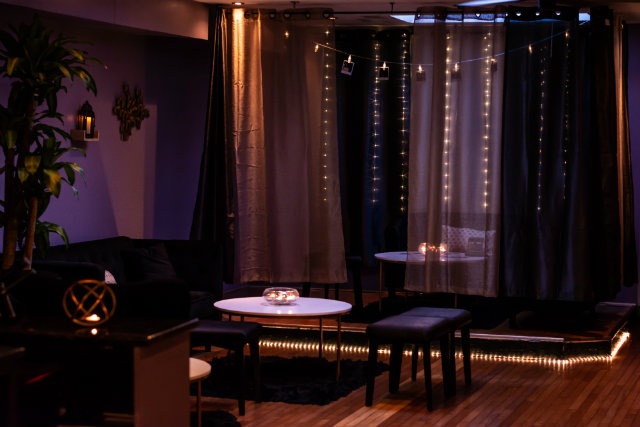 XX+ is a cozy space that’s half pool room, half lounge. (Photo by Robin Flemming)
Lina Nicolai says she’s been dreaming of opening such a space for LGBTQ+ women for 15 years. Last month, she launched XX+ in the space above Al Crostino, the Italian restaurant she owns with her mother. The team at XX+ also includes Chef KB, who grew up in Maryland and describes herself and her cooking as “Old Bay at heart,” and Tasha, born in Nigeria, who works as the bar’s social director. (Tasha asked for her last name to be withheld due to anti-homosexuality laws in Nigeria, where her mother still lives).
They all hope to bring something new to the LGBTQ+ scene in the city, especially diversity, “D.C. is losing a lot of culture, there’s a lot of gentrification going on” Chef KB says, adding that she’s seen fewer people over time who look like her out in D.C., especially in queer spaces.
“It’s really important to KB and I to stand here and represent all the things women of color can achieve,” Tasha says. “We hope to use this platform to talk about a lot of things that black queer women face.”
XX+ is a cozy space that’s half pool room, half lounge, with couches, free games of pool, custom cocktails and a rotating menu of finger foods dreamt up by Chef KB. A chalkboard sign greets patrons when they enter XX+, setting expectations for the space: “don’t be grabby, ask pronouns, don’t assume.”
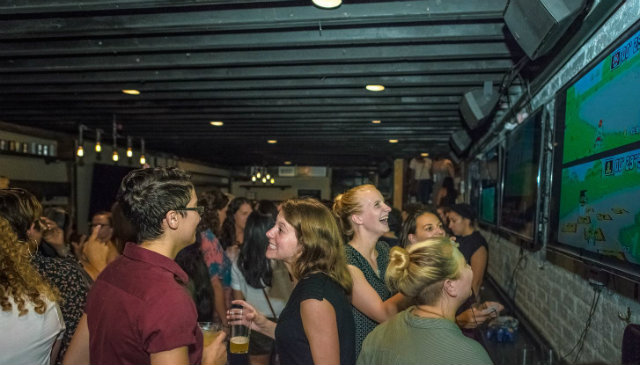
A 15-minute bus ride west is something quite different: A League of Her Own in Adams Morgan. On its opening night earlier this month, the basement sports bar was surprisingly well lit, and packed with excited patrons. The L Word, A League of Their Own, and Nintendo games played on huge television screens. The drinks were cheap and the bartenders were welcoming and friendly. Patrons flowed in and out of the space and into Pitchers upstairs.
McDaniel who manages the space, has been bartending in D.C. gay bars for more than 13 years. She hopes the space will “provide for the entirety of the community and be inclusive.”
Both teams tell us that they want to welcome everyone under the LGBTQ+ umbrella to their spaces. But some members of the community have questioned this commitment.
When XX+ announced its grand opening event in mid-July, several members of the LGBTQ+ community commented on the Facebook event questioning the bar’s name.
“Guessing the XX is referencing chromosomes? I’m hoping/guessing this wasn’t intended, but feels like it’s actively excluding a lot of trans women and non-binary amab [assigned male at birth] folk,” commented one.
“I’m not an add on, a +, and there are plenty of women who don’t have those chromosomes. The name feels pretty transphobic and exclusionary,” wrote another.
“My initial reaction was, to be honest, unsurprised disappointment,” Avery Ruel, a lesbian trans woman and one of the commenters tells DCist via email. “This type of thing is fairly common, and I know trans women across the country who’ve had to have countless similar discussions about cissexism or flat-out transmisogyny/exclusion in their local LGBTQ social spaces.”
Nicolai did respond to one Facebook comment, writing, “ We appreciate your feedback and we take this as a learning opportunity to do better for our community.”
Nicolai tells DCist that XX+’s name is meant to honor her mother, a straight cis woman. Additionally she says, “We are a female owned business and the plus represents the queer community which I am a part of.” Still, she says she’s heard the community’s concerns.
“I ask people to come to the space, and meet us personally, and if you don’t feel comfortable in here, let us know,” Nicolai says. “But I think this place is really unique. People should give us a try and judge for themselves.”
The women of XX+ say they train staff to not assume anyone’s gender when addressing them—you won’t hear “How are you ladies doing?” for example.
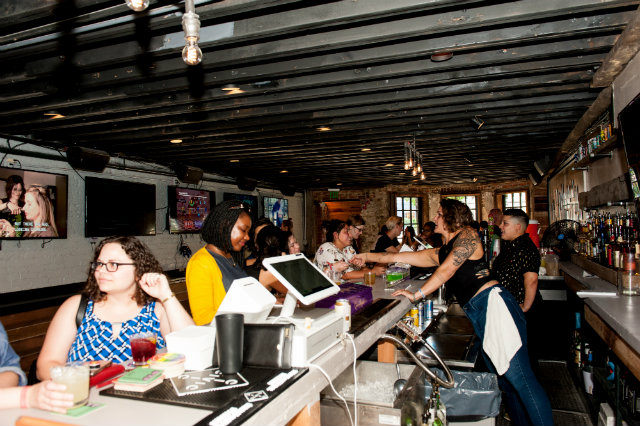 A League of Her Own (Photo by Stephanie Archie/Archie Photography)
At XX+ on a recent Saturday night, Brooke Baxa, a non-binary trans person, says those details matter.
“I understand that names are important, and that type of stuff matters. However, I do think that the actual space people provide and cultivate rings louder in my head,” Baxa says. “The space [is] extremely diverse in every sense of the word—age, race, gender, and fluidity of the queer experience was really powerful.”
They also say that they have “been to plenty of gay bars that have inclusive names and signage [but when] it comes to the culture they create and the people that are there, I’ve had really transphobic experiences and been kicked out of bathrooms and bars entirely. Just like our community is complex and diverse, so are the people who own businesses in the community.”
A League of Her Own has also trained staff to use gender-neutral language, and they’ve even ordered pronoun-identifying pins for patrons to wear. “[We want to] have the mid-forties white lesbian feel as comfortable as the 22-year-old non-binary kid of color,” McDaniel says.
(The parent bar, Pitchers, has not been without controversy: Owner David Perruzza came under fire last year when leaked emails revealed he asked for only white models to advertise the bar he used to manage, JRs, in 2012)
Still, McDaniel says, she realizes she may be missing opportunities to make the space more inclusive.
“I always want people to tell me what they think, because one of the things I know most of all is that I don’t know everything,” she says. “ I’m willing to educate myself as much as possible. People are our best resource for education, but at the same time, asking someone to do the emotional labor to educate me doesn’t feel good either. Making space while not taking up space is a bit of a challenge.”
Getting it right would mean their spaces become reliable gathering places for an often underserved part of D.C.’s nightlife crowd.
“There’s something about walking into a space and knowing your people are there,” McDaniel says.