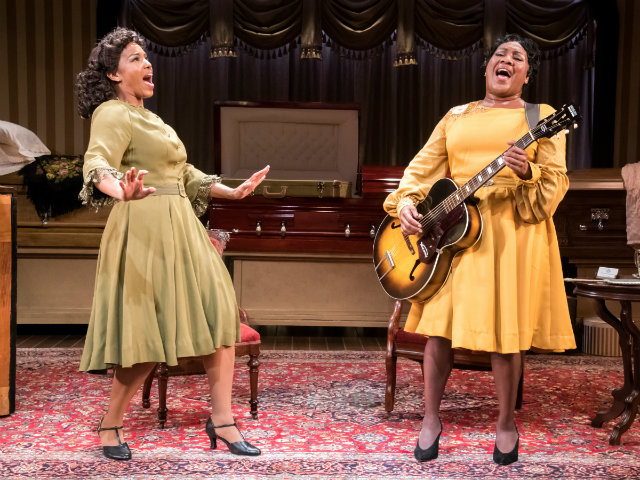
 Ayana Reed, left, and Roz White star as the title characters, respectively, of “Marie and Rosetta.” (Photo by Stan Barouh courtesy of Mosaic Theater Company)
If Sister Rosetta Tharpe’s recent induction into the Rock & Roll Hall of Fame seems like a long-overdue consolation prize for the singer, songwriter, and guitarist who some say invented the genre, inspiring Little Richard, Elvis, and Johnny Cash, Mosaic Theater Company’s Marie and Rosetta offers a full-fledged resurrection.
Set in a funeral parlor in 1946 Mississippi—one of the few places Tharpe was able to sleep safely while on tour in the Jim Crow South—the 100-minute play is a nonstop conversation in both dialogue and music between Tharpe (Roz White) and her protégée Marie Knight (Ayana Reed). Written by George Brandt, Marie and Rosetta premiered in 2016 in New York and comes to Mosaic as the opening play of the theater’s fourth season.
Though the action of Marie and Rosetta is contained within a single room on the first night the women meet, its world becomes much larger than these confines of space and time as the story unfolds. Outside, racism and sexism are raging. Tharpe has a white bus driver (because “Who you think gonna buy us food?”) and a scar from her abusive ex-husband.
Inside, different battles are brewing. Knight struggles to reconcile her pious background with Tharpe’s more forgiving interpretation of her faith and how it relates to her music (“Either way those notes are going to the same place, some are just getting there with a little more style,” Tharpe tells Knight.) And Tharpe, despite her confident outer shell, works to secure her own sense of self-worth by seeing it reflected in the eyes of a younger woman.
There is also the undertone of something more in their mentor-mentee relationship: Tharpe repeatedly comments on Knight’s beauty—even if it’s under the cover of describing the male gaze. White and Reed embody these complicated women gracefully and have palpable chemistry as they crack the script’s many jokes and jive with each other across the stage.
And, oh yeah—these ladies can sing. Like the women they are embodying, White and Reed’s voices seem to defy easy categorization, crossing belt-y gospel with rhythmic rock with more wandering blues. Though both actresses have heart-stopping solos, they’re best in numbers such as “Didn’t It Rain” and “I Want a Tall Skinny Papa” when they sing together, building off each other’s energy.
Director Sandra L. Holloway’s choice to have the musicians—pianist Ronnette F. Harrison and guitarist Barbara Roy Gaskins—on stage rather than hidden in a pit is a bit distracting at first, since the two women are not really part of the play’s narrative. But soon the brilliance of this choice becomes clear: In a play about the erasure of a great musician, why hide the talented women behind Marie and Rosetta’s transcendent piano and guitar parts? Rather than pretending they are invisible, White and Reed quietly interact with Harrison and Gaskins, occasionally letting their characters slip to offer an appreciative nod.
Marie and Rosetta is fun in the way that seeing Sister Rosetta Tharpe and Marie Knight sing must have been fun; the music translates through the decades. But the play is also important. Tharpe died in 1973 and was buried in a grave that went unmarked until 2008. It’s about time we paid our respects.
Marie and Rosetta is playing at the Atlas Performing Arts Center (1333 H St NE) through September 30. $20-$68. Eleven shows are followed by post-show discussions on topics such as “Did a Queer Black Woman Invent Rock and Roll?”, “Race and Rock and Roll: Whitewashing of Black Musical History”, and “Guitar, Piano, and Voice-The Musical Dynamics of Rosetta and Marie.”