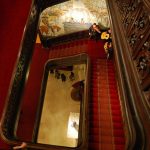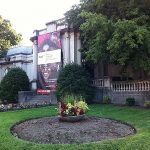
For more than 70 years, a mansion on 16th Street has housed one of D.C.’s lesser-known art gems on its walls. Roberto Cueva del Rio’s Embassy murals line the elaborate staircase and three stories of the Mexican Cultural Institute of D.C., and tell an important story of Mexican history, culture, and foreign relations.
On Wednesday, the institute will reveal the result of a summer-long restoration of the murals, bringing the images of Aztec temples, village festivals, and snow-blanketed volcanoes and mountains back to full color. The restoration has helped to preserve and enhance this piece of history.
Cueva del Rio began the murals in 1933, back when the Mexican Embassy occupied the mansion. After the embassy moved to Pennsylvania Avenue in 1989, the brand-new Mexican Cultural Institute of D.C. (MCI) took over the space to “show the public and the U.S. that Mexico is very rich in its culture, its heritage, and its contemporary artistic production,” says Alberto Fierro, the MCI’s executive director and the minister of culture and education at the Mexican Embassy.
The stately Beaux Arts building is filled with florid interior design and rotating art exhibits, but the murals remain the artistic centerpiece of the century-old building.
Cueva del Rio wanted to paint something that honored Mexico’s precolonial history, but also its enduring culture and society through festivals and agricultural scenes.
“[The murals] share a vision of Mexico from a time when many Mexicans were proudly optimistic about their future,” John Tutino, professor of Latin American history and international affairs at Georgetown University, tells DCist via email. “The 1930s was a time when rural peoples dreamed of preserving communities and families on the land, while new industries pointed to a promising urban future. While honoring the indigenous past and accepting European influences, the emphasis was to honor a mix that was dynamically Mexican.”
Cueva del Rio finished the panels up to the second floor before leaving in 1935 for work in Mexico. He returned in 1941 to complete the murals.
The years in between represented a rising crest in Mexico-U.S. relations, and Cueva del Rio’s panels expressed this new wave of Pan-American alliance.
In one panel, the faces of several North and South American presidents—including Abraham Lincoln, Mexico’s Benito Juárez, and Simón Bolívar of Venezuela—are featured in the oceans along the Americas. Two muscular hands reach from the hearts of North America and South America to form a resolute handshake between the continents, expressing a renewed Pan-Americanism.
As Cueva del Rio painted, World War II was escalating, and Mexico increasingly supported the Allies.
“Mexico was lining up in support—sending oil, food, and cloth north, along with millions of braceros to work in US fields—while 500,000 Mexican citizens fought in the U.S. armed forces,” Tutino says. “It was too soon to tell the story of Mexicans in WWII—but the mural offers the optimism of a North American alliance.”
To Fierro, who has served as a Mexican diplomat in Washington for more than 20 years, the Pan-American mural is a reminder “that we are one,” and “that we can be a continent where friendship can happen.”
Fierro had wanted to restore the murals for years but didn’t have sufficient funds until MCI won a $50,000 grant in 2017 from Bank of America’s Art Conservation Project. Fierro used the award to hire a team of students graduating from Mexico City’s National School of Conservation, Restoration, and Museography at the National Institute of Anthropology and History
“They graduated on a Thursday and arrived here on Friday,” Fierro says. They have been working on the murals since June.
Restorer Juan Pablo Morales, of Morelía, notes that the murals were very dirty and that previous restorations of the murals had “best intentions but didn’t use the best methods.”
In particular, one group of restorers had applied a varnish meant to preserve the murals, Morales says, but the varnish was better suited for oil-on-canvas paintings rather than a fresco painted directly on the wall.
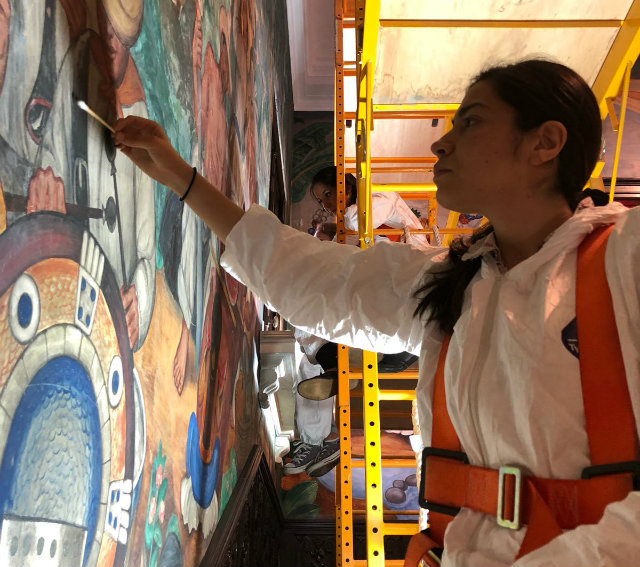
Most of the restorers’ work has been concentrated on removing this varnish to restore the full color of Cueva del Rio’s work. To remove the varnish, Morales and the other restorers wrap cotton around the tip of a thin bamboo stick and apply a special solvent to the cotton. They then gently brush the varnish off the mural bit by bit, transforming faded ocean colors into radiant shades of Pacific blue. The transformation of the murals has been significant, both to the range of color and the amount of detail visible.
Morales has been living in D.C. this summer with four other restorers, Astrid Sánchez, Yamile Fernanda Contreras García, Rocío Mota Muñoz, and Ana Elana Vivas, all from Mexico City. They have been supervised by professors Ana Lizeth Mata Delgado and Claudía Coronado García.
At Wednesday’s unveiling, conservationists and restorers will discuss their process and the pieces themselves. Fierro says seeing the murals at his workplace remind him of the importance of the Mexican Cultural Institute’s work.
“I personally got to like the murals through living with them,” says Fierro, adding that the pieces “allow us to share a very Mexican artistic expression and talk about the traditions and the history of my country.”
The Mexican Cultural Institute is located at 2829 16th St. NW. Hours are Monday-Friday 10 a.m.-6 p.m., Saturday noon-4 p.m. Restoration unveiling and talk Wednesday, 6:45 p.m., free, register here.