 Rachel Sadon
 (Courtesy of Oxfam America)
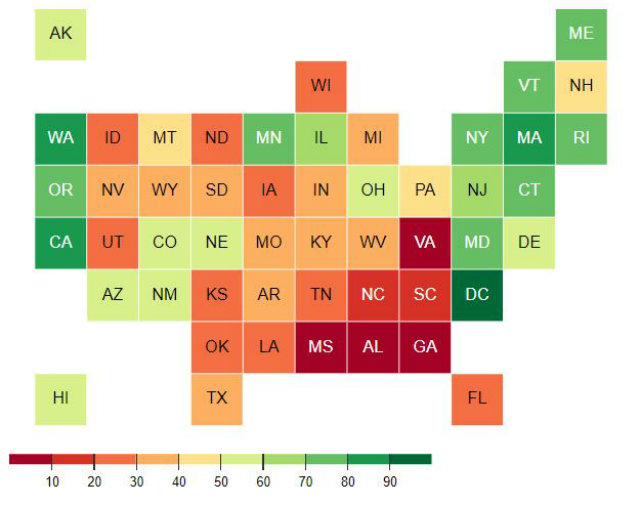
The Potomac River marks an enormous divide in labor laws, with D.C. and Virginia sitting at the very top and very bottom of a new list ranking wages and workplace protections across the country.
Oxfam America, a wing of the international anti-poverty organization, compiled the index, which compares a range of labor and employment policies. With the District and the commonwealth at the list’s bookends, Maryland ranked in the 12th spot.
“In today’s America, just a few miles make a huge difference in wages and labor protections,” said Minor Sinclair, Oxfam America’s U.S. Domestic Program director, in a release. “While legislators in some states are making moves to keep workers and their families out of poverty, legislators in other states seem content with a poor-to-middling status quo.”
As is the case with many national rankings, however, it must be noted that comparing states to D.C. (which combines city and state-level policies in one jurisdiction) isn’t exactly analogous.
Nonetheless, the District of Columbia has extended a number of protections well beyond the federal minimums, and the D.C. Council has passed a slew of labor-friendly laws in recent years that are in various stages of implementation—raising the minimum wage to $15 and passing one of the most generous paid family leave laws in the country among them. At one point, Chairman Phil Mendelson even proposed a moratorium on similar bills, like mandating scheduling requirements, so that businesses would have time to adjust.
Oxfam examined a total of 11 policy areas which fell under the broad categories of wages, worker protections, and “right to organize” laws.
The first, wage policies, offers an instructive look at the divide across the region. Oxfam looked at the ratio of the minimum wage to a “living wage” that reflects the cost of living in the jurisdiction (according to the report, no jurisdiction’s minimum wage reaches even half what would be considered a living wage). By that measure, D.C. was second only to Washington state.
Maryland, where the minimum wage is $10.10, was ranked eighth, and Virginia, which sticks to the federal minimum wage of $7.25 an hour, came in dead last. The District’s current minimum wage is $13.25 and it is slated to rise to $15 by 2020.
Similarly, under the category of workplace protections, D.C. ranks second, having passed one of the first paid sick leave laws in the country and expanded protections for pregnant women, among other laws that go beyond federal protections. Maryland was ranked 11th, while Virginia came in at 48th.
“We are proud that these efforts are reflected in our number one spot on Oxfam’s Best States to Work Index, but our real reward is seeing the positive impact these programs and policies deliver to residents,” a spokesperson for Mayor Muriel Bowser said in an emailed statement.
And under the third category, rights to unionize, D.C. and Maryland were among a 21-state tie at the top. Virginia, which was one of the earliest states in the country to pass a right-to-work law and has banned collective bargaining for state government work, is at the back of the pack at 49.
One of the reasons for the stark difference in the D.C. area’s jurisdictions is Virginia only affords narrow powers to local governments, preempting their ability to raise labor standards.
“In this region, I think there’s a lot of shared vision about what workers need. There’s been change in D.C., in Montgomery County, in Prince George’s County recognizing that the issues for the D.C. metro area might not be the same issues as our entire bordering states,” says Elizabeth Falcon, the executive director of DC Jobs With Justice, a coalition of labor organizations that has aggressively lobbied for stronger labor laws in the District. “But because of the preemption laws in Virginia, localities that might want to do better than what the state does are simply not be able to do so. That really is holding Virginia back.”
But while D.C.’s labor laws paint a progressive picture, Falcon argues that the city has a ways to go in enforcement. She points to a recent settlement by the Founding Farmers restaurant group, which agreed to pay $1.49 million to settle a class action lawsuit alleging that the company underpaid employees and violated the District’s paid sick leave law.
Brittany Alston, a policy analyst at the left-leaning D.C. Fiscal Policy Institute, echoes that argument, saying “labor laws are truly only as good as the enforcement behind them.” She believes the complaint-based system, where D.C. workers must report violations, is less effective than an enforcement model. “When we start really digging into some of these numbers and systems we see that there are deep flaws in how they’re being enacted.”
But, Alston says, “overall, we definitely have promising labor laws. There’s no doubt about this.”