Matt Blitz
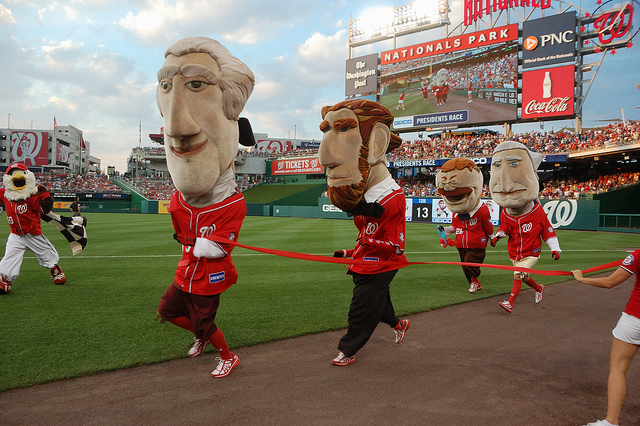 (Photo by Scott Ableman)
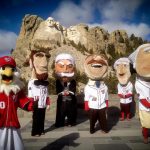
It’s maybe the most hotly anticipated moment of every Washington Nationals home game. In the middle of the fourth inning, the right field gate swings open and out run four giant-headed U.S. presidents: George Washington, Thomas Jefferson, Abe Lincoln, and Teddy Roosevelt.
With their legs churning, arms swinging, and heads bobbing, the “Rushmore Four” make a mad dash around the field for the finish line along the first base line. Usually, there’s trickery, shenanigans, and, sometimes, even straight-up cheating, but one emerges victorious. And, more often than not, it isn’t Teddy.
The Presidents Race began in 2006, in an attempt by the Nationals’ backstage operators to find something—anything—that would excite fans spending their evenings watching a bad baseball team in an old football stadium.
In the 12 years since, the Presidents Race has followed the Nats to a new stadium, where they became a more competitive team. Along the way, the Rushmore Four have become synonymous with D.C. baseball. The race is absurd, irreverent, and goofy, but also caters to a fan base that’s well-versed enough in history to understand Teddy Roosevelt’s complex relationship with big cats. It’s become such a part of D.C.’s cultural DNA that even a real-life sitting president once wanted to get in on the action.
Here’s the inside story, told by those who were there, of how the Presidents Race sprinted its way to into our hearts, a grinning Teddy became a D.C. icon, and what the future holds for the Rushmore Four. Quotes have been edited for length and clarity.
 The first Presidents Race in July 2006. (Photo by Mitchell Layton)
Inauguration
Shortly after Major League Baseball announced it was coming back to the nation’s capital in 2004, Josh Golden joined the Nationals—formerly the Montreal Expos—as entertainment manager. Those early months were difficult for his small staff, assembled hastily after the move to RFK Stadium. It was early in the 2005 season when Golden first hit on the idea of creating an event with presidents.
Josh Golden: My [job] was to create in-game entertainment and the scoreboard [productions] … including all of the sponsorship fulfillment. PNC Bank needed a feature and I drew on the very common notion of races. We hit on the Dollar Derby and established [it would be] people on currency—George Washington, Abe Lincoln, and Alexander Hamilton. They were in go-karts and these large, giant-headed characters [raced] around the District and into RFK. It was all video.”
Scott Ableman, creator of LetTeddyWin.com: “You were assigned who were you going to root for. The people the most expensive seats … were told to root for Teddy Roosevelt. [My son] drew the immediate conclusion that they weren’t going to let [Teddy] win because they wanted the fans in the cheap seats to get the victory.”
Golden: Early on, there was a dream in my mind, hearkening to the sausage race in Milwaukee and pierogi race in Pittsburgh, of a [live] race. There was an opportunity to embody real, living people that we all have a connection to as Americans: Washington, Lincoln, Jefferson, Roosevelt … the Rushmore Four. And I don’t think it’s an exaggeration to say that when that idea came up, I said “That’s it. That’s the one that people in D.C. will embrace.”
In 2006, I went to [former team president] Tony Tavares and told him I want to do this [live-action Presidents Race]. He asked, ‘Can we rent the [costumes]?” I said, “No, they don’t exist.” … He told me, “I can’t justify spending this money.” So, I partitioned some money elsewhere in my [marketing] budget and just went and did it. Remembering back now, I don’t think I technically had permission to do that.
Golden approached mascot and costume designer Randy Carfagno—who built the Nationals’ first mascot, Screech—with his sketches for the Presidents.
Randy Carfagno: I worked with Bette Midler on her 1999 tour and she wanted a nine-foot-tall Bette puppet to burst out of a 14-foot-globe. It exploded and the puppet came out and pranced down the aisle. People went ballistic. [Bette Midler] was absolutely, 100 percent an inspiration. I knew that we could make the Presidents the same way.
Carfagno first molded casts of heads out of sculpting clay and then built the characters out of foam, fabric, fleece, vacuform, netting, and aluminum.
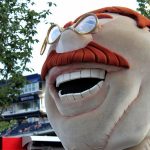
Golden: These were a work of art. The intricacy of weaving red and white foam in Thomas Jefferson’s hair. The skin on George Washington. Teddy’s teeth. The most remarkable thing to me was the eyes, the detail in the eyes of these characters were tremendous. They were delicate, but Randy knew they would hold up. They were really beautiful and, yet, so silly. They struck that perfect blend.
On July 21, 2006, the Nationals planned a grand “re-opening” of the RFK Stadium ballpark along with a celebration to introduce the fans to the team’s new owners: the Lerner family. This was also the debut of the all-new, live-action Presidents Race.
Golden: We knew George Washington was going to win [and] the line was going to be ‘first in war, first in peace, and the first winner of the Washington Nationals Presidents Race.’ But we had no plan on who would wear these costumes. I remember begging friends and family to run it. I don’t recall who the four original were.
Golden had recently hired Tom Davis to be a member of the NatPack, the team’s on-the-field, in the-stands crew that helped Golden execute the in-game entertainment. Today, Davis is the Washington Nationals’ entertainment director. Davis was standing with Golden along the right field fence as the gate opened that first time and George, Tom, Abe, and Teddy ran out.
Tom Davis: I remember thinking, ‘Wow, this is something.’ The cheering and roaring of the fans was really great. But if you had asked me back [in 2006], I’d never thought it would become such a staple and mainstay as it is today.
Golden: I was petrified. I stood with Tom thinking “I hope this works. Also, I hope they don’t fall down because I don’t know if they could get up again.” Then, I realized [the fans] were loving it and it was going over exactly as we had hoped.
 One of Teddy’s ill-fated attempts to win in 2006. (Photo courtesy of Josh Golden)
The First Term
From the very beginning—and to this day—the Geico-sponsored races were often not predetermined: Sheer footspeed of the Presidents themselves decides who’s victorious. Those early races were pretty fast, considering the racers weren’t professionals—they had just responded to an ad Golden posted online.
Golden: Every game, I would go to the stands around first inning and meet these people. Sometimes people didn’t show. Once, one of the people who showed up was about four foot ten and tried to put [the costume] on and couldn’t even keep her torso up right. I think that might have been the first time I put on a costume, because I had no other option. And I ran as Thomas Jefferson and I think won. I’m sure Tom stood in once or twice.”
Davis: I can’t divulge that kind of information.
Soon, the Racing Presidents started getting requests to appear outside the stadium.
Golden: The first call [asking] if the Presidents were available for outside bookings … was from Ford’s Theatre. They said, “For our grand re-opening, we were wondering”—wait for it—”if Abe Lincoln could be available.” I asked, “Can you guarantee his safety?” I could hear the eyeroll over the phone.
Golden left the Nationals after the first homestand of 2007, leaving Davis in charge. Realizing that there needed to be a better way to source runners, Davis instituted the first Racing Presidents tryout in 2007.
Davis: That first year, and still now, we were looking for three major things, how [prospective Presidents] handle themselves. The second thing is people having fun, having a good time with it. They are ambassadors for the team. And the third thing … personality really plays a big role. The first year, the people who were interested came and tried out. Now, it’s a three-tier process and invite-only.
The Nationals keep the identities of those who make it through the audition process and don the giant heads close to the uniform.
Davis: Tryouts are the one day a year we pull back the curtain. We don’t speak about who is on staff. It’s like our Disney approach: You don’t want to know who Mickey Mouse is. We hold pretty strictly to that.
 One of the original molds for Thomas Jefferson’s giant head (Photo courtesy of Randy Carfagno)
By Opening Day 2007, the Nats had assembled a dedicated team of racers, who would morph into fleet-footed leaders of the free world at Nats home games. The team members rotate their characters, meaning one day they could be George, and the next, Tom.
Brian and Mary (not her real name) were Racing Presidents in those early years. Neither wanted to be identified by their full names in this story in order to preserve the mystery of the Racing Presidents.
Brian: I didn’t expect the adrenaline rush. When we started in RFK, we ran out of the tunnel with a running start. I remember waiting in the suit with the anxiousness building and when we got in the sights of the crowd, they went nuts.
Mary: The fans were the best part. The kids were so sweet. Half of them loved you, and the other half cried when you got near them. The feeling of coming around the corner, tapping someone on the shoulder and having them they look up to see this giant head—the joy that they had from that, it really lit me up.
Carfagno: A regular mascot, if they weigh 16 pounds, it’s a lot. These guys are 30 pounds. I mean, they have a four-foot head!
Brian: The suits were very top-heavy. A lot of times, when you are running as a pack, you couldn’t … see your feet. Sometimes I would [accidentally] clip the person in front me and then I go down and then they go down. Accidents happened.
Carfagno: [The] biggest shock was how physically filthy they were from falling so much. The dirt that was embedded in them literally changed their skin tone. So, when we redid them [in 2014] we had to use a darker skin tone so we could mask the dirt more easily.
Brian: By mid-season, they stunk. We all had our own air fresheners that we preferred.
Every offseason, the four Presidents gets plucked, sewed, and cleaned up to ensure that they will be racing for years to come.
Ingrid Creapeau, Racing Presidents “doctor”: All of the guys with white hair, it gets replaced every single year. The guys with the brown hair, Teddy and Abe, I replace it every other year. I replace noses, ears, eyes … We like to have them looking as good as we can. We [were] trying to make the [smell] better this year … so I put replaceable, washable spit guards in them this year. No matter if you are a spitter or not, you are spitting. Those face masks can get pretty gross.
Indeed, the races really take it out of the costumes—and the racers inside.
Mary: There may have been a stunt or trick we wanted to do, but we were always racing. And racing to win.
Brian: They were times … when we would throw elbows.
Golden: I originally assumed it was inadvertent, and quickly realized—people were trying to win.
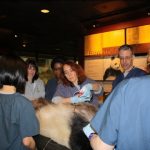
 Teddy with some fans (including Scott Ableman, a.k.a. Let Teddy Win, far left) in 2011. (Photo by Scott Ableman)
Teddy’s a Loser
Observant fans started noticing that while George, Tom, and Abe all had been victorious, Teddy was a lone loser. This wasn’t done by design—at first.
Golden: The first race we had George win, but we [decided] we didn’t want to go in order, so we skipped Teddy. Then, we skipped Teddy for a second time. By then, people started emailing us, “Why hasn’t Teddy won?” There wasn’t a plan to [have Teddy lose] until those emails started coming in. By the fifth game, we had decided that Teddy isn’t going to win. Let’s make it a thing.
Ableman: [My son] thought it was an outrage. Every time we went to the ballpark, he would tell all the people around us, ‘Have you noticed that Teddy doesn’t win?’
Brian: I wasn’t the best runner, so I liked being Teddy because he got the crowd reaction. Whether it was the rough days at RFK with not many people there or Teddy Bobblehead Night with 43,000 people, Teddy always got the fans excited.
Golden: The only two rules we had were don’t fall down and Teddy doesn’t win.
Ableman: By the end of the [2006] season, everyone was chanting “Let Teddy Win.” Late one night, after another Nationals’ loss, I did a domain and trademark search. I thought I was going to put together a website for fun, mostly for me and my son. I guess I tapped into something [with LetTeddyWin.com]. The next thing I knew, we had a movement.”
On Opening Day 2007, Teddy zip lined into RFK in hopes of securing his first victory. He screwed up the landing and lost. And so began the many absurd, ridiculous, weird ways that Teddy would lose the Presidents Race at RFK and the new Nationals Park starting in 2008. Everyone has their favorites.
Brian: When we’d have random characters run out of the crowd and linebacker-tackle Teddy.
Golden: I remember the Easter Bunny KO-ing Teddy with a leap from the stands.
Ableman: When the Nationals created a Teddy Roosevelt Twitter account. They had him run the race carrying a giant smartphone. He had a massive lead and he stopped … and started tweeting. Then, of course, he was passed.
There were national news stories, awards, a White House statement, a call for congressional hearings (from Senator John McCain, no less), and an ESPN feature narrated by Ken Burns. Even the Nats players decided to take it upon themselves to get Teddy that elusive victory at a game in 2011
Brian: We come running out of the tunnel and the [pitchers in the] bullpen held three of us against the wall to try to let Teddy win. I remember thinking ‘I can’t throw an elbow because the next day’s headline would be ‘Setup guy injured by mascot.’
Ableman: Many people believed it was a curse, that either Teddy wasn’t going to win until the Nats won or vice versa.
Crepeau: [It] had a lot to do with him being broken. [He] was off-balance, killing him weight-wise. He could barely see out of his broken frame. I think he had no choice but to lose.”
On October 3, 2012, it finally happened. It was the Washington Nationals’ last regular game of the season, the first one in which the team had finished with a winning record, made the playoffs, and won the division. With the help of the fake Phillie Phanatic, Teddy broke the finish line for the first time in the race’s history. All the team’s staff will say is that winning was all Teddy’s doing.
Davis: We had just clinched the division and were going to our first postseason. I think that excitement was the last piece Teddy needed to kick it into gear for his first win.
It was supposed to be a good omen for the Nats as they headed into the postseason. But the playoffs didn’t go as planned.
Ableman: The Nationals lost in horrible fashion in Game 5 [of the Division Series] against the Cardinals. Instantly, I was inundated on social media with people telling me that this happened because they had decided to let Teddy win.
 George crosses the finish line in 2013. (Photo by Scott Ableman)
Second Term
In recent years, the Nats have tried out three new Presidents at various times: William Howard Taft (Bill), Herbert Hoover (Herbie), and Calvin Coolidge (Cal). There was even discussion of adding another, perhaps less obvious, President.
Golden: We talked about if there were graceful ways to handle FDR. [For] the community that’s disabled, might that be a celebration of ability?
Ableman: They did have discussions with the Roosevelt estate about what would be appropriate, whether if they should have him racing or racing in a wheelchair. My understanding is that the [Roosevelt] family said that they didn’t want to do that.”
In January 2017, the Nats released a statement on the rumored FDR Racing President. “In light of logistical challenges and lack of enthusiasm from the Roosevelt family, we were not comfortable proceeding,” the statement read.
Bill, Herbie, and Cal all “retired” and were moved to the Nats’ new spring training facility in West Palm Beach, Florida, where they continue to race to this day. Meanwhile, back in D.C., it’s back to the original Rushmore Four.
Davis: I don’t want to say absolutely not [to adding presidents], but, where we are now, we are happy. There are no current plans for anything in the future.”
Mary: I hope for a female Racing President. Can’t we dream? Can’t we hope?