Martin Austermuhle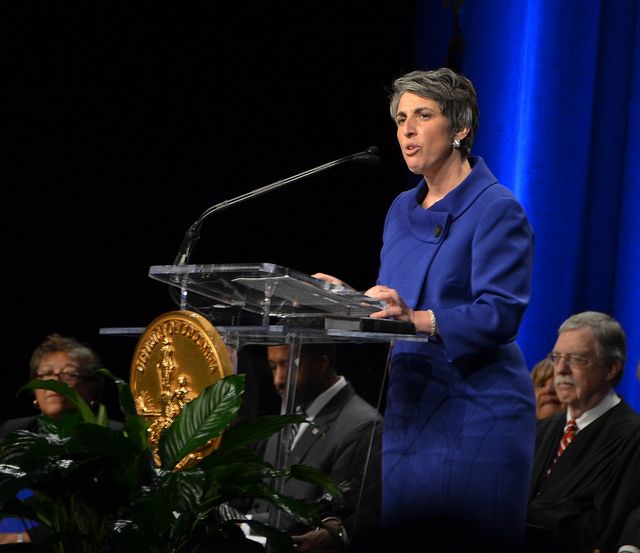
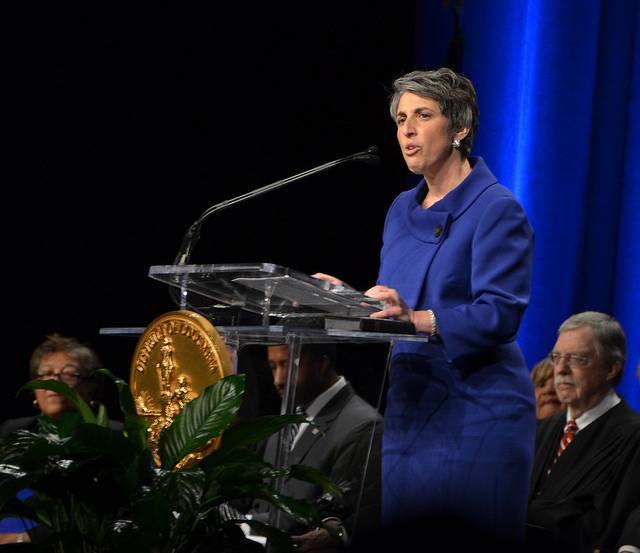 At-large Councilmember Elissa Silverman at her swearing-in ceremony in 2015. (Photo by Adam Fagen)
An attorney for D.C. Councilmember Elissa Silverman (I-At Large) is asking that the D.C. Board of Elections not allow challenger S. Kathryn Allen on the November ballot, saying that Allen’s campaign had submitted nominating petitions that were “rife with fraud.”
The request came during an hour-long hearing at the elections board, where lawyers for both Silverman and Allen fought over signatures and nominating petitions, a tedious-yet-critical part of any candidate’s hope to compete for public office in D.C.
Last month, Allen — a pro-business candidate critical of the new paid family leave law Silverman helped write — submitted over 6,000 signatures to get on the ballot as an At-Large candidate, more than twice the required number. But a large number of signatures were found to have been either forgeries or otherwise invalid, leaving Allen with 3,101 valid signatures on her petitions — enough to get on the ballot, but only barely.
Speaking on WAMU’s “The Politics Hour” last week, Allen placed the blame on Strategies for Change, a local firm she says she hired to collect signatures. That’s the same firm that allegedly collected invalid signatures on behalf of Traci Hughes, who also entered the race to challenge Silverman but dropped out after realizing she wouldn’t be able to get on the ballot. Strategies for Change has denied working for Allen.
On Friday, Joseph Gonzalez, Silverman’s attorney, argued that there were enough questions around four of Allen’s petition circulators—who are required to register with the board, and sign every petition they circulate to voters—that the board should completely toss out the petitions they handled, amounting to 625 signatures Allen would lose. That would leave her with just under 2,400 valid signatures, not enough to get on the ballot.
“Her entire body of petitions is infected with forgery and therefore this board should discount them completely,” he said.
To buttress his argument, Gonzalez questioned Leonard Howard, one of the people who allegedly collected signatures for Allen. He denied ever having worked for Allen’s campaign, and told the board that someone else had collected signatures and then forged his name on the petitions.
“Let me ask you this: did you sign any of the petitions to nominate S. Kathryn Allen?” said Gonzalez.
“No, sir,” responded Howard.
“Did you work for Ms. Allen?”
“No, sir.”
“Is it your position that every signature… is forged?”
“Yes, sir.”
But Dara Lindenbaum, an attorney for Allen, dismissed what Howard and another circulator said as “flawed testimony from circulators that have a reason to lie.”
She also said that the board’s initial determination that Allen had 3,101 valid signatures should stand, and that even if there were questions around some of the petition circulators, what mattered was the voters who signed to put Allen on the ballot.
“The voters have signed these petitions. They want to see their candidate on the ballot. To toss them out would disenfranchise them. Let’s let this play out on the ballot,” she said.
In making her argument, Lindenbaum questioned Mary Lord, a former member of the State Board of Education, who said she had signed a petition for Allen handled by a petition circulator Silverman’s side wants to disqualify. Lindenbaum said that even if there were problems with the circulators, the fact remained that Lord—and other voters had signed Allen’s petitions, and want to see her on the ballot.
But Lord, who was initially supposed to serve as a witness for Silverman, said that she had found her name and a forged signature on other petitions handled by Allen’s campaign.
“It was very chilling. Imagine finding a forged check … it had the same frightening effect,” she said. “To not be able to meet this simple test of office to me was a thumb in the eye of the system and a disrespect to the voters.”
In his closing argument, Gonzalez said that even if some voter signatures were valid, there were enough concerns with Allen’s circulators to justify tossing out those petitions in their entirety. He said the board had done so in 2002, when Mayor Anthony Williams, then running for re-election, was denied a spot on the ballot because of significant problems with his nominating petitions. Williams is the co-chair of Allen’s campaign.
“In 2002, this board confronted similar circumstances where there was expansive, pervasive, rife forgeries. And this board said no,” he said. “We’ve seen more than enough, and in whole cloth they must be invalidated.”
A similar drama played out this week in Virginia, where a judge tossed an independent congressional candidate off of the ballot because of forged signatures on nominating petitions — which were collected by staffers for incumbent Rep. Scott Taylor, a Republican. Taylor is facing a Democratic challenger.
In Allen’s case, the board will decide by Monday whether to grant Silverman’s request that a number of her nominating petitions be tossed out, likely leaving her off of the ballot. But the board will also have to decide on a competing request from Allen’s side, which has asked that the board reinstate more than 600 signatures for Allen deemed invalid earlier this week. If both happen, Allen could make it on the ballot — but only just.
Along with Silverman—and possibly Allen—the At-Large ballot will also include Democratic Councilmember Anita Bonds, Republican Ralph Chittams, Libertarian Denise Hicks, Statehood Green David Schwartzman, and independents Dionne Reeder and Rustin Lewis.
Voters will be asked to choose two candidates to send to the Wilson Building come January.
This story was originally published on WAMU.