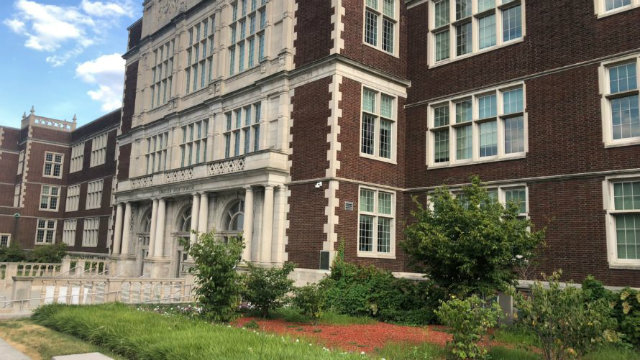
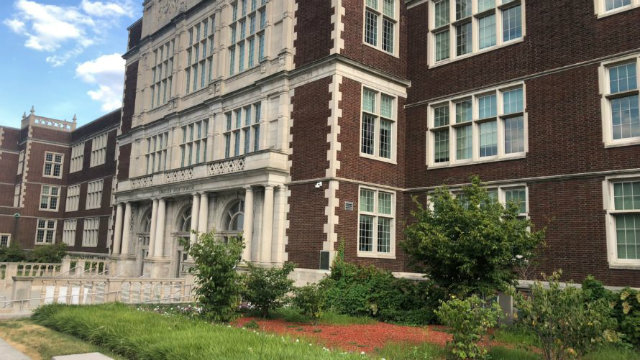
 Cardozo High School has a program designed for immigrant students in D.C. (Photo by Jenny Abamu / WAMU)
Students always have jitters at the start of the school year. But for children of immigrant families, going back to school means overcoming a unique set of fears that others may not share.
Over the last year, many of these students watched as President Trump instituted a “zero tolerance” policy at the border that led to family separations and continued his pushes against DACA and so-called “chain migration.” Meanwhile, immigration enforcement grew increasingly aggressive around schools. In Los Angeles, a father was arrested while dropping off his daughter. In Houston, a school resource officer reported an undocumented student who got into a scuffle to federal officials.
“I feel like I have to be careful about where I am going. Even going to school is a risk I have to take,” says Diana, a rising 12th grader in D.C. and an asylum seeker from El Salvador. She asked not to use her last name because some of her relatives still haven’t been granted asylum status.
“If I leave home, I don’t even know if I am going to go back home at night. It changed a lot. I changed a lot. I am just nervous and always thinking about what can happen to me or my family,” Diana says.
Diana has not only been following the news — she’s lived it. Last year, her aunt and cousins were separated by immigration officials at the border and deported. Even though she’s in the country legally, Diana is cautious about who she talks to and who she trusts because she doesn’t think she can afford to make mistakes.
“You can be scared every day, but you have to control it. And you have to try not to think a lot about it because then you can even get sick,” she says. “I was [so] scared. Not even for me, I was scared for my friends because, you know, I love them, and I don’t want anything bad to happen to them.”
This fear is increasingly common in schools in the D.C. area. While some children of immigrants go to class but are afraid to talk to authority figures, others have stopped attending school entirely.
“You have those senior ones who are even afraid to walk or feel like they are not going to be able to graduate because of their legal status,” says Sandra Shephard, the Managing Director for the Latin American Youth Center in Prince George’s County and a counselor for immigrant youth. “I had a case in May where a young person actually wanted to commit suicide because he was afraid that if he walked to get his diploma, immigration was going to come get him and his family.”
Policies aimed at illegal immigrants affect the broader community
Zero-tolerance immigration policy are intended to scare immigrants from illegally crossing the border. In 2017, Thomas D. Homan, the former acting director of U.S. Immigration and Customs Enforcement, told reporters that people in the country illegally “should be uncomfortable” or “looking over [their] shoulders.”
These policies also appear to frighten legal immigrants. A recent study from George Washington University of 213 immigrant parents found that the parents increasingly report psychological stress and anxiety — even though two-thirds of those surveyed were in the U.S. legally.
When parents don’t feel protected by institutions, neither do their children. This lack of trust can affect student interactions in schools and academic performance.
“Almost half of all parents we surveyed very often or always were saying they were warning their children to stay away from authorities or talk to the police,” says Kathleen Roche, an assistant professor at George Washington University who worked on the study. “They talk to their children about changing behaviors such as where the adolescents hang out out when not in school. Almost half these parents frequently worried about their children being able to finish school and get a job.”
In hopes of easing the minds of students, school officials in D.C., Maryland, and Virginia have issued multiple statements saying that Immigration and Customs Enforcement cannot act on campuses. They also point out that federal law requires schools to serve all students, regardless of their immigration status.
But with federal policy and enforcement in flux, and heated immigration debates in the news week after week, it can be hard for students to know who they can trust. For Diana, support and trust are two things she needs to be able to overcome her fears and stay in school.
“We don’t know everything. We need our parents’ help. When we are going to school, and even if we don’t tell you we are afraid to go, we are. We feel scared,” she says. “Support us and try to help us. I know parents do their best, trying to find everything they can for their children. They work a lot. But show them how much you love their children and show them they are not alone in this country.”
This story was originally published on WAMU.