 Mikaela Lefrak
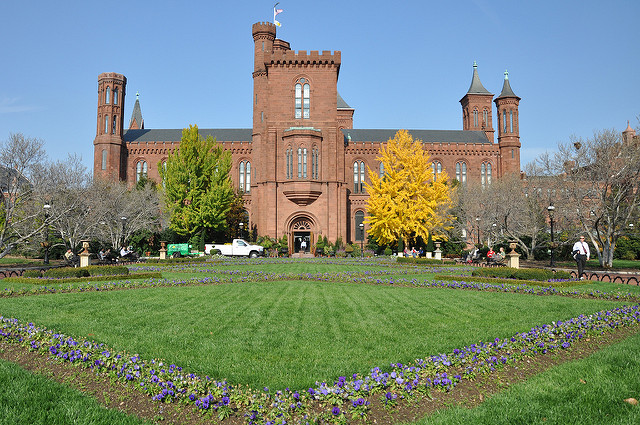 (Photo by annalync)
The Smithsonian Institution has failed to achieve most of the goals it set for itself nearly a quarter of a century ago to improve Latino representation in its workforce, leadership and programming, according to an outside progress report released Monday.
The report, titled “Invisible No More,” details the ways in which the Smithsonian has overlooked Latinos in its executive ranks and budget priorities. It was released by UCLA’s Chicano Studies Research Center and the Latino Policy and Politics Initiative.
“There’s been a consistent pattern of Latino exclusion,” said Chon Noriega, a co-author of the study and the director of the Chicano Studies Research Center.
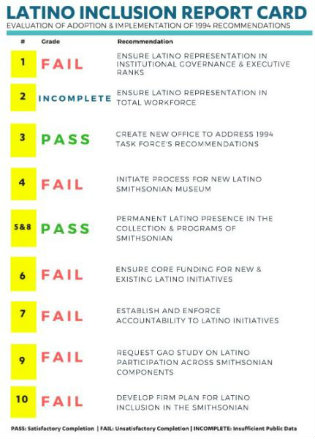 A report card examining the Smithsonian’s progress on 10 goals to improve Latino representation. (Image courtesy of UCLA)
In “Invisible No More,” Noriego and his co-authors evaluate the Smithsonian’s progress on 10 goals the institution set in 1994 in a report called “Willful Neglect.” “The Smithsonian…displays a pattern of willful neglect toward the estimated 25 million Latinos in the United States,” wrote the authors in 1994. “It is difficult for the Task Force to understand how such a consistent pattern of Latino exclusion from the work of the Smithsonian could have occured by chance.”
The report included 10 recommendations for improvement, included supporting the development of a Latino Museum on the National Mall and increasing Latino representation across the Smithsonian’s workforce.
The findings of the new report from UCLA aren’t all bad. Two of the most promising growth areas are the curatorial and archival departments, which have added significant numbers of Latino specialists. In 1994, there were only two Latino curators. The Smithsonian established the Latino Curatorial Initiative in 2010, and between 2012 and 2016 there have been an average of 7 Latino curators per years.
However, the proportion of Latinos working at the Smithsonian still lags behind that of the total Latino population in the U.S.: Latinos made up 17.8 percent of the country’s population in 2017, according to the U.S. Census Bureau. In 1994, 2.7 percent of the Smithsonian’s workforce was Latino. In 2018, it’s only at 5 percent, according to the Smithsonian.
In terms of executive leadership, Latinos remain severely underrepresented. No Latinos served on the Smithsonian’s main governing body, the Board of Regents, before 1994, and only four have served since. There has been no Latino representation since 2016.
“When you look at leadership, the Smithsonian is on par with other major cultural institutions like the Metropolitan Museum of Art, the Getty and the Chicago Art Institute, which have almost no minority leadership or governance,” said Noriega. “This is something that’s endemic to the field at large and really needs to be tackled.”
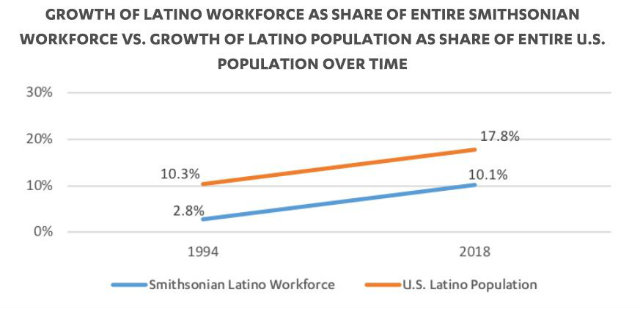 The proportion of Latinos working at the Smithsonian still lags behind that of the total Latino population in the U.S.
According to the Smithsonian, 3% of senior level leadership is Latino. A spokesperson said they are in the process of reviewing the report and its findings.
The report shows progress in other key areas, including Latino-centered collections, exhibitions and scholarship. The Smithsonian notes that the National Portrait Gallery has increased its acquisition of Latino subjects and artists by 90 percent, and the National Museum of African American History and Culture has recently begun to collect object related to the Afro-Latino experience.
However, the study’s authors point out that progress in these areas could be at risk due to inadequate federal funding for Latino-focused initiatives.
The Smithsonian has also failed in its goal to support efforts to establish a National American Latino Museum on the National Mall, according to the report. While private groups and Congressional leaders have repeatedly pushed for its creation, the authors say they could not find any mention of a Latino museum in any of the Smithsonian Institution’s annual reports from the last 23 years.
“Latinos remain largely excluded from participation in arts and cultural institutions that tell the American story,” Noriega wrote in the report’s foreword. “The Smithsonian has an opportunity to play a leadership role for the field.”
This story originally appeared on WAMU.