Martin Austermuhle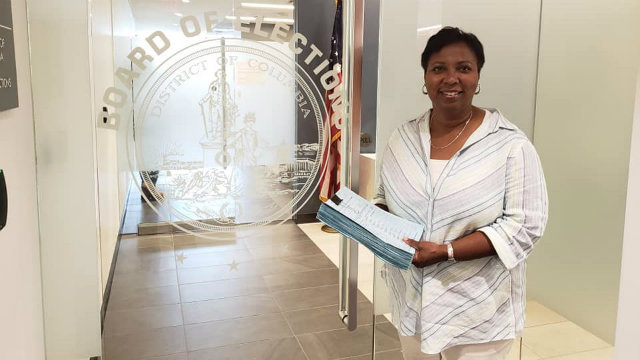
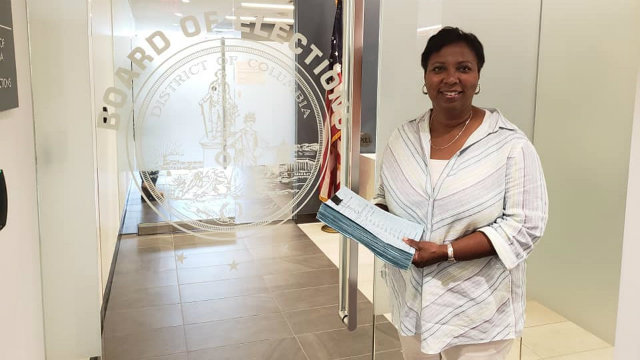 Allen submitted more than 6,000 signatures — twice the number needed — to get on the November ballot, but it was later determined that thousands of those signatures were invalid. (Photo by S. Kathryn Allen for D.C.)
S. Kathryn Allen, a business-backed challenger to D.C. Councilmember Elissa Silverman (I-At Large), was knocked off of the November ballot on Monday by the D.C. Board of Elections, which ruled that accusations of forgery and fraud on her nominating petitions were credible enough to put her below the threshold needed to qualify for the ballot.
The decision was a mortal blow to Allen’s campaign to unseat Silverman, a progressive-minded first-term Council member who was targeted in part because of her role in helping write a paid family leave law that the business lobby worries is too expensive. Allen received financial support from many of the city’s largest businesses and well-established lobbyists, out-raising Silverman according to a recent campaign finance report.
In the wake of the board’s decision—which was published just before midnight on Monday—Allen’s campaign seemed to accept that it would not be on November’s ballot, despite it still having the right to appeal the ruling to the D.C. Court of Appeals.
“We regret to announce that we were unable to prevail in our effort to get S. Kathryn Allen on the ballot for Council member At-Large,” the campaign said in a statement.
In the decision, the Board of Elections tossed out hundreds of signatures Allen had submitted to get on the ballot, citing allegations of fraud and forgery by four of her petition circulators. Some of those circulators even told the board in a hearing last week that they had never handled Allen’s petitions, and that their own signatures had been forged on them. One of her other circulators—her own campaign manager, Kevin Parker—submitted petitions that “contained many signatures in the same sequential order” as a candidate who ran in the June primary, “indicating fraud.”
The board’s decision left Allen with only 2,426 valid signatures on her nominating petitions, less than the 3,000 needed to get on the ballot—and significantly less than the 6,000 she submitted to the board in August.
“The Board has cause for concern that the integrity of the signature collection process was flawed,” read the decision.
Allen’s rejection from the ballot had echoes of Mayor Anthony Williams’s own fraud-marred re-election campaign in 2002, when the Board of Elections disqualified him from the ballot after accusations surfaced of scores of forged signatures on his nominating petitions. In its decision on Allen’s petitions, the board cited Williams—who served as the co-chair of Allen’s campaign.
“As in the case of [Williams], the board is compelled to disallow all signatures from circulators who disavow circulating the nominating petition sheets attributed to them, and/or have a taint of documented fraudulent activity,” it said.
The board also said in its decision that it would refer the cases of signature fraud on Allen’s nominating petitions to D.C. Attorney General Karl Racine for further investigation.
In its statement, the Allen campaign placed the blame for the fraudulent signatures and nominating petitions squarely on a campaign consultant hired to collect signatures.
“We entered this campaign with good intentions and good faith. It is extremely unfortunate that our decision to contract with a petition circulator service cast a shadow on an otherwise optimistic and unifying campaign. We have learned some hard lessons and will offer our suggestions to the D.C. Board of Elections to reform the petition circulation process, so that this does not happen to future candidates,” it said.
In her own statement, Silverman cheered the board’s ruling as a necessary means to protect the city’s democratic process.
“The board’s decision clearly communicated that fraud is not permissible,” she said. “D.C. residents need to be able to trust our elections process. The idea behind the nominating petitions is for a candidate to demonstrate some grassroots support among voters, and that should not be faked.”
Along with Silverman, the At-Large ballot will also include Democratic Councilmember Anita Bonds, Republican Ralph Chittams, Libertarian Denise Hicks, Statehood Green David Schwartzman, and independents Dionne Reeder and Rustin Lewis.
Voters will be asked to choose two candidates from the group to join the Council at the Wilson Building in January.
This story originally appeared at WAMU.