When hurricanes and other extreme weather events head towards the District, there’s a focus on preparing the city’s most flood-prone areas. But what about places that are already pretty wet, like D.C.’s neighborhood of houseboats?
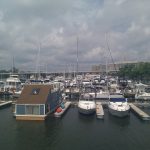
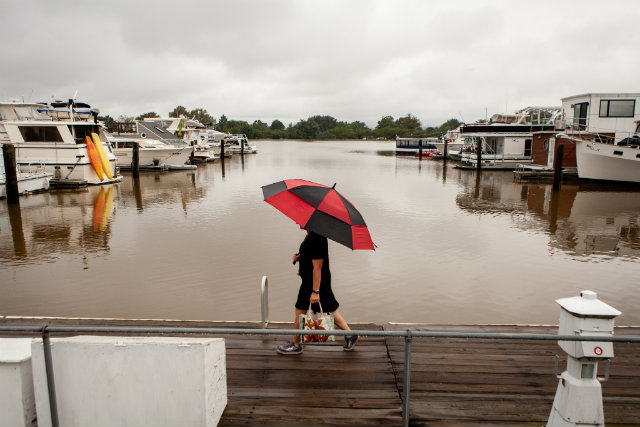
Gangplank Marina is part of The Wharf Marina, and it’s the only neighborhood of liveaboards in the city, as well as the largest such community on the East Coast. (Liveaboards, as you might imagine, means people who live on their boats, and can also refer to the boats themselves.) There are 88 live-aboard vessels at Gangplank, according to Marco Le Gette, the vice president of operations for Oasis Marinas, which manages The Wharf Marina.
Jean Link, a resident at Gangplank for three years, says that people in the neighborhood “watch the weather like no one else in the whole world watches the weather. We do that year-round—that’s not just for a storm.”
But precipitation isn’t the foremost concern. “We’re in boats, things that like the water and are always prepared for the water,” says Link, who serves on the board of the Gangplank Slipholders Association. “When everyone else is worried about flooding, we’re going to be floating on top of that water. Our biggest fear is bad winds.”
Intense winds make waves, which push the boats against the docks and otherwise endanger them.
Le Gette says planning for weather events like Hurricane Florence start at the beginning of hurricane season. “Preparation is a big thing that we stress,” says Le Gette. “It’s literally their houses, so you want to prepare and make sure everything’s at hand.”
In addition to the usual storm tips, like charging phones and having spare batteries and non-perishable food at hand, live aboards need some specialized supplies: extra lines (the boat term for rope), extra fenders, and safety equipment.
“We recommend that you double up your lines,” during a storm, Le Gette says, in addition to securing extra fenders on the boat and putting chafe guards on the lines, which basically serve as insulation.
The boats are plugged into an electricity source, but most of the larger ones also have generators on board. The marina has markings to monitor the rising tide—when it gets to a certain height, the marina operators will cut the power, says Le Gette.
Community members also watch the water line for the sake of the docks. “We’re tied to the docks,” Link says. “If the docks go over their pilings [the posts that keep the dock in place], then they can float,” taking all the boats with them.
But it would take a whole lot of water to do that. “If the flood goes over our sea wall, it’s still fine,” she says. “If the flood goes up to Maine Avenue, we would be floating around as big docks with boats attached to them. That would be crazy and we wouldn’t want that.”
A more likely challenge houseboats in D.C. face is water debris after storms.
Le Gette says that marina operators communicate the safety plan to residents and manage expectations.
One thing he emphasizes is that, much like people who sleep on land, liveaboards don’t need to stay in their homes to weather the storm. If the forecast looks too foreboding, “there is no reason to stay on your vessel,” says Le Gette. “I would highly recommend tying your vessel as best you can, and going somewhere inland.”
Sometimes, not even the boat stays in the water.
“If this was a severe enough storm and we were going to get a direct hit or a really good whopping, if you will, we recommend you haul your vessel out,” says Le Gette, meaning that residents take their boats out of the water and store them somewhere on land. “That’s tough with houseboats. Given where you are in D.C., there’s not a lot of locations that can do those haul outs for those kinds of vessels.”
While some people at other locations Oasis Marinas manages are hauling out, Le Gette isn’t recommending that Gangplank residents do so for Florence, which will likely spare the Washington region of its most intense rain and wind.
“We are preparing as if we’re going to see some heavy winds, large amounts of precipitation, tidal surges,” says Le Gette. “The weather does seem to be calming down, but you can never underestimate.”
Link says that hurricane season isn’t the most daunting weather for Gangplank Marina. “The winter is really the make-it-or-break-it for someone living close to the water,” she says.
Previously:
D.C. Will Probably Dodge The Worst Of The Hurricane
These Are Some Of The Areas Most Susceptible To Flooding In D.C.
How Hurricane Florence Will Affect Planes, Trains, And Automobiles
One Way To Protect The National Mall From Flooding: A Huge Underground Cistern
With Hurricane Florence Looming, Here’s The Status Of D.C.-Area Events This Weekend
Mayor Bowser Declares State Of Emergency In D.C. Ahead Of Hurricane Florence
Hurricane Florence Is Traveling A Similar Path As A 1933 Storm That Got Very, Very Close To D.C.