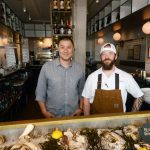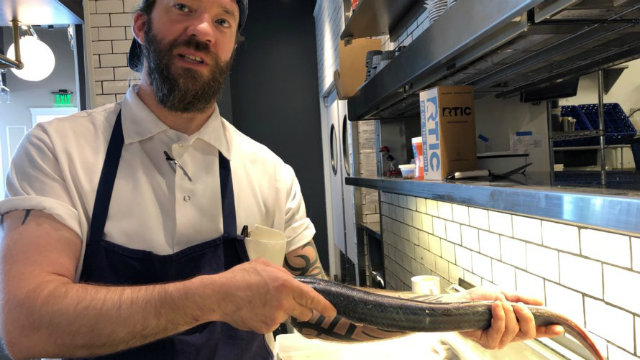
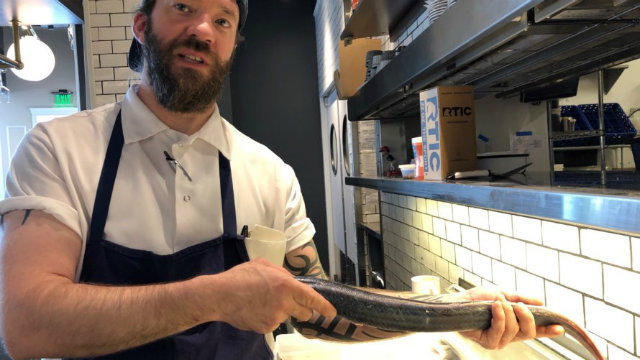
 Chef Kyle Bailey at The Salt Line in D.C. holds an eel he received from Troy Wilkins through Dock-to-Dish, a restaurant supported fishery program. (Photo by Esther Ciammachilli / WAMU)
Eels are misunderstood. They’re slimy, and look like snakes—which makes it hard for some people to stomach the thought of eating one. But eel season is ramping up at one D.C. restaurant, where the chef serves eels caught in the Chesapeake Bay.
Despite appearances, eels are fish. They breathe through gills and move using two long fins—one down their back, another along their bellies. The two fins meet to form a tail.
At seafood restaurant The Salt Line, chef Kyle Bailey is happy to offer eel to his customers.
“They’re available and I want that because I don’t see them anywhere else in town, and I would love to be the restaurant that has something that nobody else has,” Bailey says.
Bailey’s eels are provided by Dock-to-Dish, a restaurant-supported fishery program in the Washington region. It allows chefs to trace the fish they get back to the dock they came from.
From Kent Island To The Salt Line
The source of Bailey’s eels is Troy Wilkins, one of a couple dozen Maryland watermen who fish for the elusive, yet abundant creatures on a regular basis.
On a recent day, Wilkins sails near Kent Island in the Chesapeake. From the deck of his fishing boat, the Misty Tango, he reels in two-foot-long, cylindrical eel pots one by one.
Several pots come up nearly full. Roughly a dozen greenish-brown eels writhe around inside the pots before he dumps them into a holding tank. Some eels are big, about four or five pounds. Others are much smaller.
Wilkins says fishing for eel takes patience and some knowhow.
“Take the clam for instance,” he says. “He cannot swim. So, you know, that’s pretty easy to catch. But an eel can swim, and he might be in two foot of water today, and the next day you might have to go all the way in 30 foot of water.”
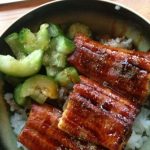
Eels live in rivers and tributaries around Maryland and Virginia. The most common species in the Chesapeake is American eel. Wilkins says they were once used as bait. Now, they’re a delicacy among foodies. Sushi lovers know eel more famously as “unagi,” and the fish is very popular in Asia.
Most of Wilkins’ eel catch goes to buyers outside Maryland. Occasionally though, he gets a call from Kelly Barnes.
“I’ll say ‘Troy, I need some eels from you this week.’ And he says, ‘Sure, Kelly. Whatever you need,’” says Barnes.
Barnes, who runs Dock-to-Dish, then provides them to the Salt Line.
Versatile and flavorful
Chef Bailey compares the versatility of eel—if not its taste—to chicken. Eel is flavorful enough to stand on its own, but works well with marinades and spice rubs. It can be grilled, broiled, fried, and baked. But timid diners are often reluctant to try new things. To ease customers into trying this fish, Bailey uses it in dishes they’re familiar with.
“We thought about classic veal dishes and inserted eel into that. And we came up with an eel cacciatore. It just sounds very playful and fun and comfortable and safe and homey,” he says.
Traditional cacciatore is made with a braised meat in a tomato and wine sauce and served with pasta. Bailey says customers loved the eel cacciatore. Some have even come back and asked for it again. Bailey says the dish is likely to make a comeback on The Salt Line menu.
Fall is approaching, and that’s when Bailey says he enjoys cooking with eel the most. He says that whenever eel is on the menu at The Salt Line, customers have lots of questions for the wait staff.
“Its’ like, ‘Eels! Oh my god! Where are they from?’ It’s like, ‘They’re from 15 miles away, man,’” Bailey says.
And, he adds, the one thing that surprises customers more than finding out eels come from local waters is realizing how much they enjoy eating them.
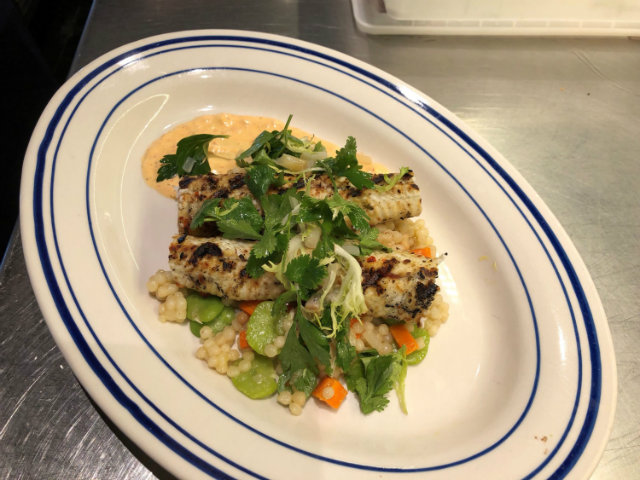 The finished product: grilled eel on a bed of couscous and fava beans, topped with an herb salad. (Photo by Esther Ciammachilli / WAMU)
To highlight eel’s versatility, Bailey made for me a light, summery entrée featuring grilled eel over a bed of couscous and fava beans with an herb salad.
For this dish, Bailey heats the grill to a really high temperature. He takes two six-inch eel fillets that have been doused in a Mediterranean marinade and places them skin-side down on the fire. As soon as the eel hits the hot grill, the skin begins to shrink, causing the fillet to curl slightly. The fillets are done in about five minutes. The finished product is tender and smoky with a light herby flavor. If your mouth isn’t watering, it should be.
This story was originally published on WAMU.