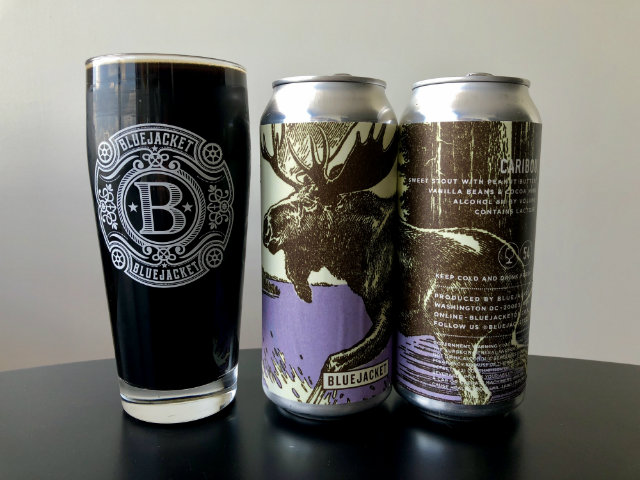
 The Caribou has a hint of peanut butter (Photo courtesy of Bluejacket)
Only four ingredients are necessary to make beer—yeast, hops, grains, and water—but many D.C.-area breweries don’t stop there. Like any craftsperson, brewers get bored with the status quo, and have taken to experimenting with odd ingredients as a challenge. Here are some beers around Washington that represent imaginative risks undertaken by our local breweries. Take a risk as a drinker and try them yourself.
Beer: Caribou
Brewery: Bluejacket
Strange ingredient: Peanut butter
There are plenty of overwhelming and imbalanced iterations of peanut butter beer to be found in American craft brewing, but the newly-released Caribou succeeds where others have failed. This stout is based on the Mexican Radio, a five-year mainstay on Bluejacket’s menu that uses chocolate, hatch chiles, and cinnamon sticks. The Caribou uses the same base stout recipe but ditches the chiles and cinnamon in exchange for peanut butter, Madagascar vanilla, and cacao nibs in post-fermentation to create a sweet and creamy stout that is plush in flavor and aroma.
“When you pop a can of it, it smells like peanut butter cups ten feet away,” says Greg Engert, beer director for Bluejacket.
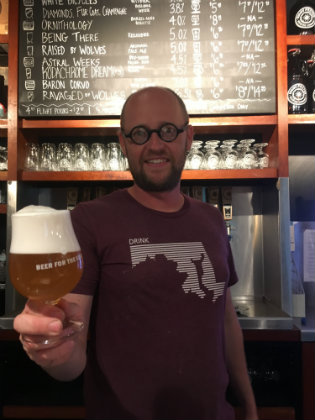 Right Proper Brewer Nathan Zeender and his Diamonds, Fur Coat, and Champagne (Photo by Sam Nelson)
Beer: Diamonds, Fur Coat, Champagne
Brewery: Right Proper Brewing Company
Strange ingredient: Dried elderflowers, grapefruit peel
Right Proper Brewing Company might be the king of weird beers in D.C., and Diamonds, Fur Coat, Champagne might be the most accessibly weird beer they produce. The tart Berliner Weisse was a favorite at the more experimental T Street Brewpub for years before Head Brewer Nathan Zeender decided to brew and can it at Right Proper’s Brookland Production House.
“I wanted a beer that would mimic the taste of Brut Champagne,” he says.
To achieve that, Zeender uses a house bacteria culture, necessary for all sour beers, and adds both dried elderflowers from Mountain Rose Herbs in Eugene, Oregon, and fresh grapefruit peel late in the boil. This gives the beer a balancing touch of floral and citrusy aromas and flavor.
Zeender likes elderflower because it has a “really nice floral bouquet…and historically it has been seen as a very powerful herb.” As a brewer, he’s also used nettles, dandelions, flowers, and other herbs in beers like Convergent Worlds, Spirits Rejoice, and other beers sometimes featured in Right Proper’s American Primitive Series.
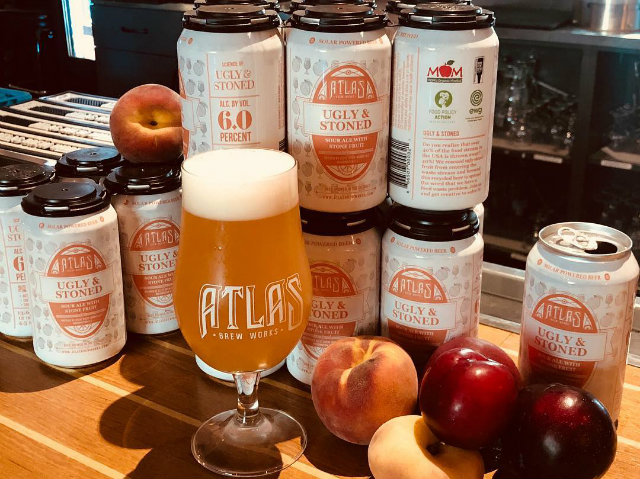 Atlas Ugly & Stoned (Photo via Facebook)
Beer: Ugly & Stoned
Brewery: Atlas Brew Works
Strange ingredient: Ugly fruit
Ugly fruit is the fruit usually discarded by vendors because it’s been bruised or damaged in shipping. Most shoppers don’t want it, and neither do stores. But Atlas Brew Works head brewer Daniel Vilarrubi does.
“We decided we could make a beer that raises awareness about food waste in this country,” Vilarrubi says.
Atlas Brew Works used discarded stone fruits, including peaches, nectarines, plums, pluots, cherries, and apricots, for its fruity sour ale Ugly & Stoned. Volunteers came to the brewery to help cut the fruit (which was donated by MOM’s Organic Market), making the preparation of the beer a communal event. After pasteurization, brewers added the fruit puree to the beer in mid-fermentation.
Atlas brewed three batches of Ugly & Stoned, each a little different based on the selection of stone fruit. Vilarrubi says the first batch had more peaches and nectarines while the third and final batch, currently on tap and available in cans, turned out a smokier flavor.
Vilarrubi suspects that some of the fruit pits accidentally made it inside the pasteurizer and clogged the pump, lightly scorching the fruit puree at the bottom. The result is a surprising, smoky fruit finish, and a happy accident for many drinkers (including this writer).
“We could have dumped the batch but that’s not really in the spirit of this beer,” Vilarrubi says.
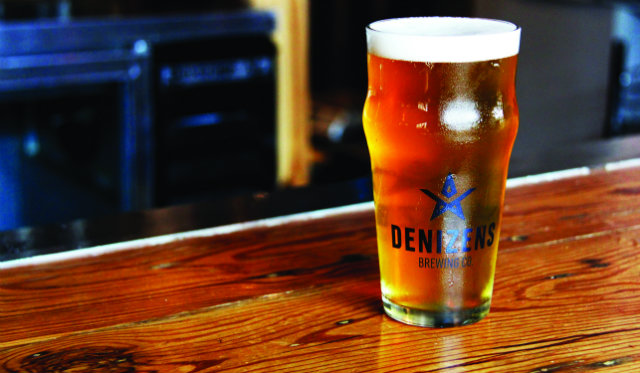 Boho Chic (Photo courtesy of Denizens Brewing Co.)
Beer: Boho Chic
Brewery: Denizens Brewing Co.
Strange ingredient: Heirloom malts
The Boho Chic beer is so traditional that it might qualify as untraditional in today’s landscape. Unlike the other beers on this list, there are no special fruits, spices, or herbs. The odd ingredient here is the grain. Denizens Brewing Co. co-founder Jeff Ramirez opted to use heirloom malts—an industry term for very old malts—for this kellerbier, an unfiltered German-style lager, and borrows a pre-industrial process for making it.
All beer requires grain to be germinated to turn into malts for brewing, but the malt has to dried so it doesn’t sprout. Most brewers purchase malts that have been machine-dried. For Boho Chic, Denizens gets its malts from Weyermann Specialty Malts in Bamberg, Germany, which uses an old-school method. Rather than placing wet grains in a germinating machine, “the malts are spread over the floor and turned with a coal shovel,” Ramirez says.
To Ramirez, the heirloom malts give the beer a richer mouthfeel and a sweeter grain flavor—more earthy and bready than modern lagers and kellerbiers. Ramirez also uses an open fermenter to brew the beer, meaning there is no pressurized top to the conditioner during the process.
“I’m a lagerhead,” Ramirez says. “[Lagers] have gone through all this refinement, but keller pilsners have always been my favorite shift beer after work. I wanted to take it a step further, from our unfiltered lagers we make, to something more challenging, accentuating historical brewing techniques and emulating them to the best of our ability.”
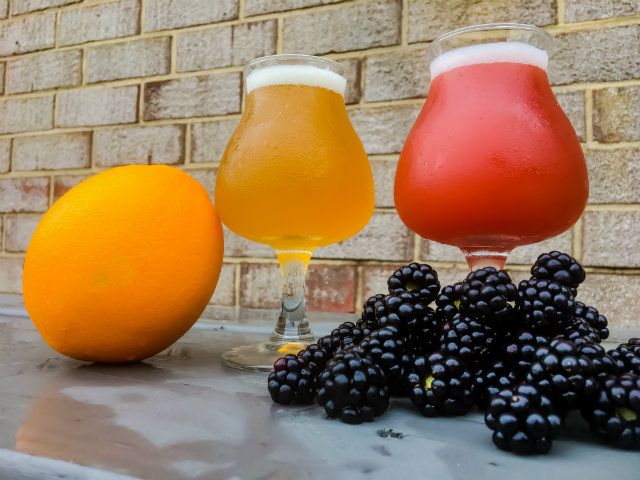 The Zestify! and Tartuga (Photo courtesy of Hellbender Brewing Company)
Beer: Zestify!, Tartuga, and Guava-Beary
Brewery: Hellbender Brewing Company
Strange ingredients: Norwegian yeasts
Co-owner and head brewer Ben Evans wanted a late-summer challenge, so he decided to brew a series of fruity kettle sour ales using foreign yeast strains and local fruits. His Zestify! Is made with Valencia orange and orange peels, and Tartuga contains 110 pounds of blackberry puree.
What makes these beers more complex, though, is the use of foreign yeast strains. Most brewers will buy commercial brewing yeast or grow their own. Evans works with microbiologist Peter Van Berkum, who identifies and collects interesting yeast strains from Norway for Hellbender’s beers. Van Berkum ordered a special strain for these sours from a homebrewer on the Gjernes farm in Voss, Norway.
Hellbender’s kettle sours involve more testing and labor, but Evans said he embraces the challenges demanded by these recipes.
“[These strains] ferment rapidly at really hot temperatures and make awesome flavors,” he says.
Last month he hand-picked peaches and other fruits for his next batch of kettle sour. Evans collaborated with Red Bear Brewing to make Guava-Beary Gose, a kettle sour that uses Norwegian yeast, coriander, French sea salt, raspberries, and guavas. In a smaller batch, Evans used the peaches for Dr. Fuzz, a peach gose. Both are currently on tap at the Hellbender brewery in Fort Totten.
Beer: Experimental Ale
Brewery: The Public Option
Strange ingredient: Irish moss
Irish moss, a kind of red algae seaweed, might be found in garden ponds or rocky beaches, but it’s also used at D.C.’s smallest brewpub, although most drinkers won’t be able to see or taste the ingredient in a pour. Public Option owner and brewer Bill Perry uses Irish moss as a clarifying agent in some of his experimental ales, one of which is always kept on tap at the brewpub.
Beer is naturally hazy with bits of sediments floating around unless it’s properly clarified, decanted, or filtered. There are lots of agents that can be used to clarify beers and help remove sediment before filtration, but the moss helps the sediment clump, making it easier to filter out. Perry likes to use Irish moss because it’s been used for a long time in homebrewing, and Public Option is “not much bigger than a homebrewing operation,” he says.
Recently Public Option’s Experimental Ale, which changes often, included Irish moss in the process of making an American wild ale using locally harvested wild yeast.
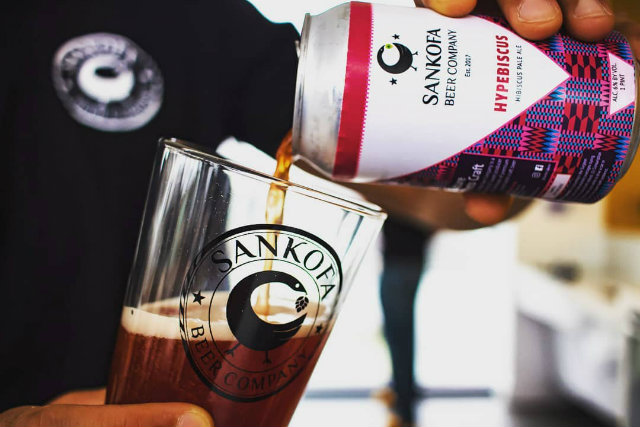 Sankofa Beer’s HYPEbiscus gets a purple tint from hibiscus flowers. (Photo courtesy of Sankofa Beer)
Beer: HYPEbiscus
Brewery: Sankofa Beer Company
Strange ingredient: Dried hibiscus flowers
Kofi Meroe and Amado Carsky, co-founders of D.C.’s Sankofa Beer Company, have been home-brewing for eight years and tested many recipes before selecting this light, flowery pale ale for their West African-inspired company’s flagship beer.
Meroe adds dried hibiscus flowers during the cooling process of the boil. The flowers don’t change the flavor much, but they do add floral aromatics and “a cool purple color that comes through, so that you’ll see a hue,” Meroe says. Meroe’s idea for the beer was inspired by the popularity of hibiscus teas he grew up with in West Africa.
“My mom brought some [hibiscus flowers] back from Ghana once, and I thought, ‘Hey, we drink this all the time, let’s make a beer out of it,’” Meroe says.
Sankofa Brewing Company did a soft launch of the beer at Public Option two years ago and has since scaled up the beer’s production and distribution. HYPEbiscus is now available in several restaurants and stores in the District