Natalie Delgadillo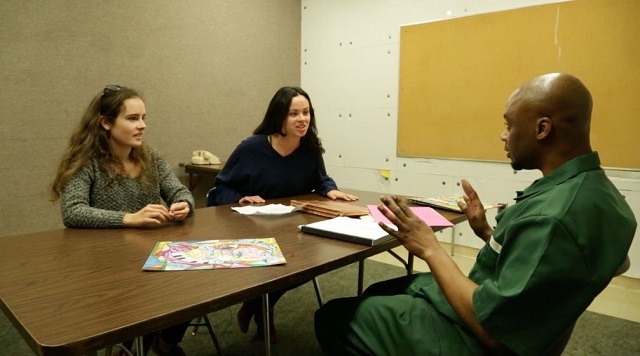
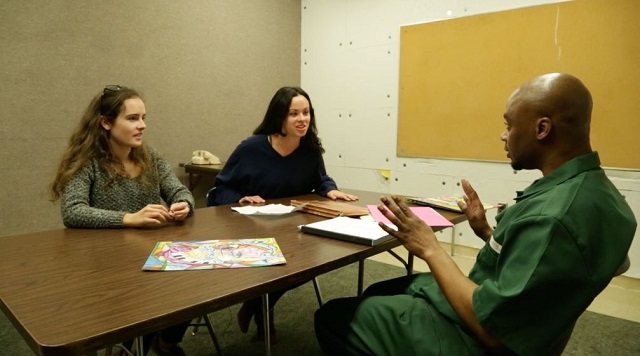 Georgetown University students Julie Fragonas and Isobella Goonetillake speak with Valentino Dixon at Wende Correctional Facility. (Photo Courtesy of Strong Island Films)
A group of undergraduates at Georgetown University have played an instrumental role in freeing Valentino Dixon, a Buffalo, NY man who was wrongfully convicted of murdering a man in 1991.
On Wednesday, Dixon was freed after more than 26 years in prison, fully exonerated of all murder charges in court. The same day, Lamarr Scott, the man who has repeatedly confessed to the killing on camera since it happened in 1991, pleaded guilty to manslaughter and assault in the death of Torriano Jackson in court.
Dixon’s exoneration is in part the result of an investigation by students at Georgetown, who took a prison reform project course in the spring semester of 2018 and worked on Dixon’s case.
Three students in particular—Julie Fragonas, Isobella Goonetillake, and Naoya Johnson—got heavily involved. They interviewed Dixon’s original prosecutor and public defender, created a website to advocate for his release, and made a documentary about his story. Dixon had appealed about a dozen times before the Georgetown students got involved.
During their research, the students discovered that during the original trial, prosecutors never told Dixon’s attorney that a gunpowder test on Dixon’s hands came back negative. That information, combined with the consistent confessions from Lamarr Scott starting less than a week after the killing, helped exonerate Dixon.
Dixon’s appellate attorney, Donald Thompson, filed a motion that drew on the students’ findings, according to a press release from the university.
The Georgetown class is taught by Marc Howard, a professor of government and law at Georgetown, and his childhood friend Marty Tankleff, who was wrongfully imprisoned for murdering his parents in 1990 and served 17 years in prison.
The class, called the Prison Reform Project, assigned 16 students four cases of what Howard says are wrongful convictions, and tasked them with researching the cases and making documentaries on each story. In Dixon’s case, the students’ work led to new information that ended up contributing to his release.
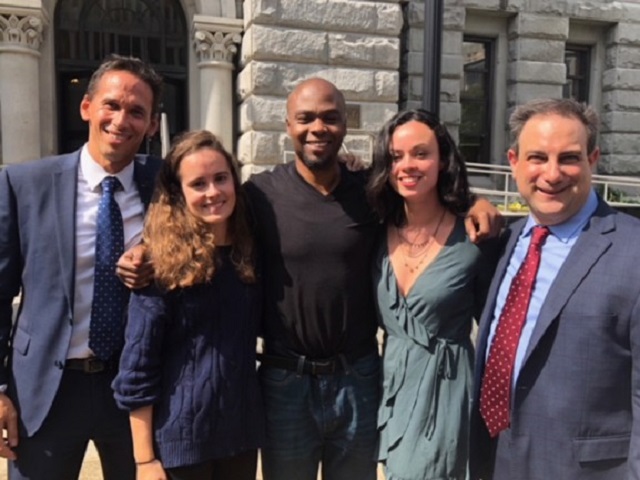 Georgetown professor Marc Howard, student Julie Fragonas, former inmate Valentino Dixon, Isobella Goonetillake, and Marty Tankleff standing in front of the Erie County, New York, courthouse after Dixon was released. (Courtesy of Georgetown University)
“It was our students who did this groundbreaking work. It’s borderline miraculous,” Howard says. “Despite all [the] distractions in their lives, they made this their top priority … They realized this wasn’t a drill, this wasn’t an exercise, these weren’t mock cases.”
Howard says the students worked 20-30 hours per week on research and the documentaries on their cases.
The class is a part of Georgetown’s Prisons and Justice Initiative, which Howard leads. The initiative includes a myriad of classes on prison reform, including several that take place at the D.C. Jail.
Dixon, who has earned a kind of fame for himself while in prison for his artwork, says he was happy and relieved to learn that students from Georgetown were getting involved in his case.
“I had a lawyer at the time, but with a lawyer, you don’t truly believe you have the best shot in the world,” Dixon told DCist shortly after his release on Wednesday. “Once Georgetown came on, I felt like I had some security now. Georgetown is a respected university, a prestigious university … That gave me a whole different type of feeling that I’ve never had before.”
Howard says that the atmosphere in the courtroom Wednesday was visibly joyful. Normally subdued while the judge is present, Howard says the audience was cheering and weeping as Dixon’s conviction was overturned.
“It means everything, it means the world to me,” Dixon said of his release. “To see the joy on my mother’s face, on my daughter’s … it’s indescribable.”