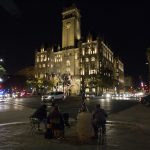
 Trump International Hotel. (Photo by Alex Edelman)
By DCist contributor Kip Dooley
There was little room for politics in Steve DaSilva’s childhood home, a small apartment near Mt. Pleasant. “Work sleep, go to church, repeat” was the mantra of his working class Brazilian-American parents. To this day, he says, he’s “not really political.”
Yet here he is on a Tuesday night at Trump International Hotel, plodding his way through small-talk with an aspiring life coach he’s just met named James Boone. It’s both of their first times at DCMAGA Meetup, a group founded shortly after the 2016 election as a haven for Trump supporters in a city where about four percent of the population voted for the president, and one in three have participated in a protest since his inauguration.
Only eight people showed for the first DCMAGA meetup during a snowstorm in February 2017, says founder Mike Wojtaszek, a federal contractor from Virginia. The group now has 370 members in its private group on Mobilize, a professional networking platform. They usually meet at Trump Hotel, but occasionally host spin-off events like a screening of Dinesh D’Souza’s revisionist history film “Death of a Nation” last month. Wojtaszek says the group is “a really diverse crew” of Republicans, independents, and “walkaway Democrats.”
Over the course of four recent meetups, which ranged from around 12 to 60 people, it became clear that the group represents a broader tent than the stereotype of Trump meetup attendees: disaffected straight white men. A handful of women attended, particularly during an event co-hosted by the Virginia-based Women for Trump group, along with several black Republicans, and a couple of people who openly identified as bisexual or gay. Ralph Chittums, the Republican candidate in the D.C. Council at-large race, spoke at the Women for Trump event.
“I went in assuming all I was going to see were old white Republican men, but I was very wrong,” says DaSilva.
While polling is inconclusive about the exact amount of support Donald Trump has among voters of color, the percentage of those who disapprove is consistently higher, often doubled. In D.C., people of color who support the president is an even tinier slice of the pie than the country as a whole. So who are they?
Like many millennials of color, both DaSilva and Boone were galvanized by Barack Obama’s election in 2008, and like a lot of millennials since then, they’ve grown pessimistic about electoral politics. But unlike the roughly 68 percent of black or Latinx millennials polled by NBC in June who disapprove of President Donald Trump, they’ve gone the other way, joining the small minority of black and Latinx voters who support him.
“So, what’s your ‘walkaway moment?’” Boone asks DaSilva, referring to #walkaway stories, a recent wave of video testimonials posted online by young people explaining why they’ve gone from Democrat to Republican. It was launched in May by a gay New York hairdresser named Brandon Straka, who has become a conservative media star. (No one mentions the possibility that the walkaway phenomenon was an orchestrated campaign rather than a spontaneous cross-cultural conservative awakening. The Daily Dot pointed out one of its most prominent figures, supposedly a Latina woman with immigrant parents, turned out to be a Twitter bot.)
DaSilva traces his “walkaway moment” to a time long before YouTube sensations. “I got red-pilled when I was five years old,” he says, after he visited family in Brazil for the first time. There, he witnessed widespread poverty and violent crime. In America, his family wasn’t rich, but they could at least make a living and count on basic safety. “Kids born in America don’t understand how blessed they are,” he says. “We do have people in need … but we don’t know what poor is in this country.”
DaSilva says he’s unimpressed by the notion of an ascendant Latinx left, led by New York Congressional candidate Alexandria Ocasio-Cortez. “I know lots of people who come from socialist countries,” he says, which he characterizes as countries where strict government regulations stifle working-class families like his. “It’s not cute. It’s not funny.”
A white guy from the Midwest wearing a blazer and tie joins our circle, eager to share his own #walkaway story. When I tell him I’m a reporter, he asks to remain anonymous. Struggling to find a date is small potatoes for a District Trump supporter like him. He says he thinks his neighbors in Logan Circle would disown him—or worse—if they found out about his political views. “I genuinely live in fear,” he tells me quietly.
DaSilva and Boone are less paranoid than their new Midwestern friend, but say that they do tend to keep their views to themselves, especially within their own Latinx and black communities.
DaSilva learned about DCMAGA Meetup through Twitter, while reading about how a group of black Congressional interns were kicked out of an Uber in July for wearing red MAGA hats. Boone says he “just got sick of hardcore identity politics.” He’s long since stopped discussing politics with friends and family, and has gotten used to being called “coon” and “Uncle Tom” online. “There’s guilt by association when you think a little different,” he says.
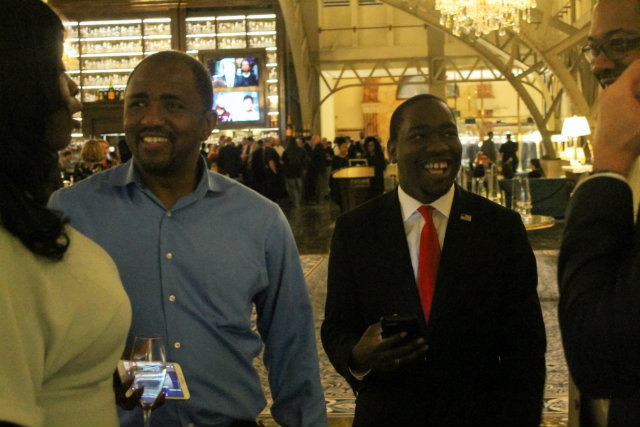
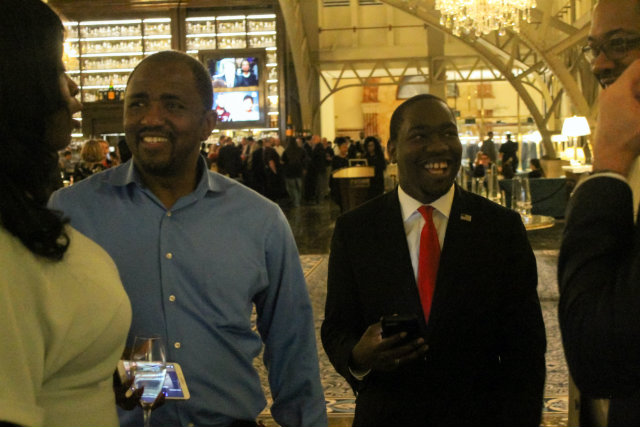 Aisha Love, Greg Steward, Diante Johnson, and Republican At-large Candidate Ralph Chittams at a DCMAGA Meetup at the Trump International Hotel on September 11, 2018. (Photo by Kip Dooley)
Boone shifted to the right for psychological reasons as much as political ones. Growing up in a liberal, black environment, he says he was taught that the world would always treat him unfairly because of his blackness. As he grew into adulthood, he found that stultifying.
“If I think that the world is against me due to factors I can’t change, then why change?” he says. “I view that as a death sentence in terms of one’s identity, one’s understanding of oneself, their personhood as an individual.”
Boone reads widely on fringe libertarian ideologies like anarcho-capitalism, and is influenced by leftist thinkers, too. He comes to life while explaining Noam Chomsky’s take on Russia, the wooden beads on his bracelet clicking as he gesticulates. DaSilva gives him a weird look when he brings up anarcho-capitalism. “Don’t be fooled by the ‘anarcho’ part!” Boone says. “It means ‘no rulers,’ not ‘no rules.’
Neither is there much talk at the meetup about Trump’s inflammatory rhetoric and policies concerning race and immigration. During a follow-up phone call with DaSilva, when I bring up Trump’s statements about Latino immigrants being criminals, he says, “I know who he’s talking about … [and] they are animals … I’m Brazilian, and I was not offended by that. I know Mexicans who were not offended by that.”
I caught up with DCMAGA Meetup regulars Greg Steward and Bernardo Ramos, at Ramos’ Northeast work site. Steward is a middle-aged black real estate developer who hails from Deanwood. Ramos immigrated here—legally, a fact he mentions repeatedly—but asked I not publish from where, exactly.
Steward is a fast talker and cites a lot of data from alternative online news and conservative Twitter pundits. He doesn’t trust establishment liberals, who he believes harbor racist beliefs beneath a welcoming veneer. To a Democrat, he’d say, “The only difference between you and the KKK is you say that you’re my friend.”
Ramos sticks with the basics when explaining his support of Trump. A devout Christian who runs his own construction business with an all-Latino work crew he jokingly refers to as “The 12 Apostles,” he likes Trump’s business-first ethos more than Democrat welfare programs. “You don’t want government to support you,” says Ramos. “You want to make it on your own.” Though he knows the plight of immigrants, he says he has little sympathy for those who come here illegally. Rules are rules, he says, and countries have borders.
And sure, he says, sometimes he feels out of place at Trump International Hotel. He can’t afford the pricey drinks there, and was once confused for a waiter when he showed up to Trump’s birthday party wearing a tux.
But the MAGA tent, he says, is more diverse than the way he sees it represented. “It’s teachers, firemen, police officers, U.S. attorneys, we even have a few judges,” says Ramos. “It’s people from all levels of life, not just wealthy.”
Wojtaszek, the group’s founder, says it has morphed into a personal and professional network, where people with heterodox views share not just political ideas, but life and career advice.
While DaSilva and Boone aren’t sold yet on joining the DCMAGA Meetup officially, Steward and Ramos both say they’re in it for the long haul. “If you support Trump, you paid a social price,” says Steward. “You lost friends, because some people can’t deal with you thinking different. This is just an evolution of my social circle going forward.”
For Steward, what makes DCMAGA Meetups unique is the chance to disagree without others taking offense. “We have the same basic values, but after that, the monolith thought pattern isn’t there,” says Steward. “You can sit at the bar and argue all night, and then say, ‘See you next month!”