Natalie Delgadillo
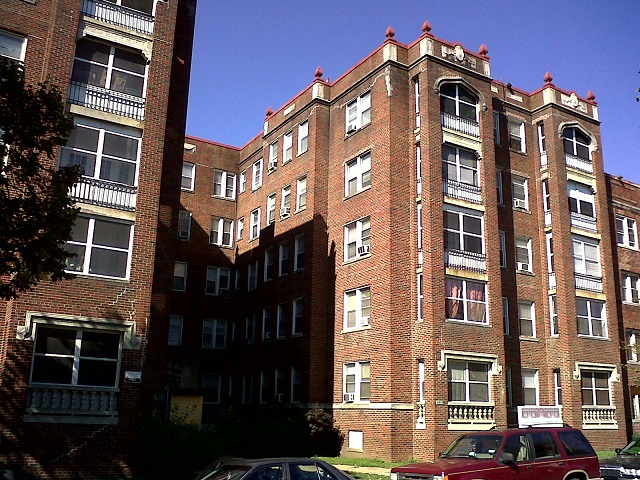 Dahlgreen Courts (Courtesy of Wikimedia Commons)
The District agency tasked with cracking down on landlords for housing code violations isn’t getting the job done, according to a case study from the Office of the D.C. Auditor published on Monday.
The study is focused on the Department of Consumer and Regulatory Affairs’ handling of Dahlgreen Courts, a 96-unit apartment complex in Brookland that has a long history of complaints from tenants. In March of this year, residents sued building management and the developer for poor living conditions, claiming in the suit that 40 tenants had tested positive for “elevated levels of lead in their blood and/or Chronic Inflammatory Response Syndrome” due to lead and mold exposure, Washington City Paper reported in the spring.
In 2016, residents of Dahlgreen Courts submitted several complaints to DCRA about their living conditions, prompting a whole-building inspection. The agency ended up issuing 24 notices of violation for 105 total violations in 17 units and two common areas, according to the report from the auditor’s office. The potential fines were $36,300, but the landlord only paid $2,500 for violations in six units, the report says. It took the owner eight months to remediate the violations.
The data studied come from December 1, 2016, to September 26, 2017, according to the auditor’s office. It was undertaken at the request of D.C. Council Chairman Phil Mendelson, who has been openly critical of the DCRA, suggesting it should be split into two separate agencies.
“The process for responding to housing code violation complaints allows landlords to put off remediation through extensions and delayed re-inspections,” said D.C. Auditor Kathy Patterson in the report. “This can allow the property owner to work the process to delay cure and keep District residents in substandard housing conditions for extended periods of time.”
The problem can eventually result in a loss of affordable housing, Patterson said, because conditions can get so bad that they force people to move out.
The report says that DCRA’s fines are not levied consistently enough, and even when they are, they’re low enough that a landlord can choose to ignore them. It also says that because DCRA does not publish information about violations, landlords generally don’t have to worry about a hit to their reputation from providing substandard housing conditions. Moreover, the periods between initial and follow-up inspections are too long, per the auditor’s office.
There are 19 recommendations in the report, a large portion of which are directed at the D.C. Council. It says that the Council should increase fines by 25 percent, and charge a fine for each additional day a violation exists after the abatement deadline. Additionally, it recommends that the Council should require DCRA to allow extensions for abatement only in very specific cases, prevent “problematic landlords” from becoming landlords elsewhere, and shorten the time periods between preliminary inspections and re-inspections of properties to assess whether violations have been taken care of.
The D.C. Council has been considering multiple bills that address the agency’s work. In July, councilmembers discussed three measures that would force DCRA to deny slumlords business licenses and building permits, streamline the process to remedy housing violations, and abate housing code violations themselves when landlords refuse.
The report includes a response from the director of DCRA, Melinda Bolling, who said she “challenges some general conclusions and exaggerations provided” in the report.
In particular, Bolling said that Dahlgreen Courts isn’t representative of the way DCRA generally enforces property abatement problems, nor the “improvements made under the Bowser Administration.” She points out that the presence of lead and mold in the building roped in the Department of Energy and Environment, which made it inappropriate for the study to “hone in” on DCRA, “rather than suggesting how to improve a District-wide or interagency response.”
Bolling also took issue with the report’s recommendations, particularly in that they were mainly for the D.C. Council.
“Most of the recommendations are addressed to Council, when we think that reforms are in process and most of the matters discussed are quintessential Executive Branch functions, not amenable to Council action,” she said in her response.
Bolling does concede, however, that “inspections and re-inspections can be more efficient.”