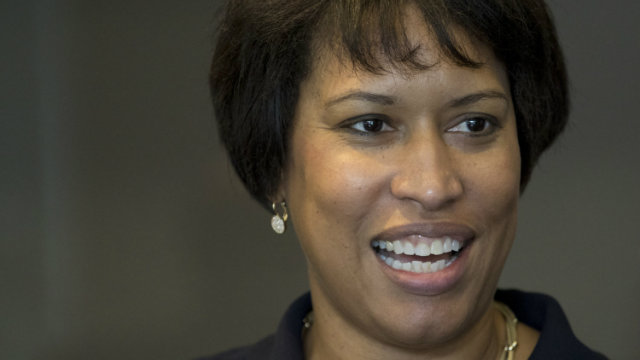
 Mayor Muriel Bowser’s choice for deputy mayor for education faces hearings before a D.C. Council that wants to limit mayoral authority over the city’s schools. (Tyrone Turner / WAMU)
Mayor Muriel Bowser has chosen Paul Kihn, a former consultant for D.C. Public Schools to be the District’s new Deputy Mayor of Education. As the highest education official in the city, Kihn would be charged with overseeing education agencies in the mayor’s office and developing a citywide education strategy for the city’s 91,537 students in public and public charter schools.
If approved by the D.C. Council, Kihn would inherit a school system still recovering from controversies. Last school year, investigations revealed that one-third of students who graduated from D.C. Public Schools did not meet attendance requirements. Reports also uncovered problems with residency fraud and teacher turnover. Kihn’s predecessor, Jennifer Niles, resigned in February amid reports that she helped former schools chancellor Antwan Wilson circumvent the school lottery system to transfer his daughter between schools. Ahnna Smith has been interim deputy mayor for education since then.
Bowser announced Kihn’s appointment Tuesday morning.
“Paul believes that everything we do has to be child-centered and he puts students first,” Bowser said. “That aligns with my vision.”
Bowser says Kihn will focus on “opportunities” the District has for improvement, including better analyzing school data and fostering collaboration among various education agencies. He will also have to deal with a Council intent on stripping his office of some of its power.
Last week, D.C. Council members introduced two pieces of legislation that would give the state superintendent more independence from the mayor’s office. The Council is also moving forward with plans to create an education research agency under the auditor’s control, out of reach of the deputy mayor.
Who is Paul Kihn?
Although not originally from D.C., Kihn has been in and out of the District since 2008. He spent three years in Philadelphia as the Deputy Superintendent of that city’s public schools before he resigned for “personal reasons.” His resignation was part of an exodus of school employees in Philadelphia in 2015.
According to public documents, Kihn has advised D.C. school officials on issues including graduation rates, class credit recovery programs and teacher pay. In 2016, he gave a presentation calling for more focus on “disengaged 9th graders,” noting, among other things, that the District should offer more a personalized approach to the credit recovery programs that are meant to help students make up classes in which they didn’t perform well.
Kihn tells WAMU that D.C. officials heeded his advice in these areas, but it’s still “too early to tell” how many of his recommendations have been followed.
In the case of credit recovery, District officials only recently revised their policies after reports that the courses lacked rigor, and that some students took the credit recovery classes before taking the original class in a bid to push students to graduate. The policy now states that students must wait until they have completed the original course before taking the recovery class.
Kihn hasn’t made any large proclamations about his plans for D.C. schools, but he did outline his vision for urban school systems in a 2016 essay published in the industry news publication Education Week.
In his essay, Kihn called for traditional public school districts to forgo trying to be all things to all people and to “specialize” by focusing on the “hardest-to-serve” students. He wrote that charter schools, like magnets and other special admission schools, could more-or-less manage themselves.
“While some believe that there is an inherent tension and that [charters and traditional public schools] often work in opposition with each other, my own feeling is that a growing charter sector actually creates new opportunities for traditional school districts and district schools,” Kihn says.
The D.C. Council has not yet set a timeline for hearings on Kihn’s appointment.
This story originally appeared on WAMU.