Rachel Kurzius
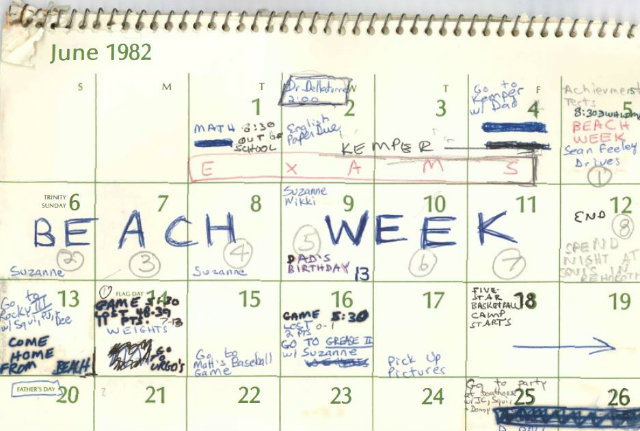 Brett Kavanaugh submitted his 1982 calendar in an effort to clear his name. (Courtesy of the Senate Judiciary Committee)
A D.C.-region rite of passage is becoming a potential point of contention in the confirmation process for the highest court in the land.
In an effort to clear his name of sexual misconduct allegations, Supreme Court nominee Brett Kavanaugh gave the Senate Judiciary Committee his personal calendar from the summer of 1982, when he was a rising senior at Georgetown Prep. Scrawled in capital letters across the week of June 6 are the words “BEACH WEEK.”
It has a lot of people asking, “What, exactly, is Beach Week?”
A 1988 Washington Post article detailing the tradition is headlined “Beach Blanket Bacchanal; High School’s Out, and It’s Beer, Beer, and More Beer.”
For decades, after the final week of school, students in the region have decamped with their friends to the shore, most commonly to spots like Ocean City, Md., Rehoboth, and Dewey and Bethany beaches, as well as the Outer Banks.
“It started in earnest around the mid-70s as far as I could tell,” says Christopher Chambers, a Georgetown professor and McDonogh School graduate. “That’s when you had the middle classes really exploding and a lot of teeangers having access to their own or family automobiles.”
He went to Beach Week in the summer of 1979. For the first three nights, he and his friends stayed in an Ocean City low-rise motel—which he says was “conducive to devilry”—before spending two days in Fenwick Island.
While it may have started as a tradition for new graduates, by the next decade, high schoolers in different grades would often also attend. One woman who graduated from an area single-sex private school and spoke on the condition of anonymity remembers that a “smattering of sophomores went, a ton of juniors went, and then a very large group of seniors.”
“Every private school was on the same schedule,” she adds, so the beach towns would fill with teens renting houses and filling up motels. “You walk down the road at Dewey or Rehoboth or Bethany and there’d be a party every other house spilling onto the front lawn,” she says. “In the afternoon, you just started meeting up with friends and finding parties. The primary activity was drinking.”
Beach Week wasn’t just for private schools, either. One man who graduated from a Montgomery County public school in the mid-2000s (he didn’t want to be named and associated with underage drinking) says that it was “definitely an area thing, rather than an elite prep school thing … The whole point was that it was your last high school hurrah before college.”
That often meant copious amounts of drinking. “I saw people get super, super drunk, blackout drunk, getting carried home on people’s shoulders,” he says. “It was, ‘How do we drink as much as possible?'”
Indeed, there’s an entire genre of articles that come out annually, right before Beach Week begins, in which police officers and parents warn about the potential dangers that could befall graduates.
For that reason, many parents insisted on having chaperones either living in the rental house or staying nearby. The female private school grad from the late-80s remembers that “the game was to find whichever parent was the most lax or the most clueless.”
But not everyone who attends Beach Week is there to get boozed up. Jason Nellis, a 2002 graduate of Walter Johnson High School, who describes his high school self as a “very nerdy theater kid,” says he and his friends skipped the alcohol. “There was no ubiquitous sense of Beach Week like it was the end of the American Pie movies,” he says. He says the riskiest thing he did was stay out in the sun without reapplying sunscreen.
He’s happy with his Beach Week experience. “I remember it really fondly,” he says.
Still, drinking is more common than not. A survey of 59 female Beach week attendees in 1996 found that only 12 percent abstained from getting drunk.
Genevieve, a 2009 graduate of a public high school in Fairfax, says that people’s behavior at Beach Week is basically a reflection of their personalities the other 51 weeks of the year. “The kids who choose to drink, the kids who choose to party, the kids who choose to make bad decisions, will do so before Beach Week, they’ll do it during Beach Week, and they’ll do it after Beach Week.” It’s just that Beach Week offers five uninterrupted days without oversight.
Julie Swetnick, a D.C. resident and a 1980 Gaithersburg High School graduate, alleged in a sworn declaration released by her lawyer on Wednesday that she witnessed Supreme Court nominee Kavanaugh “engage in abusive and physically aggressive behavior toward girls,” including in Ocean City, Md. during “Beach Week.”
Swetnick’s declaration includes witnessing efforts by Kavanaugh to “cause girls to become inebriated and disoriented so they could then be ‘gang raped’ in a side room or bedroom by a ‘train’ of numerous boys.” She says that she was the victim of one of these rapes in 1982, though she doesn’t identify Kavanaugh as one of her attackers.
Kavanaugh denies these claims.
The woman who graduated from a private school in the 80s says these allegations are “not the first time I’ve heard of ‘line ups.’ It’s not a new concept to most of us who grew up and went to those parties. At Beach Week it was always exponentially more drunken, more disgusting, more debaucherous, but it was the same behavior happening at house parties.”
She adds that Beach Week had a bunch of people from different schools in the same place, so “for guys who tended to be predatory, at Beach Week you have access to hundreds of girls mingling, strangers stumbling in drunk to parties, and no curfew.”
The graduate from Montgomery County public school in the 2000s says he’s been following the allegations against Kavanaugh closely. While he says he never witnessed sexual misconduct during his teenage years, he remembers that “even when I was in high school in Montgomery County, we kind of felt like we were superheroes—that we could just get away with anything.”