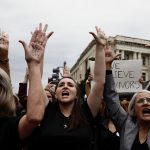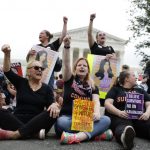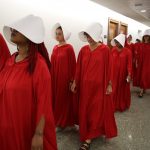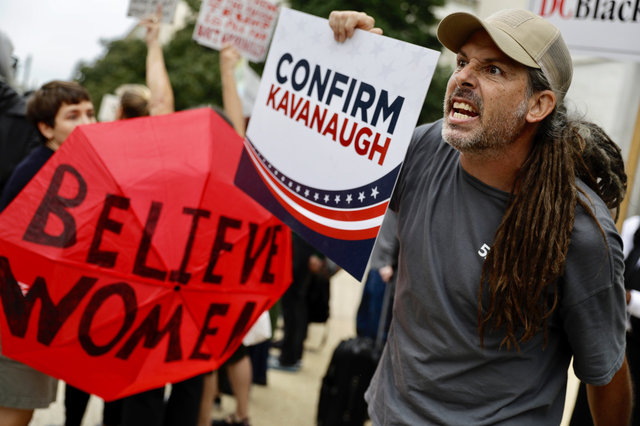
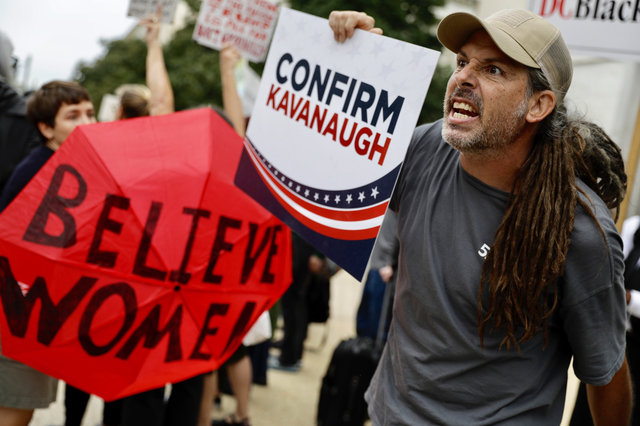
 Protesters outside the Ford-Kavanaugh hearing on Thursday. (Photo by Tyrone Turner / WAMU)
By WAMU’s Kathy Goldgeier, Martin Austermuhle, Patrick Madden, and Mikaela Lefrak
Two issues came up in Brett Kavanaugh’s Supreme Court confirmation hearing Thursday that raised questions about laws in the Washington region in the 1980s.
Kavanaugh said he was of legal age when he drank beer as a high school senior. But that doesn’t line up with a change in the legal drinking age in Maryland.
Also, Democratic senators called for an FBI investigation of his alleged sexual assault. Others are asking for a police investigation. Maryland Gov. Larry Hogan, a Republican, was the latest public official to call for an independent investigation, following a similar request from a dozen state lawmakers from Montgomery County. But it’s unclear that any legal action could be taken three decades after an alleged assault.
Here are some facts about D.C.-area laws that bear on these events.
Statute of limitations
In emotional testimony before the Senate Judiciary Committee, Christine Blasey Ford described an alleged sexual assault by Kavanaugh. She says she was 15 years old when it took place, in the summer of 1982, in Montgomery County.
At the time, attempted rape was a misdemeanor in Maryland, which meant it had a 1-year statute of limitations, according to Lisae Jordan, the executive director and counsel for the Maryland Coalition Against Sexual Assault. Maryland law changed in 1996, making attempted rape a felony with an unlimited statute of limitations. But a crime that occurred in 1982 would be prosecuted under the law as it existed in 1982.
It’s worth noting that the idea of prosecuting this case is hypothetical now because Ford has not indicated that she wants to do so. The Montgomery County Police Department issued a statement on Monday saying it “has not received a request by any alleged victim nor a victim’s attorney to initiate a police report or a criminal investigation regarding Supreme Court nominee Brett Kavanaugh.”
In addition, Kavanaugh was 17 at the time of the alleged incident, making him a juvenile. So the case would have to begin in juvenile court. Since then, the law has changed so that defendants accused of certain criminal charges, like second degree rape, can be tried as adults, Jordan said. But in 1982, the only way to move up a juvenile case was if the crime was punishable by the death penalty or life in prison.
And if the case took place in juvenile court, the proceedings would likely be confidential, meaning they wouldn’t be released to the public, according to Glenn Ivey, former State’s Attorney for Prince George’s County.
Ivey raised another challenge in pursuing this case: it appeared at the hearing that Ford was uncertain where exactly she was in Chevy Chase at the party where the attack allegedly took place. Because Chevy Chase straddles Maryland and D.C., that could be a problem. “You’d have to be certain as a prosecutor which jurisdiction she was in, otherwise the case would be thrown out,” Ivey said.
According to Jordan, Ford’s allegations, along with the #MeToo movement, are prompting other women to explore their options in dealing with long-ago sexual assault. “We’re seeing an uptick in people reaching out for help,” she said. “Some survivors want to know what their options are. Many have been re-traumatized by the [Supreme Court nomination] process, and it’s only getting worse.”
Jordan encouraged survivors to contact the Maryland Sexual Assault Legal Institute at her coalition, which can help them assess their options. And one Virginia prosecutor said the first step is always going to the police. “They consult with us as cases are being investigated,” said Kathy Stott, deputy Commonwealth’s attorney in Fairfax County. “We have to see what the facts support and see if the laws criminalized that behavior.”
Drinking age
Brett Kavanaugh was asked repeatedly about his drinking habits while in high school.
“The drinking age as I noted was 18, so the seniors were legal,” he said. “Senior year in high school, people were legal to drink.” In fact, the legal drinking age in Maryland, where he lived, went up while he was in high school, and he was outside its boundaries. The state’s drinking age rose to 21 on July 1, 1982, seven months before his 18th birthday.
In Virginia, the legal drinking age for beer in 1982 was 18. In 1985, the state voted to raise it to 21 by 1987, to comply with Congress’s Uniform Drinking Age Act. The legal drinking age for wine and liquor in 1982 was 21.
D.C. was one of the last places in the country to raise its drinking age to 21, doing so in 1986 after receiving pressure from Congress and surrounding jurisdictions, which had already raised their own drinking ages. (At the time, seven states and Puerto Rico were also holdouts in raising their drinking ages.) The D.C. bill only raised the drinking age for beer and wine (liquor was already 21), and also grandfathered in residents already 18 when the change was set to happen.
This story was originally published on WAMU.