Martin Austermuhle
 (Photo by Stock Catalog
Tuesday the D.C. Council is expected to debate and vote on a bill that would regulate and restrict the practice of home-sharing—when a person rents out a room or their full house to someone else for short periods of time—and the services that facilitate it, like Airbnb, VRBO, FlipKey and HomeAway.
The debate is a long time coming: 18 months ago, the Council first held a contentious hearing on a draft bill regulating home-sharing, but took no further action thereafter. Since then, most of the the region’s other jurisdictions—including Arlington County, Alexandria and Montgomery County—have implemented their own rules and restrictions.
It’s an issue that has drawn in a number of stakeholders, including homeowners who want to be able to easily rent out a room, basement or second home; D.C.’s hotels; and activists who argue that home-sharing eats into the city’s stock of affordable housing.
Here’s what you need to know about home-sharing in D.C.—and the proposals to regulate it:
What is home-sharing? Do any regulations currently apply to it?
Home-sharing is a pretty simple concept. You have extra space in your house (or even an extra apartment or house) that you rent out to visitors for short periods, usually less than 30 days at a time. While home-sharing has become extremely popular in recent years with the explosive growth of San Francisco-based Airbnb, it’s also not new. Vacation rentals through services like VRBO have existed for decades. Although the two services are very similar, VRBO has traditionally been known to rent out bigger spaces for vacations, while Airbnb offerings run the gamut from shared spaces to entire homes that can be used for tourism or business travel.
What both have in common is that they have fallen into something of a regulatory gray area. D.C. rules traditionally required home rentals to run for no fewer than 90 days, and while the city did have separate licenses for transient housing (like hotels, motels, bed and breakfasts, and rooming houses) those came with their own rules and restrictions. In the past, home-sharing services like Airbnb and VRBO largely put the onus of abiding by those regulations on the homeowner.
But with its significant growth in many cities across the U.S., Airbnb has recently taken steps to come into compliance with local laws. In 2015, the company started collecting and remitting the 14.5-percent hotel tax for every Airbnb stay, and later that year it published a Community Compact in which it pledged to work with local governments on rules and regulations for home-sharing. Since then, Airbnb says it has negotiated 500 regulatory agreements across the world.
What attempts have there been to regulate home-sharing in D.C. and the region?
Just about every jurisdiction in the Washington region now regulates home-sharing in some capacity.
Arlington County was the first place to adopt regulations and restrictions, in late 2016. Homeowners and renters there can get a license to rent out a bedroom, basement or full home, provided that they actually live at the property for 185 days out of the year. Lawmakers said the purpose of that time limit was to address one of the main concerns with home-sharing: investors or commercial operators buying up multiple homes to be used only for short-term rentals, instead of long-term leases.
Earlier this year, Alexandria started collecting taxes and allowing residents to home-share, while Montgomery County followed suit in July with its own rules requiring that homeowners get home-sharing licenses and imposing a 120-day cap on home-sharing if the owner isn’t present during the rentals.
D.C. is by far the biggest home-sharing market in the region—there are an estimated 9,000 home-sharing rentals in D.C., with roughly 7,000 of those listed on Airbnb—but so far hasn’t imposed any regulations on the practice. In early 2017, Council member Kenyan McDuffie (D-Ward 5) introduced a bill that would have set requirements for licenses and inspections, and also set a 15-day cap on how long a homeowner can rent out their house on home-sharing sites when they are not present. That bill prompted spirited debate at a day-long hearing in April 2017, but it did not move forward.
But last week Council Chairman Phil Mendelson unveiled a revised bill to regulate and restrict home-sharing.
What regulations is the D.C. Council considering?
Mendelson’s bill would allow anyone to rent out a bedroom or basement in their own home as often as they choose if they also live at the property. If they’re not, a 90-day annual cap on home-sharing would apply. And the bill would fully ban anyone who owns a second or third home from using it for short-term rentals. (The latter two provisions are similar to regulations in place in San Francisco; new rules adopted in New York City are even more strict.)
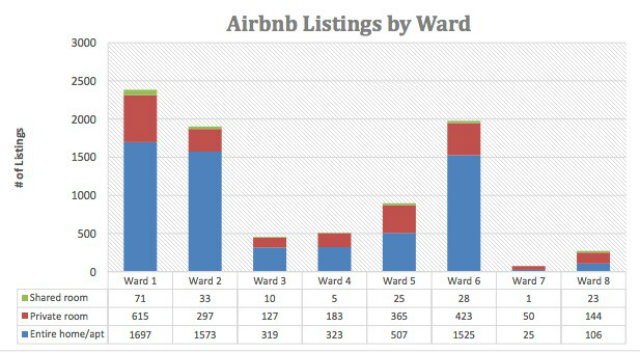 The overwhelming majority of Airbnb rentals are located in wards 1, 2 and 6, and are for entire homes or apartments. This data is from 2017. (Image courtesy of the D.C. Council)
“It absolutely allows home-sharing, because there is no limitation if it is the person’s primary residence and they are present,” Mendelson told WAMU last week. “What it does restrict is commercialization where it’s not one’s residence, it’s an investment property, and the owner of the property isn’t present.”
That’s been the main concern of some activists in D.C.—that home-sharing has encouraged homeowners, investors and commercial operators to take housing units off the market for long-term leases and instead use them exclusively for short-term rentals. (Data shows that an overwhelming majority of Airbnb rentals in D.C. are whole-home rentals.) That, they say, only further exacerbates the city’s existing affordable housing challenges. They say no better example exists than the rent-controlled building in Columbia Heights that in late 2016 was found being used almost completely for short-term rentals. And last year, Attorney General Karl Racine sued a California-based company for turning units in four apartment buildings into short-term rentals.
“These illegal commercial hotel operations are driving up our rental prices and lowering the availability of affordable housing for hardworking tax payers that work and live in D.C.,” said Graylin Presbury, president of D.C. Federation of Civic Associations, in a letter sent Monday. The federation is part of It’s Time, D.C., a local coalition of labor and community groups supporting home-sharing regulations.
Speaking on Monday, Mendelson agreed that home-sharing was having an impact on housing costs.
“We have a significant affordable housing crisis in this city, and to the extent that we’re losing units that could be rented out to tenants… that actually hurts us with regards to affordable housing,” he said.
What are Airbnb and other home-sharing services saying about D.C. attempts to regulate them?
Home-sharing services like Airbnb—the biggest player in D.C.—generally say they’re fine with some regulations, but argue that what Mendelson has proposed goes too far.
“What is currently up here is such a blunt instrument that we think it’s far too draconian,” said Chris Lehane, Airbnb’s head of global policy and communications, on Monday.
Lehane specifically took issue with the proposed 90-day cap, as well as the outright ban on the use of second homes for home-sharing. He said the rules ignored the city’s distinct housing market—where diplomats and government workers may own homes but travel extensively—and would also disproportionately impact residents in low-income communities who may use home-sharing for extra income.
“The current draft would impact the ability for people in D.C. to really democratize the benefits of travel and tourism by using home-sharing to make sure the economics are being kept here in D.C.,” he said, pointing the 300 Airbnb listings east of the Anacostia River. “It’s targeting specific neighborhoods and specific communities that have historically not benefited from travel and tourism.”
Lehane also said there’s little evidence that home-sharing impacts broader housing costs—only 10 percent of Airbnb’s listings are full homes rented out for more than 180 days a year, says the service—and also said the current bill was being pushed by the city’s hotel industry. (That has been the case nationally.) He said the Council should slow down and consider more narrowly tailored regulations.
And it’s not just Airbnb urging the Council to reconsider the bill.
“For decades, local homeowners have utilized their whole-home rentals to make ends meet and welcome traveling families to destinations across the city,” said Philip Minardi, head of public affairs for HomeAway. “This onerous policy will stifle the innovation economy that Washington, D.C. has built.”
Lehane and Minardi seem to have found some support in Mayor Muriel Bowser, who hinted in a statement from spokeswoman LaToya Foster that Mendelson’s bill is too restrictive.
“D.C. residents use Airbnb to supplement their income, and residents use it to check out our local neighborhoods. Washington, D.C. is known for our willingness and ability to innovate in order to solve tough challenges. The sharing economy is here to stay, and we want Washingtonians to have every opportunity to benefit from these industries. The mayor wants to ensure that any regulations put in place are about building a more equitable and inclusive D.C.—not about locking Washingtonians out of emerging and profitable markets,” said Foster.
One sticking point for the Council could be the overall cost of Mendelson’s bill, along with the overall impact. An analysis by D.C. Chief Financial Officer Jeffrey DeWitt put the one-year cost of the bill at $20 million, both in terms of lost revenue and the cost of enforcing the new home-sharing rules. But the analysis also said that the bill’s wording on where home-sharing would be allowed—in areas already zoned for transient housing—could lead to a dramatic decline in home-sharing across the city.
What are the next steps?
With a last-minute lobbying blitz taking part on both sides—on Monday, Airbnb emailed its users in D.C. to tweet their concerns with the bill at the Council—the measure will be taken up on Tuesday in the Council’s Committee of the Whole. That’s where changes both big and small can be made. And if it clears the committee, it will head to the legislative session that takes place right afterwards, where Council members will cast a first vote. A second and final vote would follow at least two weeks later, and then—if the bill passes—it would be sent to Bowser for her signature or veto.
This story originally appeared on WAMU.
Previously:
New D.C. Bill Would Slam The Door On Renting Out Second Homes On Airbnb
War Over Airbnb And Other Short-Term Rentals Heats Up
Airbnb Touts 80 Percent Growth In D.C. As Council Debates New Restrictions