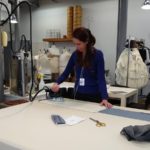
Walking around the huge warehouse-style practice space of Washington National Opera’s rehearsal studios in Takoma, singers’ voices draft from behind closed doors, a milliner puts the finishing touches on her hats, a wigmaker fusses with updos, and, in a big open room, stitchers sew away, racing against the clock to finish 138 costumes by opening day on Saturday. Behind WNO’s version of Giuseppe Verdi classic opera La traviata, there is a small army.
Costume director Marsha LeBoeuf is the lady in charge, and she has just the right combination of obsessiveness and urgency to pull it off. The core team of six costume ‘drapers’ and ‘stitchers’ is now padded to 20 as they rush to finish the costumes, all while meeting LeBoeuf’s exacting standards. The team has been working since May on the costumes and hairpieces, an important part of bringing this classic opera to life.
She describes the types of exchanges she has with the costume designer, Jess Goldstein (who won a Tony in 2005 for the play The Rivals) as she combs through Goldstein’s sketches to figure out how to bring his vision to life: “Is this a drape, is it a line of trim, how do you see this? How full is this skirt? What is this fabric? Is it satin, is it velvet? What’s underneath it?”
All of these are important questions when creating a chorus of 1907 Paris partygoers, not to mention the tragic heroine, Violetta, who must look flawless while dying of tuberculosis. Goldstein used the painter John Singer Sargent’s luxurious portraits for inspiration as he updated the costume design from its usual 1850-60s setting to the beginning of the 20th century.
WNO has put on La traviata before, in 1988, and LeBoeuf, who has been with the company for 30 years, remembers the big Antebellum hoop skirts designed for that production. Current WNO Artistic Director Francesca Zambello decided to move the action forward in time about half a century for this revival.
“It’s a little bit more accessible to modern audiences, a little prettier,” Goldstein says. “I’m trying to do a strong silhouette, not too fussy in terms of the trims.”
There are accommodations that must be made for opera singers—a modified corset for the women to allow for the diaphragm to fill and a not-too-tight shirt collar for the men—but overall Goldstein says that “designing for opera is pretty much the same thing as designing for theater. It’s all about creating a character for the actor to assume.”
LeBoeuf received Goldstein’s sketches back in March and after months of work and lots of back-and-forth on the designs, they’re nearly ready for the stage. Goldstein, who lives in New York, was in D.C. last week to check how the costumes were fitting on the actors’ bodies and work with LeBoeuf and the team on final adjustments. His palette of lavenders, roses, and pinks for the first party scene of the opera started with dozens of spools of thread hung on a wall in the costume shop. Just a few days before his visit, half-dressed mannequins wear elaborate, full skirts and detailed bodices. At wooden work tables, the stitchers furiously cut and sew the missing pieces, colorful fabrics cascading past the ticking needles of their machines.
Tucked away in another room, Samantha Wootten is working on 37 wigs and seven sets of facial hair. The wigs rest on mannequin heads; the moustaches appear to be floating on a cork board. Wooten and her team of five created everything in this room.
“The stock term is wig master,” she grins.
And master, indeed. The process of wig-making involves tying each individual hair into almost invisible lace. For a “full build”, this takes between 40-65 hours per wig. The hair used for La traviata’s wigs is human, but it’s also possible to use yak, mohair (goat), or angora (rabbit). Wootten works closely with Goldstein on the hairstyles, noting that “some of the flow of the dresses is mimicked in the hair.”
But her favorite part of wig-making is when her painstaking work gets all mussed up on stage as the performers act, sing, and sweat. After each show wigs are washed with shampoo and conditioner just like real hair and coaxed anew into shape with rollers and hairspray.
“The wigs are forever and always going to be an ever-morphing thing,” Wootten says. “You are getting to use your skill and your talent and your craft all the time. All this work was for one rehearsal. Then we tear it all down and do it over again.”
As for the costumes, they’ll be worn for 11 shows at WNO and then have a chance at a new life with one of four other opera houses (The Atlanta Opera, The Glimmerglass Festival, Seattle Opera, and Indiana University) that co-produced the show—a way that many modern opera houses share the significant costs of costume and scenery design. Built to last, many costumes that are not soon reused for another version of La traviata are carefully packaged and kept in storage for decades.
“We build a lot of infrastructure in these things to make them stage-worthy, but also to make them survive,” LeBoeuf says.
La traviata itself has now survived more than 160 years of history, and LeBoeuf believes that even today’s audiences will be able to connect with the story of a sick young woman who agrees to break up with her boyfriend to protect his sister’s reputation, only to dramatically reunite with him on her deathbed.
“The heroine, Violetta, she finds something that’s very elusive: the really honest love of somebody,” LeBoeuf says.
Plus, she’ll be dressed to kill—and to die.
La traviata runs at the Kennedy CenterOctober 6-21. Tickets $25-$300
This post has been updated with correct credit information for Jeffrey Goldstein’s sketches