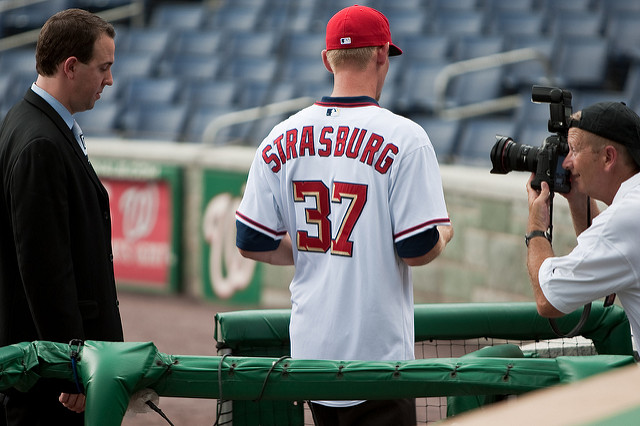
 (Photo by Cathy T)
It was the doldrums for D.C. sports when Todd Dybas, Ben Standig, and Brian McNally launched The Sports Capitol on Feb. 26.
“I looked at the editorial calendar and I was like, ‘Man, how are we gonna make it through some of these summer months?’” says Dybas, the sports news startup’s managing editor. “And then the Capitals took care of that, of course.”
That May, the hockey team heroically beat their rival in Pittsburgh, ending the 20-year-old “D.C. Sports Curse,” then went on to defeat Tampa Bay and win Washington’s first-ever Stanley Cup in June.
Washington’s other franchises kept the stories coming through the summer: D.C. United signed international soccer icon Wayne Rooney, and a month later won their debut at the team’s brand new home at Audi Field. The Nationals, even if not stellar like in 2017, remained competitive, and hosted five days of MLB All-Star Weekend fanfare in July. That same month, the Wizards, now a perennial playoff team, made a splash (and took a gamble) in signing former All-Star center Dwight Howard. Washington’s football team kicked off training camp with its first new starting quarterback in three years. And in September, the Mystics made their first-ever trip to the WNBA finals.
“All of a sudden, it’s pretty good being a Washington sports fan,” The Washington Post’s D.C. Sports Bog enthused in July.
And it’s a good time to be reporting on all of this. Two new outlets, The Sports Capitol and The Athletic, launched this year, the former a small operation spearheaded by three veteran sports journalists, the latter a venture capital-backed behemoth that’s founded sites so far in 39 U.S. cities and states, along with seven in Canada, stealing beat reporters away from major newspapers along the way. Both are banking on D.C. fans’ ample interest fueling them to shell out—$30 for six months for The Sports Capitol, $60 per year for The Athletic—for in-depth reporting and storytelling by reporters intimately familiar with the local teams, rather than just nightly write-ups of games and other churn.
Adam Hansmann, co-founder of The Athletic, says market research showed his company that “D.C. fans, or maybe people that lived in D.C. and have moved away, are a more news-savvy group than what you have in most markets… I think it’ll be a very smart fan that we’re trying to serve, and we’ll have to live up to that standard.”
Legacy outlets are also getting in on the boom, most noticeably Washington City Paper, which launched its own sports page in June. Kelyn Soong, a former Washington Post reporter hired as WCP’s sports editor, says it was pure coincidence he started the same week the Caps won the Stanley Cup. “There’s really no down weeks this summer” since then, he says. Under his stewardship this summer and early fall, WCP has stayed on top of not just the big four teams, but also niche areas like e-sports, wrestling, and even ballet.
In a subtler but still notable change, The Post recently launched a newsletter for D.C. Sports Bog founder Dan Steinberg, who’s shifted to an editing role for the paper. Steinberg says the rollout of the free newsletter, which goes out weekday mornings, is “not totally dissimilar from subscriptions in that you’re trying to create a really personal connection and loyalty. You want readers to feel a personal connection to your brand and your writers’ brand, and to feel like they’ve bought in somehow.”
 Capitals fans react as the team wins the Stanley Cup in June 2018. (Photo by Tyrone Turner/WAMU)
Along with The Post and WCP, The Sports Capitol and The Athletic join legacy outlets including The Washington Times (which less than a decade ago cut its sports page, only for new owners to bring it back less than two years later) and TV and radio stations covering the teams.
But “a vehicle that caters to the D.C. sports fan, I think its time has come,” says David Aldridge, who’s now helming The Athletic’s D.C. site after a celebrity-worthy career as a sports writer and TV reporter. “I think you can see, whether it’s us or The Sports Capitol or The Post putting out a sports newsletter now, people understand that. They see it, we all see it.”
It wasn’t long ago that D.C. sports were an overall sad affair. It was a volatile and generally disappointing time about a decade ago, with one team excelling (the Alex Ovechkin-led Caps) while others like the Nationals, the Washington football team, or the Wizards losing or—sometimes more frustratingly—hovering around the middle of the pack with no clear future strategy.
There were bright spots: the short-lived (and much-hyped) RGIII era, the Kirk Cousins-led rebound in 2015, a pair of U.S. Open Cup wins by D.C. United, Gilbert Arenas’ Wizards reaching the playoffs from 2005 through 2008. But by and large, D.C. sports fans won’t remember most of the 2000s and the earlier part of this decade fondly.
Times have changed, through. Aside from consecutive playoff appearances—the Nationals, Capitals, and the John Wall-led Wizards have each made repeat postseason trips in the last four years—each franchise boasts star players with some level of mass appeal.
“There are a lot of big names here,” says Dybas. “There’s Bryce Harper here, Alex Ovechkin here, John Wall is here. Stephen Strasburg, Max Scherzer. Anyone you put on the [Washington football team] is going to be a thing.”
George Solomon, director of the University of Maryland’s Shirley Povich Center for Sports Journalism, and formerly The Post’s assistant managing editor for sports from 1975 to 2003, has noticed a broad shift in news over the last 15 years.
“Digital and visual have really come on strong, and because of that, the newspaper circulation nationwide has declined,” he says. “With that, newspapers and now websites have tried to counter that by being more inventive, more creative, to appeal to a younger audience.”
And with fans now getting real-time game updates on their phones, they’re not as reliant on the paper, or even home pages of websites, for basic recaps and box scores. Readers expect features, opinion, and analysis—the type of sports coverage that afternoon papers like The Washington Star used to put out to differentiate themselves and serve readers, notes Aldridge.
“I think we’re all sort of PMers [a term for afternoon papers] now, in that regard,” he says. “Everybody has to kind of approach it from the standpoint of, the fan knows the score, they know who won or who lost. You have to tell them why or how that happened.”
Dybas had the same hunch prior to The Sports Capitol’s February launch. He’d seen other trends afoot, like more sites “chasing hits” by putting out briefs with clicky headlines and relying on ads for revenue that hurt the user experience. He also saw financial ties between certain broadcast outlets and teams, he says. He and his Sports Capitol colleagues also felt The Post was “going more heavily toward national coverage and kind of leaving D.C.-specific coverage behind,” he says.
Steinberg says The Post has sought to thoroughly cover national sports “while also doing the best local sports coverage that anyone can do. I would believe that regardless of how many outlets there are in the market.”
However, he notes, “I don’t think we have a monopoly on the good sports stories.”
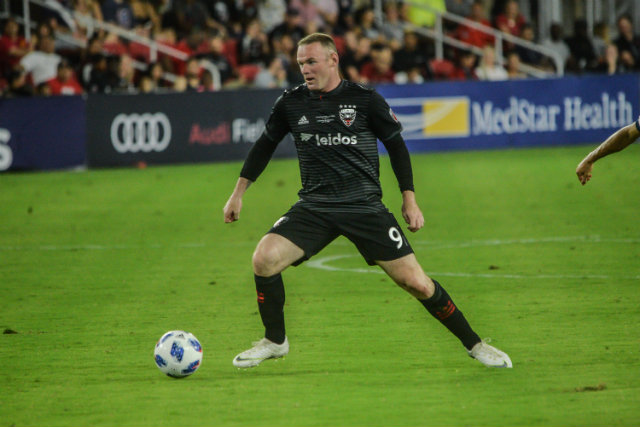 D.C. United forward Wayne Rooney at the team’s opening game of the season in 2018. (Photo by Pablo Iglesias Maurer)
The Post’s sports page has long been celebrated, and not just for putting out national names like Aldridge, Michael Wilbon, Tony Kornheiser, John Feinstein, and others. Under Solomon’s leadership, the paper championed diversity in hiring, both in race and gender. And that remains true in 2018: The paper noted in a public relations post last year that all four lead reporters covering the big four teams are women. And that short list doesn’t include others on staff like Ava Wallace and veteran sportswriters Liz Clarke, Cindy Boren, and Sally Jenkins, to name just a few.
Aldridge, who began has career at The Post in 1987, recalls working alongside reporters like Christine Brennan (now a columnist with USA Today), Rachel Nichols (now with ESPN) and Jenkins years ago. (He notes Solomon also hired himself, Wilbon and Anthony Cotton, all black journalists.) “It was never like, ‘Wow, this is a thing,’ because that was what I always saw.”
Aside from The Post, Washington has a track record of producing female sports reporters, with alumni like Lindsay Czarniak, Sage Steele and Diana Russini, who worked for local TV stations before ascending to careers with ESPN, and Carol Maloney, who stepped down as sports anchor at NBC Washington in 2017 after six years there. And it continues, with ABC 7’s Erin Hawksworth, NBC 4’s Sherree Burrus and others.
Dybas has noticed more women in the press pool over the last four years. “It’s great. It’s also not enough,” he says. “However, it’s at least an improvement that I hope compounds.”
While The Sports Capitol’s full-time staff of three is all male, Dybas notes they’ve hired a female intern (one of two for the fall) in University of Maryland senior Sammi Silber. The Athletic has hired two women to its Washington site’s staff, and also has national writers like Dana O’Neil and Lindsay Jones dipping in to cover Washington’s teams on occasion.
The Athletic D.C. has hired 13 staffers in all, including two editors, roughly a month out from its launch, and Aldridge is still busily recruiting. As Deadspin reported in August, the site tried and failed to lure away a number of Post reporters, including Steinberg. Hansmann, the company’s co-founder, declined to comment on that, but was both complimentary of The Post and optimistic about The Athletic’s hiring outlook with Aldridge at the helm.
Hansmann dismisses the notion that having an online subscription-based competitor in The Sports Capitol poses a challenge.
“Honestly, I think competition creates a healthy dynamic,” he says. “We’re in other markets where there’s certainly no shortage of free sources of information, paid sources of information, newspapers, magazines, ESPN—sort of everyone kind of doing their thing. So no.”
Each reporter who spoke with DCist has been complimentary of his colleagues in town—many of them are friends—and endorses the added competition as a positive. And each applauds that there are at least a few more sports reporting jobs popping up at a time when newspaper jobs are disappearing.
The Post still has the most resources of any outlet, and Soong, of Washington City Paper, says it remains “the juggernaut” in local sports media. But competitors could push the paper “to really be on top of their game,” he says.
Soong expects WCP’s new sports section can meet a demand for niche coverage—“to find those stories that people are interested in that you may not be thinking of, or that may not be surrounding the big four sports teams in D.C.,” he says.
Steinberg says The Post is chasing the same goal as when he began working there 12 years ago: “Have the best coverage that satisfies the most readers, that reaches readers where they are and on topics that they’re interested in, and topics that they don’t know they’re interested in. We want to do all those things, regardless of what the competition is and what the competition is doing.”
Amid all of the change and experimentation with new tools and media, it’s the fan who stands to benefit the most.
“If you’re a sports fan and you want to read as much as you can about the teams you follow, I think this is a great thing going on,” Solomon says.