Jacob Fenston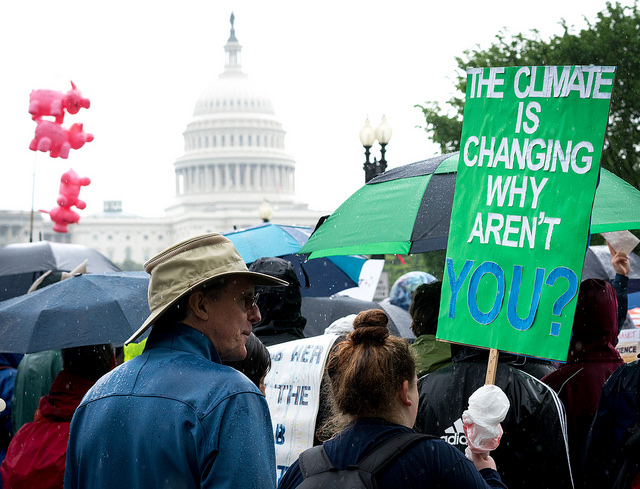
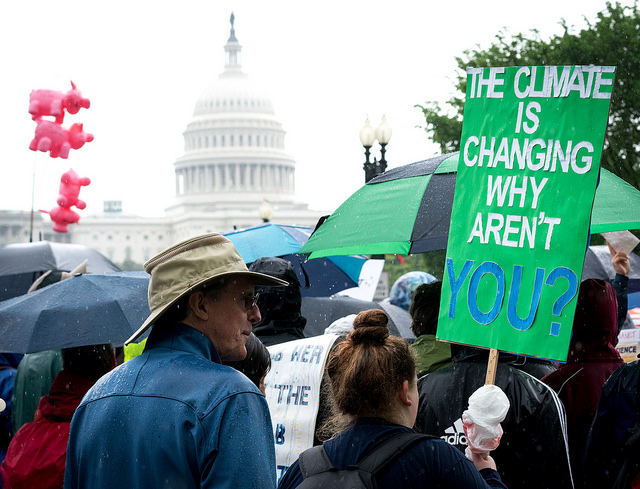 The scene at 2017’s March for Science in D.C. (Photo by Victoria Pickering)
According to a U.N. report released Monday, the future of the planet looks dire.
Tens of millions of people flooded by sea level rise, hundreds of millions suffering through severe droughts. Mass die-offs of 70 to 90 percent of coral reefs.
That could be reality in just 20 years, unless governments around the world take action urgently.
The day after the report was released, its grim findings hung heavy in the air of hearing room 500 at the Wilson Building, where the D.C. Council met to considering major climate legislation. Among other things, the legislation would create the strongest renewable energy requirement in the nation, transitioning to 100 percent clean energy in just 15 years.
“It’s standing room only in here,” someone in front of me just said. Hearing on major clean energy/ climate bill about to start. @councilofdc @marycheh pic.twitter.com/nqWntbtA0S
— Jacob Fenston (@JacobFenston) October 9, 2018
“Fighting climate change is, I believe, the greatest moral challenge of our time,” said Council member Mary Cheh (D-Ward 3), who chairs the environment committee. Cheh introduced the bill in July. At the hearing, 87 people signed up to testify. Most, if not all, supported at least part of the legislation.
Cheh admitted that there would be costs associated with ending carbon emissions, but said the cost of doing nothing would be far greater.
“It would be ruinous, it would be catastrophic,” she said.
Cheh also acknowledged that the efforts of one city wouldn’t make a dent in global emissions, but said D.C. could serve as a model for others.
The legislation does four big things:
- It would expand the District’s renewable portfolio standard, requiring that 100 percent of energy sold in the city come from renewable sources by 2032 (up from the current standard of 50 percent by 2032). It would also limit the area where that clean energy is produced to the regional grid that includes D.C., with the aim of encouraging new local solar and wind farms to meet demand. It also would require renewable power to be purchased on 10-year contracts, which supporters say would help stabilize the clean energy market.
- The bill would help fund green energy efforts by increasing the sustainable energy trust fund fee that all District customers pay. These fees would double on electric bills, an average of less than $1, according to Cheh’s office. The fees would triple on gas bills, an increase of about $2 for residential customers. This would provide $15 million to the District’s Green Bank, to finance clean energy projects. Additionally, 20 percent of the proceeds from the fee would go to assist low income residents struggling to pay energy bills.
- The legislation would toughen energy standards for new and existing buildings. This is important because three-quarters of carbon emissions in D.C. come from power use in buildings.
- It would also reduce transportation-related emissions by encouraging people to buy cleaner cars. The bill would tie vehicle excise taxes to efficiency, and exempt electric cars entirely.
At the hearing, representatives from utility companies expressed in general terms support for reducing carbon emissions, but had concerns about some specifics in the bill. Ronan Gulstone, with Washington Gas rattled off a long list of objections, including the fee increase.
“It has the potential to be a regressive tax on low and moderate income residents,” he said.
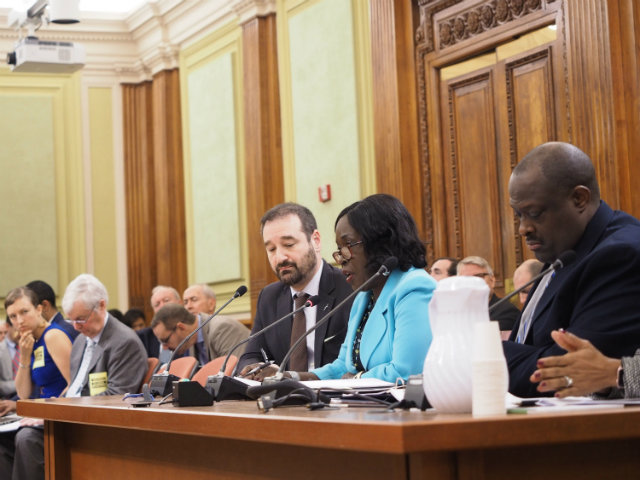 Sandra Mattavous-Frye speaks at Tuesday’s hearing. She calls the bill imperative, but understands concerns of cost for low-income Washingtonians. (Jacob Fenston / WAMU)
Sandra Mattavous-Frye, who advocates for consumers as the District’s people’s counsel, called the legislation a “watershed bill.” At the hearing, she said, “A cleaner energy future is not an option; it is an imperative—our obligation to future generations.” But she also echoed the utilities’ concerns about affordability for residents.
Mattavous-Frye cited research finding that 27,000 D.C. residents are already severely burdened by energy bills, living at or below 50 percent of the federal poverty line, and paying one-third of income toward energy bills.
“The clean energy future must be affordable,” she said.
Already, eight out of 13 council members support the clean energy legislation. However, before coming to a vote it will also need a hearing in the business and economic development committee, where it was also referred by Council Chairman Phil Mendelson. The chair of that committee, Kenyan McDuffie, has scheduled a hearing for Oct. 29. According to a McDuffie spokesperson, the council member has not yet taken a position on the bill, but is weighing input from residents.
Correction: An earlier version of this story incorrectly stated that a hearing had not yet been scheduled in the business and economic development committee.
This story originally appeared on WAMU.