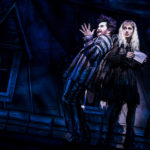
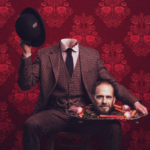
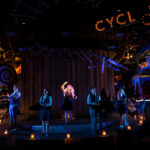
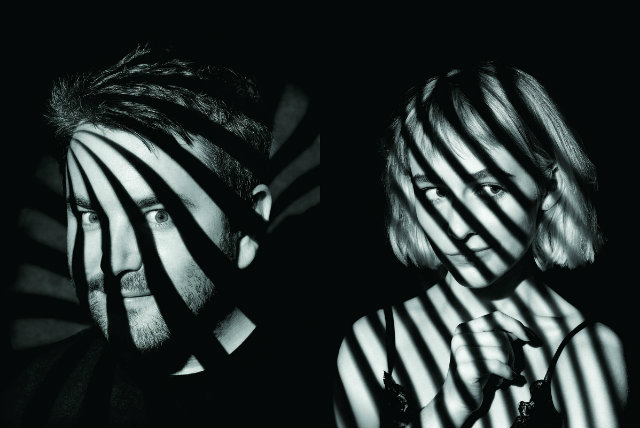
 Alex Brightman, left, and Sophia Anne Caruso take on the newly-expanded roles of Beetlejuice and Lydia in “Beetlejuice: The Musical” at The National Theatre. (Photos by Darren Cox/SpotCo
By DCist contributor Eric Althoff
Say his name three times. You know you want to.
Thirty years after the “ghost with the most” turned the afterlife into a Calypso-infused party—and established the Tim Burton film aesthetic in the process—Beetlejuice: The Musical kicks off its world-premiere run at The National Theatre this week.
Beetlejuice, the 1988 film, followed a recently deceased couple, the Maitlands (Alec Baldwin and Geena Davis) and the family who moves into their home: Delia Deitz (Catherine O’Hara), a sculptor of monstrous artistic sensibilities; her husband (Jeffrey Jones); and his daughter Lydia (Winona Ryder). Anxious to get the new family out of their home, the Maitlands seek the help of a “bio-exorcist” named Beetlejuice (Michael Keaton), but the prankster poltergeist turns out to be much more than any of them can handle.
Anthony King, who co-wrote the book for the new musical with Scott Brown, says that they were keen not to simply transmute the story to the stage word for word.
“A lot of people who love the movie [forget] that Beetlejuice is in it for about 12 minutes” despite being the titular character, King says. “Lydia is not in it that much, [so] the idea from the beginning was to make the Beetlejuice and Lydia bigger characters.”
The co-writers, who grew up together in Durham, North Carolina, also believed that the musical could be a tad naughtier than its source material.
“What is edgy about the show is contained within the Beetlejuice character,” Brown says. “He is Loki, he is anarchy, he respects nothing. He has no sense of consequence.”
From the other side of the globe, Australian Eddie Perfect got wind of the musical rebirth of Beetlejuice. He pushed his agent for months to get his previous compositions to the creatives in New York but was rebuffed due to his work sounding “very Australian” and not what they were looking for.
Undaunted, Perfect offered to write a few songs for free as a test run.
“They sent me the script, and it was super funny, dark, and really surprisingly emotional,” Perfect says of the book by King and Brown. “So I set about writing two songs…in my garage.”
After getting the job, Perfect flew to New York, landing amid a blizzard, and got to work on fleshing out the vocal colors of the characters—most importantly, for the manic Beetlejuice himself.
“He’s not going to have a beautiful baritone voice. He’s going to sound like something between Tom Waits and Kate Bush,” Perfect says, adding the spirited spirit breaks the fourth wall during the show. “Beetlejuice has got the ability to talk directly to the audience and then have snakes fly out of his face or catch fire.”
That character’s music had to be just as manic as he is. Accordingly, for the ghost’s opening song, Perfect composed a number that incorporates such disparate styles as ska, folk, death metal, big band, swing, and country.
“Just all over the the place,” he says.
Beetlejuice the film made use of Harry Belafonte’s ‘50s tunes “Jump in the Line (Shake Senora)” and “Banana Boat Song (Day O),” adding a Caribbean flavor to the movie’s antics. While composing the music for the play, Perfect says, he knew it was important to include that same Calypso musical motif.
“Every now and again, we would try to put in a musical style that was post-1999 and it never really felt right,” he says. “I think Beetlejuice’s record [collection] had sort of stopped at around ‘89.”
Meanwhile, Lydia’s musical aesthetic would be more agro, reflective of the teenager at the center of the reconfigured story.
“I thought Lydia is the kind of girl who would have a Fender guitar and a little amp,” Perfect says. “She would write rock songs about how she hates everyone, about how everyone around her is a complete phony. That’s going to be her sound.”
For the show’s director, Alex Timbers, it was those kind of characters that attracted him to the film thirty years ago.
“I was about 10 years old when [Beetlejuice] came out, and I totally fell in love with it because it has this childlike whimsy, but also these kind of dark, outre tones as well,” says Timbers. “I think a lot of people relate to it because so many of these characters are outsider figures.”
Timbers, whose Broadway directing credits include Rocky and The Pee-Wee Herman Show, was anxious to recreate the film’s DIY aesthetic on the National Theatre’s stage.
“We can’t do stop motion animation on stage; so how do we embrace puppetry, practical effects, little bits of magic, but not do it in a way that looks like it could cost [a lot and] feels handmade and charming and small-scale.”
When he signed on to the project, Timbers reached out to King and Brown—with whom he had worked previously on the show Gutenberg! The Musical!—with the caveat that Beetlejuice: The Musical put Lydia front and center.
“It felt to me that she had the biggest emotional journey she could go on. And the musical [should] center more on the Beetlejuice-Lydia relationship,” Timbers says, adding that their dynamic followed more along the lines of the Beetlejuice cartoon series, which ran from 1989 to 1991 and elided the Maitlands entirely.
In the film, Lydia’s deceased birth mother is never mentioned directly, but the musical takes pains to deal with the grief Lydia feels over losing her.
“We were talking about how everybody in this show has a different way of dealing with [grief], even Beetlejuice,” says Sophia Anne Caruso, who plays Lydia. “I hope that young girls and young people can relate to my character and leave with a new idea in their head about maybe how to approach that. Or how to move forward.”
King and Brown say the focus on Lydia changes how the netherworld is presented. In the film, the ghosts descend into a world that’s bogged down by red tape and paperwork. “Almost like a DMV,” King says.
“The spine of the movie is a midlife crisis in a lot of ways,” Brown says. “Other people come in and start reupholstering [the Maitland] home, and they can’t do anything about it. What are the questions that Lydia would have about that?” he says. “Because Lydia doesn’t care about how a house is decorated.”
And then there is the titular apparition himself, with his striped shirts, arsenal of puns, and vocal tricks that keep everyone else on their toes. For the musical, Beetlejuice functions both as narrator and a warped version of the Emcee from Cabaret, both driving and commenting on the anarchy around him.
Timbers cast Alex Brightman, who previously starred in the Broadway run of School of Rock as the slacker-turned-substitute teacher superstar. While Brightman is a huge fan of the film, he says his task with the musical is not to imitate Keaton’s performance in the movie, which he believes would be a “disservice” both to Keaton and to the musical’s creators.
Like Timbers, he turned to the cartoon Beetlejuice for inspiration.
“How do we make a cartoon sort of smash cut [where] he’s here and then he’s there?” Brightman says. “How do we do that on a stage? That’s been really fun.”
If the team’s vision of a new Beetlejuice goes well at the National Theatre, the musical may eventually move to Broadway.
But rather than trying to muscle onto the Great White Way at the outset, Timbers, the director, felt it was important to get it in front of audiences in time for Halloween, and he could think of no better city than D.C.
“When we started to try to figure out where to premiere the show, immediately the producers and I kind of got excited about D.C.,” he says. “Then I saw [the National Theatre pre-Broadway premiere of] Mean Girls, and I had such a great experience.
And despite the macabre elements present in Beetlejuice: The Musical, cast and crew alike believe D.C. audiences will leave the National Theatre will leave with a silly grin on their faces.
“There’s a positivity to this show that is unexpected,” Brightman says “There’s a hopeful message, which sounds insane considering it’s about a demon from hell and a girl grieving over the death of her mother. But within all of that, there is this genuinely really positive message about hopefulness and how to climb out of your grief one way or another.”
Beetlejuice: The Musical runs at The National Theatre through Nov. 18, various times, $54-$114