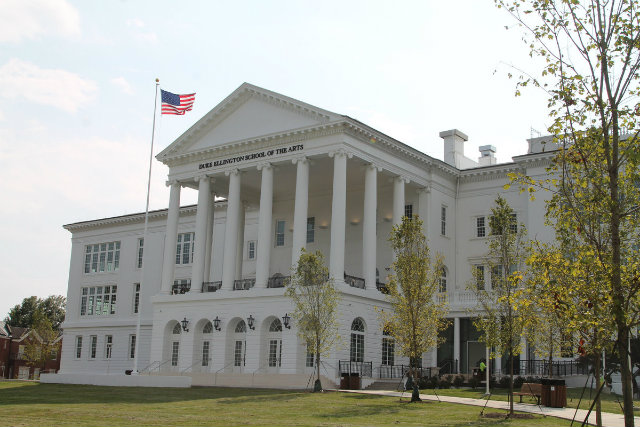
 The Duke Ellington School of the Arts reopened in 2017 after a major renovation. (Photo by Christina Sturdivant)
After missing more than two months of coursework, senior Sherwayne Carter is back in the classroom at Duke Ellington School of the Arts. But his mother could still face a $12,000 fine in the residency fraud case that has turned their lives upside down.
Carter is one of 164 students who were flagged for residency fraud at Duke Ellington in May by the Office of the State Superintendent (OSSE). Another 56 students were asked for more documentation. Last spring, officials decided to crack down on students who don’t live in the District but attend D.C. schools without paying tuition. Some D.C. residents also were caught up in the sweep, causing what some parents describe as chaos at the school.
Some students received notices that residency fraud cases had been filed against them, appealed the charge and were able to start school in August. Carter’s family missed the first two letters from the District, and were not aware there was a problem until classes started, when he was barred from attending the school. The family’s pro-bono lawyer, Gary Smith, says that the letters were mailed to the wrong address.
Since Carter’s family did not appeal his case, OSSE concluded there was evidence that Carter was actually a Maryland resident. Smith says this claim is “patently false,” noting that Carter’s mother has both utility bills and a driver’s license to prove she is a D.C. resident. To attend school, Carter has had to move in with his grandmother, whose D.C. residency is not in question. She now has custody of him. Smith is currently seeking to reopen Carter’s case in court, challenging the assertions that his mother is a Maryland resident.
“We are hoping the case gets reopened, and she doesn’t get hit with a $12,000 judgment,” Smith says. “She is not well-off. They are trying to do the best they can.”
It’s unclear how many other students may be in the same predicament as Carter. OSSE won’t say how many high schoolers have confirmed they live in the District, and the office refuses to confirm whether or not the issue can be called a “widespread” problem. The office can confirm that officials are continuously dealing with cases and clearing families to attend school.
A group of parents called “I Am Ellington” conducted an informal survey, emailing and calling other families to see if they are cleared. Kit Arrington, one of the parents helping to collect information, says that to date, she has received 97 responses from families saying they are cleared.
“We have had families that have been pulled out of school that didn’t know they were being investigated,” Arrington says. “None of this is about, ‘this being an crazy investigation.’ It is about, ‘why are you handling it this way with this group of student in this school.’ It is aggressive and it is punitive.”
Officials from the school district say their goal is to be fair, noting that they sample all schools for residency fraud cases, and only investigate further when they see anomalies.
“OSSE has been working with families to provide them as many due-process pathways as possible related to residency verification, including offering multiple ways of connecting with us, robust outreach, and technical assistance. While we cannot comment on any specific student’s case, we are confident that we are providing families as much support and information as possible,” officials noted in a statement.
Officials say the public should expect a full enrollment report later this fall.
This story originally appeared on WAMU.