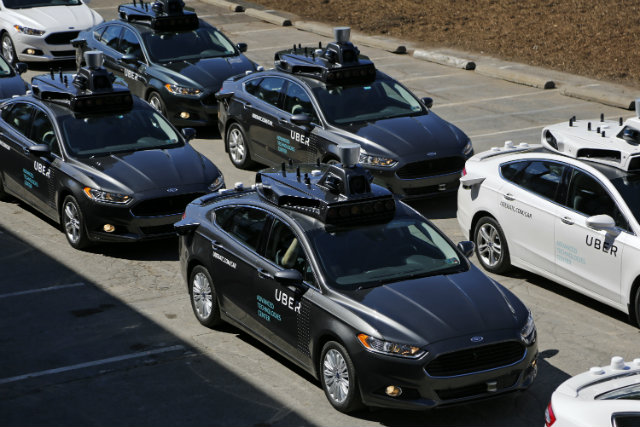
 Uber has tested self-driving vehicles in Pittsburgh, pictured here. Now, Ford is launching a similar fleet in D.C. (AP Photo / Gene J. Puskar)
By Meg Anderson, WAMU
A new fleet of self-driving cars is coming to Washington, D.C. early next year.
Ford Motor Company will begin testing autonomous vehicles here starting in early 2019, with plans to launch the cars commercially in 2021, according to Mayor Muriel Bowser’s office. The program will be formally announced at a 2 p.m. press conference.
“What we want to try and do is take advantage of the benefits of self-driving cars. The idea that mobility could be improved, that safety could actually be improved,” says Andrew Trueblood, Chief of Staff for the Office of the Deputy Mayor for Planning & Economic Development. “And the other piece of it is equity. Is this an opportunity to improve access to mobility but also access to goods and services in the city?”
To start, Ford will launch five to 10 self-driving vehicles, which will be housed in a warehouse in Ward 5. Last week, Argo AI, a mapping company partnering with Ford, tested an autonomous Ford Fusion in that ward, driving near Union Market, Gallaudet University and the complicated intersection at the eastern end of H Street Northeast known as the Starburst intersection, according to The Washington Post.
In February, Bowser created a working group to tackle issues associated with self-driving vehicles, including public safety, environmental issues and accessibility for people with disabilities. The ayor’s office has also explored using autonomous vehicles along 10th Street Southwest near The Wharf, and along the 14th Street Corridor. Although the cars will be based in Ward 5, Ford and Argo AI have committed to testing them in all wards, according to the mayor’s office.
D.C. will be the second city for Ford’s self-driving vehicles program, according to the mayor’s office. Last February, the car company announced a similar endeavor in Miami, where they have partnered with Domino’s Pizza and the food delivery service Postmates. The self-driving cars delivering food in Miami hit the road last spring as part of the pilot program. For now, the Florida cars still have a real person driving them who is hidden from view. The company is testing how people will react to a self-driving car when they come outside to get their food and what’s the best way to deliver the goods to them without using a person. Ford plans to have those vehicles actually be autonomous by 2021 as well.
The question of how to operate autonomous vehicles safely — and how those cars should interact with the real humans on the road — is something that technology and motor companies have been tackling in the D.C. area for years, sometimes in creative ways. Last year, a driver for Ford in Northern Virginia was spotted dressed as a car seat to test how robo-cars should interact with other drivers, in lieu of the usual head nods, hand waves and other normal human interactions that come up so frequently at intersections and elsewhere.
Safety is a primary concern in launching self-driving vehicles, especially after a pedestrian was struck and killed last March in Tempe, Arizona, by an autonomous vehicle operated by Uber.
Mayor Bowser said safety is a concern with any new mode of transportation.
“I’m sure everybody was concerned when the automobile was introduced, when we had street cars, when we test any new transportation,” Bowser said at a press conference. “What people don’t typically say is, ‘I wish there was a time when there was no automobile… or that there wasn’t worldwide air travel, where we can easily connect to each other.’”
Raifman says they plan to use lessons learned in the first few months on the ground in Miami to inform decisions made in D.C.
“You definitely identify some challenges around pick-up, drop-off zones, double parking, things like that, frankly a lot of the same issues that you or I would encounter when we’re driving down the street,” Raifman says. In D.C., Raifman said the city’s many traffic circles might pose a unique challenge.
In addition to safety concerns, the effect that driverless vehicles will have on the thousands of drivers of taxis, Ubers, and Lyfts working in the D.C. area — and on the city’s public transportation system — is still unknown.
“We are very sensitive to the changing nature of work generally by automation,” Trueblood says. “Local government cannot stop that. It is a much bigger and broader force that will be coming and so our role is to do what we can to be proactive and think about it.”
To attempt to mitigate some of the effects of automation, the new initiative will also involve a partnership with the DC Infrastructure Academy to train residents for jobs as technicians and operators of self-driving cars.
This story originally appeared on WAMU.
Previously:
How D.C. Taxis Are Preparing For A Driverless Future
Here’s Why That Dude In Clarendon Drove Around Dressed Up Like A Car Seat