Natalie Delgadillo
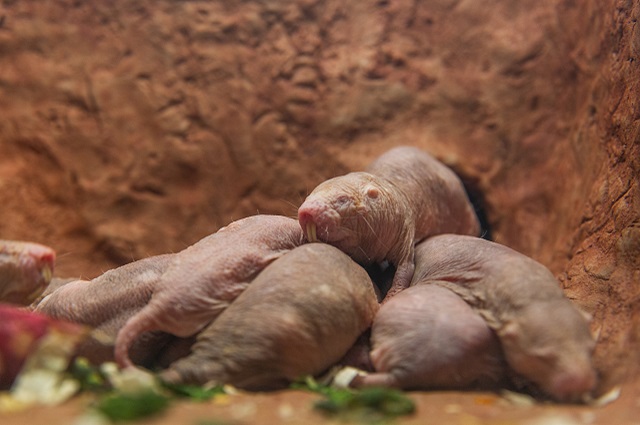 (Photo courtesy of the Smithsonian)
All hail the Queen! Whenever she arrives, anyway.
In case you missed it, the Smithsonian National Zoo is home to a naked mole-rat colony, and every day a drama continues to unfold: the colony is in the process of choosing its queen.
“There’s one frontrunner, a female who is larger than all of the other mole-rats right now,” says Devin Murphy, a spokesperson for the National Zoo and my go-to gal for naked mole-rat gossip. “We won’t know for sure until [one of the mole-rats] has babies. That’s the only way to tell,” she says.
Naked mole-rats are one of only two eusocial mammalian species. That means that they behave much like bees and other insects—only one female mole-rat reproduces, and all the other mole-rats hover around her, taking care of her babies, protecting her from danger, and eating her poop. She reigns supreme.
So far, the Smithsonian mole-rats appear to be more or less taking orders from the biggest female without a lot of objection, Murphy says. But it’s impossible to know what’s in their little hearts—there could be a mutiny any day now.
“Right now we’re just waiting to see if there will be a challenger,” Murphy says, stressing that any of the female mole-rats could stage a coup at any time before the presumed queen gets pregnant and gives birth.
If you’re interested in watching the power struggle unfold for yourself, take a gander at the zoo’s naked mole-rat cam, which launched at the end of August.
The stationary camera is placed in one of the mole-rat chambers. Because they are an advanced hierarchical civilization, the mole-rats designate each chamber for a very specific use—one for pooping, one for eating, one that serves as a nesting chamber. The chamber with the camera is the one the mole-rats designated for food, Murphy says, which makes it unlikely that we’ll see anyone getting frisky and giving away the queen’s identity early. But maybe a fight will break out and we’ll all witness an attempted takeover.
Still, the queen can’t rest easy once she’s given birth to a litter and taken her rightful place as head of the colony. She’s got to physically intimidate and overpower her subjects to show everybody who’s boss. At any time, a challenger could attack and kill her, becoming queen of the colony herself.
But when things are stable in the kingdom, the queen’s word goes. Her colony rolls around in her poop so they all have her smell on them, Murphy says (this is useful for telling colonies apart in the wild—despite their other talents, naked mole-rats can’t see anything). They also eat her poop, and when she’s pregnant or just given birth, the hormones in it propel worker mole rats to take care of her young. (To be clear, naked mole-rats also eat their own poop and each other’s poop, not just the queen’s, to ensure no nutrients go to waste. But the queen’s droppings in particular pass along hormones that influence the other mole-rats to rear her young.)
By some disputed mechanism, the queen also sexually represses the other females in the colony and the males she does not choose to mate with, preventing them from reaching sexual maturity and making them infertile.
Talk about a dictator.
When the queen finally does have babies, she could have anywhere from 12 to 28 in a single litter. The more of them she has, the longer her body will get, allowing her to fit more in there next time. Colonies in the wild can grow so huge that there are splinter factions—a rogue female in a far-off land will simply stop taking orders from the queen, Murphy says, and helm her own smaller colony.
The Smithsonian queen probably won’t have to worry about such treachery, at least not yet. Check back for updates on her coronation.