“If you want to understand a place,” Colin Dickey writes in Ghostland: An American History in Haunted Places, “Ignore the boastful monuments and landmarks, and go straight to the haunted houses.”
Washington D.C. sure has its share.
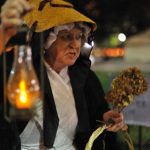
Just ask Natalie Zanin. She’s been leading Historic Strolls’ “Ghost Tour of Washington” for nearly two decades. Zanin isn’t interested in the manufactured scares and special effects that abound on Halloween. She’s interested in stories.
“It’s got to be based in history,” Zanin says. “A lot of awful stuff happened in Washington.”
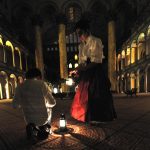
Her tour focuses on Lafayette Square—“once a graveyard,” she notes darkly—and the buildings that surround it, from St. John’s Church to the White House.
On a Thursday night tour, a small group lingers outside Decatur House. The residence-turned-museum is said to be haunted by Stephen Decatur, who died in a duel in the 1820s.
But Zanin has heard stories of another ghost: Charlotte Dupuy.
Dupuy was an enslaved woman at Decatur House who, in 1829, sued her master, none other than Secretary of State Henry Clay, for her and her children’s freedom. She lost the case, and she and her family remained enslaved for another decade before finally gaining freedom.
Dupuy can sometimes be heard crying in the house, Zanin tells the group.
For a long time, even in ghost stories, America’s history of slavery and Native American genocide went overlooked, overshadowed by an abundance of white, colonial ghosts.
That’s evolving, Dickey writes in Ghostland.
“Ghost stories as a rule are about the resolution of certain injustices,” Dickey tells DCist. “It’s a way for us to deal with an unresolved past.”
Another ghost tour—this one in historic Georgetown—begins at Oak Hill Cemetery, where Abraham Lincoln’s son Willie, who died of typhoid at age 11, was first interred. George Saunders told the story of Willie Lincoln and the other ghosts who inhabit Oak Hill in his 2017 novel Lincoln in the Bardo.
“Residents who live in front of the cemetery along R Street report seeing a tall slender man wearing a long black waistcoat and a top hat muttering to himself, wandering around the gardens of Oak Hill Cemetery,” says Andrew Rawls, who runs Fiat Luxe (Latin for “Let There Be Light”) tours. “They believe that is the spirit of Abraham Lincoln.”
Rawls says the ghost tour of Georgetown, which traces a haunted history from Prospect Street to the Exorcist Steps, is Fiat Luxe’s most popular tour.
“The history in Georgetown is so deep and mired in romance and espionage, and this fascinating world that I was not exposed to being from California,” Rawls says.
On the way to Prospect Street, Rawls stops in front of the “murder house,” where 91 year-old socialite Viola Drath was killed by her 47-year-old husband.
“Most of the time when we talk about scandals and scary stories of Georgetown, we’re talking about the 19th century,” Rawls says. “This happened in 2011.”
The next stop is a mysterious mansion on Prospect Street called Halcyon House where according to Rawls, several spirits take up residence.
“Ghost hunters have actually done a bit of research here and found that it is a hotbed of spectral activity,” says Rawls.
The majority of the spirits that live on in Halcyon House are those of escaped slaves, according to Rawls. People who were born into slavery in Virginia would attempt to swim the river to D.C. “They were trying to swim across the river to get to a tunnel, and that tunnel would allegedly lead to Halcyon House as the first stop on the Underground Railroad,” Rawls says.
Sometimes, Dickey says, ghost stories can be a means to confronting a dark history. “A way for us to root through trauma without having to address the roots of those traumas,” he says.
Dickey has traveled the country visiting haunted houses and investigating local lore, but he equivocates when asked if he believes in ghosts himself.
“I’m much more interested in the stories themselves than I am in any metaphysical or ontological belief. Belief in ghosts is kind of like belief in God,” Dickey says. “You can’t convince someone who believes in ghosts that they don’t exist. And you can’t convince someone who doesn’t believe in ghosts that they do.”