Rachel Kurzius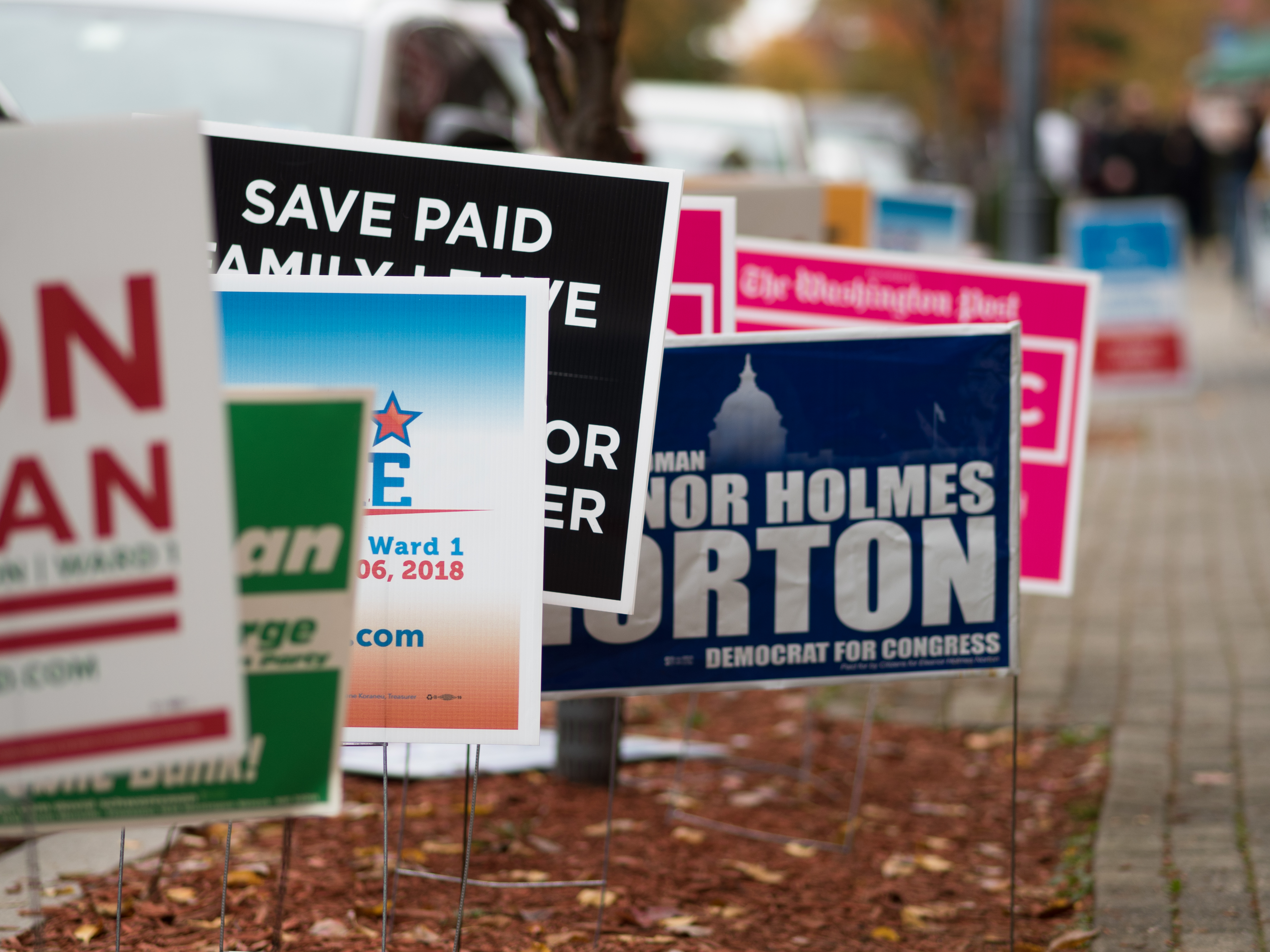
Once elections have ended, Yadira Molina finds the remaining campaign signs around the city irritating.
“Immediately after Election Day, all of those things become litter,” Molina, a Petworth resident, says. “So it’s like seeing litter everywhere.”
And some of the candidates agree. After celebrating his victory in the ANC 2B04 race on Election Day, Aaron Landry says he “took an early lunch and I canvassed the neighborhood and took them all down. The election’s over, and I wanted to enjoy the autumn leaves, or the few that we have left.”
But even though Landry didn’t let a day pass before ridding his neighborhood of the blue and white signs, politicians in D.C. have a longer grace period when it comes to removing their signs from the public space.
Like other posters and placards, campaign signs need to be removed within 30 days of the event to which they’re related, under D.C. law. In this case, that’d be Election Day, leaving us with a deadline of December 6.
The administration of campaign sign-related law falls under multiple D.C. agencies: the Office of Campaign Finance is in charge of making sure signs include information about who paid for them; the Board of Elections is responsible for keeping signs at least 50 feet away from the entrance to a polling place; the Department of Transportation oversees the rules and regulations for posting beyond those 50 feet; and it falls to the Department of Public Works to enforce these rules.
“Thirty days?” says Carter Wood, a resident of D.C.’s Chevy Chase. He used to live in North Dakota which, until 2012, banned campaigning on Election Day. That meant people had to take down all the signs before then. “Thirty days, boy, that just seems like a long time to me. If you have enough volunteers to put the signs up, you should have enough volunteers to take them down.”
After D.C.’s deadline lapses, candidates are susceptible to increasing fines: $150 for the first violation, $300 for the second, $600 for the third, and $2,000 for the fourth, per DDOT.
Some candidates organize events to take down all their signs. At-large Councilmember Elissa Silverman, for instance, is hosting a “sign takedown party” on November 18, and is asking supporters to “please take down any signs you see in your area on public property.”
“We understand that there’s lots of signs all over the place and, as they sit there, they become more of a blight,” says Charles Smith, the field director for the Silverman campaign. He notes that Silverman hosted a similar takedown party after the 2014 elections. “It’s a way to encourage our volunteers to make sure the signs are taken down.”
Smith says that many of the materials from the signs can be recycled. “Apparently an education group has reached out and wants the metal stakes and cardboard-type signs for art projects and such,” he says. “We’ll make sure they’re not tossed into a dumpster somewhere.”
Molina is a fan of the “sign takedown party” idea. But she doesn’t need a group to do it. She says, “If I knew that I could, I would probably take down all of the signs on the way back from the bus stop.”
As long as they’re in public space, now Molina can.