 Mikaela Lefrak
A hundred years after Armistice Day, there is still no national memorial to World War I in the U.S. capital.
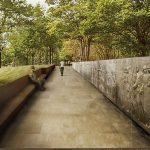
A memorial planned for Pershing Park on 14th Street and Pennsylvania Avenue Northwest near the White House is scheduled to open on Veterans Day in 2021. It will include sculptures of soldiers and a cascading fountain.
But construction hasn’t started yet, even though organizers and city officials held a ceremonial groundbreaking last year. The U.S. World War I Centennial Commission, the group tasked by Congress to develop the memorial, is only about halfway to its $40 million fundraising goal.
The story began 10 years ago, when a private group called the World War I Memorial Foundation began a push to reimagine an existing memorial to World War I veterans from D.C. as a national memorial. D.C. Delegate Eleanor Holmes Norton and then-Mayor Vincent Gray pushed back: The District of Columbia War Memorial in West Potomac Park is the only locally-focused memorial on the National Mall, and they didn’t want its intended message to be overshadowed.
“It would be wrong to commandeer the District of Columbia’s memorial, paid for with the blood and treasure of D.C. residents,” Norton said in a press release at the time.
The next plans was to build a new memorial on the National Mall, but too many bureaucratic roadblocks stood in the way. In particular, a provision in a federal law requires Congress to grant an exemption for new structures on the already-crowded Mall.
Then, Congress shifted its focus to a new location: Pershing Park. Despite opposition from the World War I Memorial Foundation, whose leadership still wanted to see a memorial on the National Mall, Congress green-lighted a National World War I Memorial in 2014 and set up the World War I Centennial Commission to lead the project. At that time, the bill’s co-sponsors still thought the memorial would be completed in time for the war’s centennial in 2018.
Picking a design was no easier. The Commission held a design competition and selected “The Weight of Sacrifice,” a proposal by 25-year-old architect Joseph Wieshaar. His initial concept went through many rounds of edits as it made its way through the process of receiving approvals from the Commission of Fine Arts, the National Capital Planning Commission, and the National Park Service.
The CFA granted its official approval in July of this year, and the NCPC is still “reviewing the details,” according to Chris Isleib, the Centennial Commission’s director of public affairs. “Our plan is still to start construction next year,” he said.
Isleib noted that more than 150 individuals donated to the memorial fund on Nov. 11, the 100th anniversary of Armistice Day.
“I’m proud, because it’s no longer the forgotten war that it was in 2014,” he said.
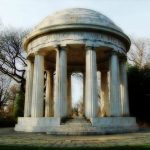
There are other World War I monuments to visit, both in the nation’s capital and outside it. The District of Columbia War Memorial commemorates the 26,000 soldiers from D.C. who served in the war; four hundred and ninety-nine of them lost their lives. The Doric-style temple was completed in 1931.
The 217-foot tall Liberty Memorial Tower and museum in Kansas City, Missouri received National Historic Landmark designation in 2006. In 2014, an act of Congress made it a national memorial to World War I.