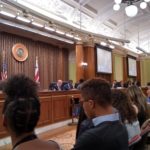
Update, 5:50 p.m.: On Tuesday evening, the D.C. Council narrowly voted to table the Youth Vote Amendment Act of 2018, delaying the vote before the full group.
This follows an attempt earlier on Tuesday by Ward 2 Councilmember Jack Evans to table the measure, which failed by one vote. Evans tried again later, citing “significant unreadiness” on the council. Ward 8’s Trayon White switched his vote during that attempt, which was enough to prevent the bill from moving to a vote.
“To the young people here, we’ll keep working on it,” Ward 6 Councilmember Charles Allen said.
Original:
Since March of this year, 16-year-old Tiffany Missembe has been devoting time each week to what she calls her part-time job: getting D.C. to lower its voting age to 16.
“My parents are immigrants and they can’t vote,” says Missembe, a Ward 4 and Woodrow Wilson High School student. “I think if 16 and 17-year-olds are able to vote, I could vote for not just me, but for my parents, other people in my community, and my aunts and uncles.”
Missembe is part of Vote16DC, a local coalition of youth, adult allies, and organizations that believe D.C. should lower the voting age to 16. It’s a branch of Vote16 USA and Generation Citizen. She and other youth organizers will see the fruits of their labor as the full D.C. Council will vote its first of two votes of the Youth Vote Amendment Act of 2018 on Tuesday, Nov. 13.
The legislation was introduced this term by Ward 6 Councilmember Charles Allen in April of this year along with six other co-introducers, including four of the five members of the Committee on the Judiciary and Public Safety. On Thursday, Nov. 1, the bill passed through the same committee with a 3-0 vote. If the legislation passes and Mayor Muriel Bowser signs it into law, the voting age for D.C. residents would lower from 18 years-old to allow 16 and 17 year-olds to vote in all elections, from local to presidential races.
“At the age of 16, your legal relationship with the government changes,” Allen said in a news release. “Young people work and pay income taxes. Some are raising a family or helping their family make ends meet. They can drive a car. Ironically, they pay fees to get a license plate that reads ‘End Taxation Without Representation.’” He told WTOP that, with a majority of the council co-introducing the bill, he feels confident it will pass.
Critics like the Washington Blade’s Mark Lee have still called the measure “eye-rolling,” writing sarcastically, “Sure, go ahead, extend voting rights to those with hardly a wick or any whittle of worldly experience in the real world.”
But Missembe says that the Youth Vote Amendment Act of 2018 reflects the reality that she and other teens should be able to participate in the democratic process. “We have jobs and we work,” Missembe says. “We pay taxes and we’re not being represented in our government. D.C. strives on ‘no taxation without representation,’ yet 16 and 17 year-olds are working and they’re being taxed but not being represented in our government.”
Some of the organizers working alongside with Missembe are 17-year-olds QueSton Bell and Greta Jelen. According to Bell and Jelen, they’re also fighting for the right for themselves, the families, and communities to vote.
“My grandparents don’t really [vote] so I feel like if I were going out voting, I could easily pull them along with me and urge them to exercise their right,” Jelen says. “It would increase voter turnout overall and, for areas of the city that have low voter turnout, like Wards 7 and 8, which are underrepresented, if we add to the voter population in those areas, they’ll receive greater representation.”
For Bell, a Ward 5 and Cesar Chavez Public Charter Schools for Public Policy student, his greatest inspiration for working in Vote16DC is his grandmother.
“She’s an older lady and grew up during the time of the civil rights era,” Bell says. “Knowing everything that people of color had to go through to get the right to vote so I know it’s really meaningful to her seeing the expansion of suffrage to more people.”
Jelen says that models of teen advocacy in the media, like the student activists from Stoneman Douglas High School and the March for Our Lives movement, have also shown the importance of youths using their voice.
“Right now we can only use our voice to influence other people votes,” Jelen said. “We can’t have our own and it seems unfair that you would delegitimize a group that is already involved and has an important perspective.”
The three are all hopeful that the legislation will pass through its first vote and plan making it to the hearing, even if they miss their last period of class for the day.
“I think it’s going to pass,” Bell said. “My hope is that everyone comes out and that they stick to support the bill. I hope it inspires the youth to see how much work and dedication that’s been put into this campaign and that the voting age can be lower.”
Since all three students are currently enrolled in schools across the District, managing schoolwork, attendance and other responsibilities can be a challenge, they say. But they all agreed, becoming organizers for the movement has become a passion project besides a paid part-time job.
Jelen says that her organizing has required her to miss some school and other club meetings, but she wouldn’t want it any other way.
“It’s definitely a passion project, but it does affect my school work,” Jelen says. “It always ends up being okay, like I always end up getting my work done. I don’t think I would be willing to miss that time for just anything.”
Missembe added that joining the organization in March has not negatively impacted her school work or attendance. Bell says he participated more with the organization during this summer, but is still trying to get the word out to the youth in his community.
Dave Chandrasekaran, the Vote16DC campaign manager, says that making sure the teens can participate in the political process as the bill moves through the D.C. Council is key.
“It’s very important to us from the beginning of this coalition to have young people in the driver’s seat of all decision making and all activity to moving this measure,” Chandrasekaran says. “Being present in city council has been an important value for us and so in nearly every measures that the Council has taken, in every meeting with community stakeholders, in every meeting with council members individually we’ve had young people there.”
Chandrasekaran added that he hopes the movement helps youth get involved in local politics. “D.C. has a large base of people who obviously are very tied into politics, watch politics, and work in politics, but a lot of that is focused on the federal level,” he says. “We forget how important the local level is, and the fact that every decision D.C. leaders make affect all D.C. residents, but really impacts youth. The youth leaders involved in Vote16 DC have made the case really strongly about how much they care about what’s happening in their city.”
He says the District is the perfect place to see this movement flourish since it has a progressive council along with a politically active community.
The median age for D.C., 34, is three years younger than the national median age, 37.7, according to the U.S. Census. Additionally, the District has a higher voting and registration age percentage than the U.S., with 18-24 year-olds having a 20 percent higher voting rate than the national average.
Three Maryland jurisdictions, Takoma Park, Greenbelt, and Hyattsville, all have passed legislation that dropped the voting age to 16 for local elections. But, if D.C. were to follow in those footsteps, it would be the first jurisdiction in the country to lower the voting age for presidential races as well.