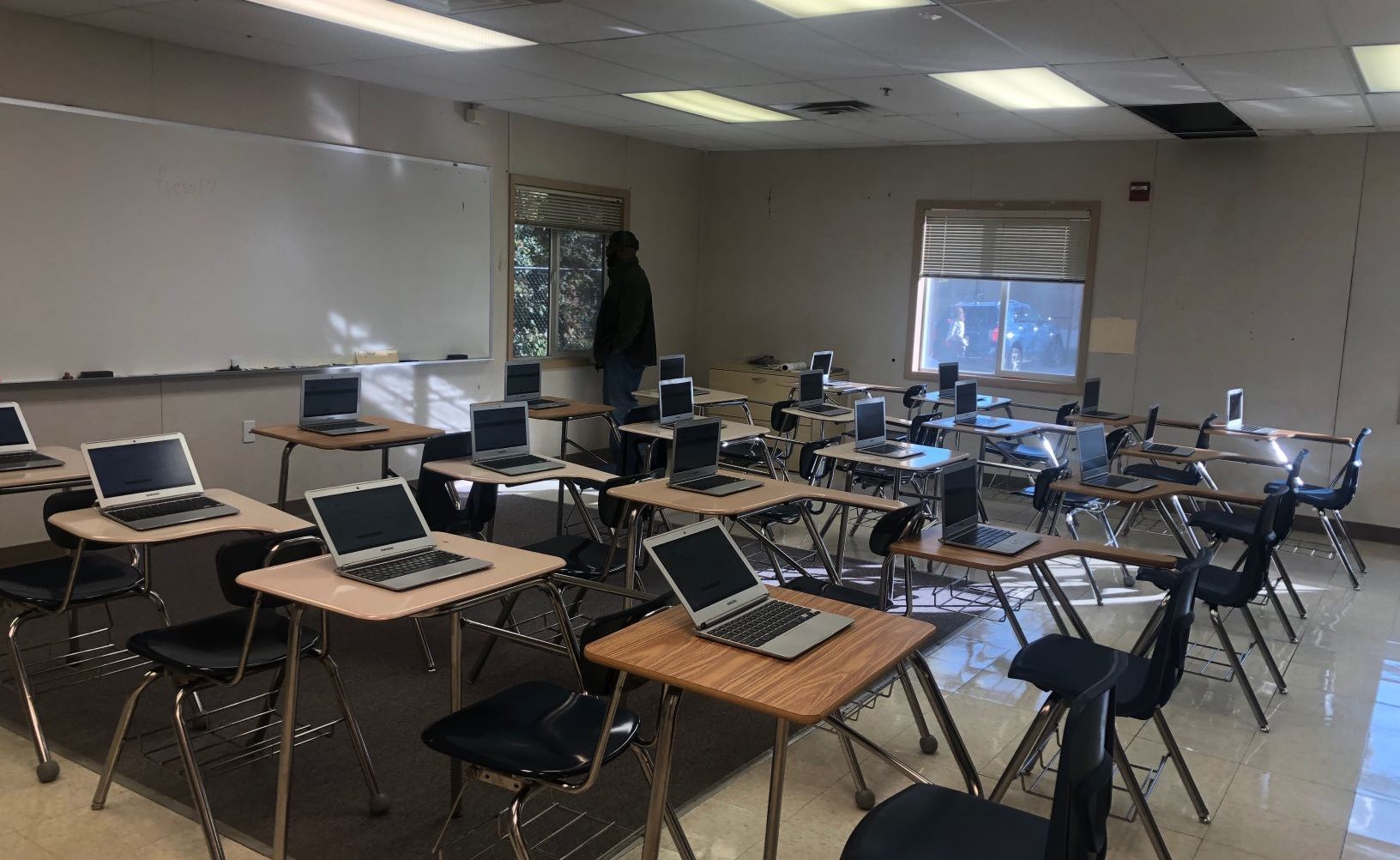
In a school district that has struggled with attendance, the top public school bucking the trend doesn’t actually require kids to come to class.
Friendship Public Charter School Online is the only K-8 tuition-free virtual school in Washington, D.C., and it reported the highest attendance rates in the city for the 2017-2018 school year — 99.8 percent. They also reported no truant students.
But these rates may not be what they seem. In D.C., there are no attendance policies that specifically address virtual school programs, which gives these school officials the flexibility to report and interpret numbers as they see fit.
What’s A Virtual School?
The physical red and white Friendship Public Charter School Online building in Northwest D.C. is practically empty most days of the week. Just a custodial worker and a few maintenance men are there on a regular basis. Three months into the fall semester, the last time a person signed the visitor log was in May.
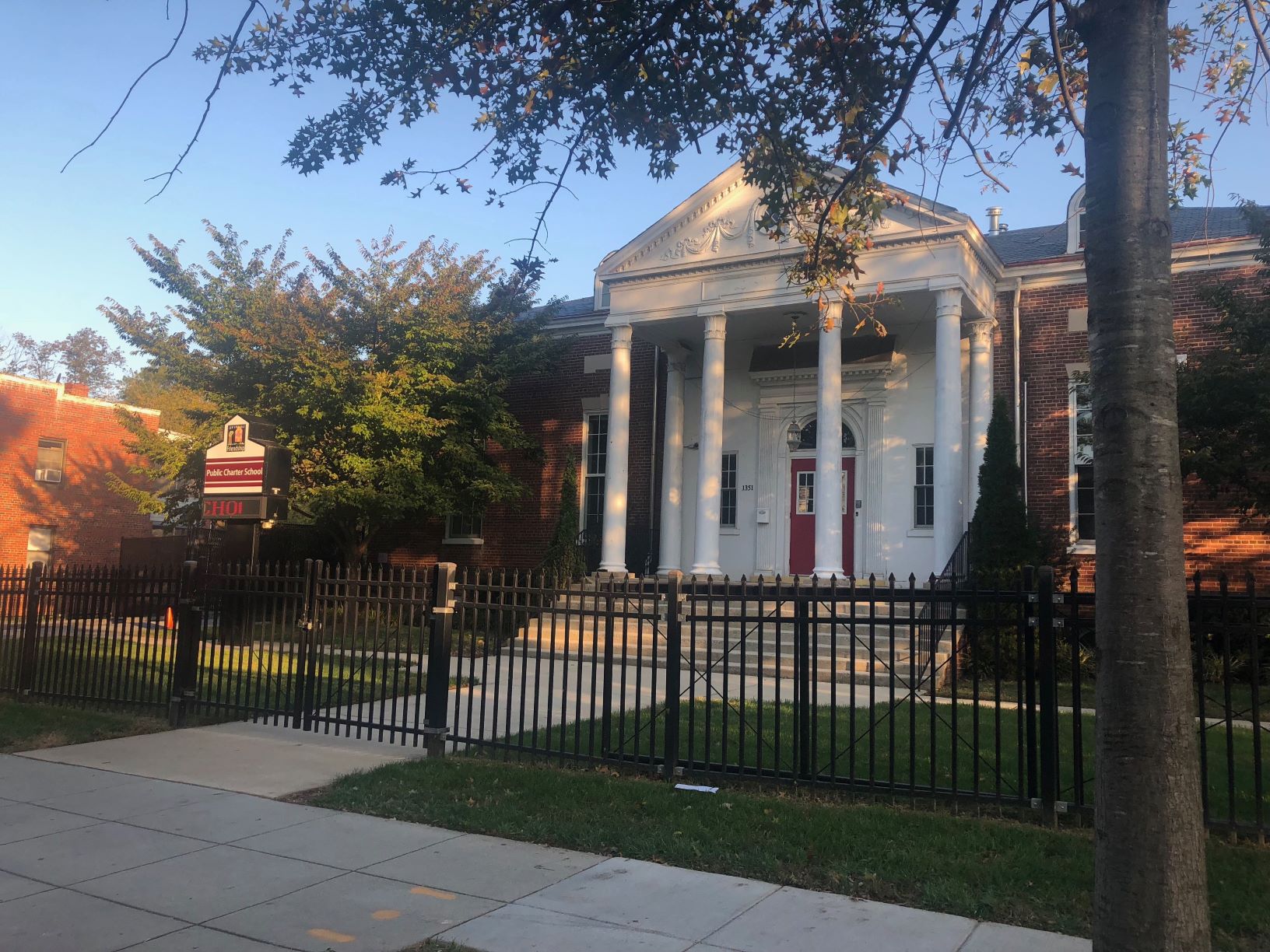
Friendship Public Charter Online’s Northwest, D.C. campus.Jenny Abamu / WAMU
Students only meet on campus on Thursdays. The rest of the week, the school’s 200 students have to peer into a computer screen in their homes to see their teachers. Amy Fuller is one of those teachers. She teaches social studies to middle schoolers. Most weekdays she uses a webcam and specialized software to enter a “virtual” classroom. Students can see her, in the upper left-hand corner of the computer screen. They also see a digital “chalkboard” in the middle of the screen. But Fuller can’t see her students.
“Remember, I can’t see you, but if I don’t see the assessments being done or they are not being mastered, it’s my way of knowing that you are not with me,” Fuller tells her class during one lesson.
Students who choose these programs must have an adult, called a “learning coach” around to support them. There are a number of reasons that families opt-into virtual schooling. A number of students are part of military families who move around a lot, others are seeking refuge from bullying, some were originally homeschoolers, and many just don’t care to make the trek across the city to a brick-and-mortar campus.
What Counts As Attendance Online?
Last year investigations into school attendance revealed widespread problems throughout D.C. public schools, and city officials have found themselves at a crossroads in an effort to change attitudes towards attendance. Principals have gone so far as to host barbecues and give away prizes in an effort to get students to show up for class.
So how is this virtual school beating the odds?
According to Friendship Online school leader Tracy Sloan, the attendance policy at Friendship Online states students must show that they have complete five hours of academic work a day to be counted present. That is similar to state policy that said students must be present for 80 percent of the school day.
But that doesn’t mean students at Friendship Online are sitting in front of a computer for five hours every day. A student can work ahead or work fewer hours on one day and more the next.
For Omar, an eighth-grader in Fuller’s class, this flexibility is one of the biggest differences between going to school in-person and online.
“There is a big difference in the amount of work you can do because you can go ahead in your work, no one is going to stop you,” Omar said.
As long as students show they have worked 25 hours by the end of the week, teachers, like Fuller, think it’s okay if they work a little less one day and more the next.
“If I see one day they did eight lessons and one day they only got two, well maybe they were prepping because they knew that they had some sort of event or something,” said Fuller in an interview. “So those hours that they worked, those hours count even though they have divided them between the two days.”
Sloan, the administrator agrees that while the school encourages students to work during regular school hours, they are understanding.
“Yes, we do have flexibility for students that would not fit in a traditional school,” Sloan said.
But does this practice align with District attendance policies? Students in brick-and-mortar schools must be in class 80 percent of the day, every day, to be counted present. Karen Williams, president of the D.C. State Board of Education, which approves attendance policies, said she is not sure if the virtual school’s policy aligns with the regulations.
“We haven’t even looked at the implementation and the ramifications of virtual schools because there is only one in the city. I know that sounds bad, but we haven’t,” Williams said.
Lack Of Policies
D.C.’s State Education Board isn’t the only one that hasn’t considered the implications of having virtual schools or lacks policies to guide them. Other states, including Indiana and California, have struggled to respond to virtual schools that have used policy loopholes to raise attendance numbers.
In California, state funding is based on student attendance, offering schools an extra incentive to get kids in class. But in 2016, an investigation by the East Bay Times found that teachers employed by K12 Inc., a Virginia-based for-profit online learning company, were instructed to count students present if they logged in the online learning system for as little as one minute.
Following the reports, California’s then Acting Attorney General, Kamala Harris, ordered the company to pay an $8.5 million dollar settlement for violating California’s false claims, false advertising and unfair competition laws. In October 2017, the California state comptroller released a report noting that virtual schools managed by K12 lacked sufficient documentation to support the accuracy of attendance rates reported to the state department of education.
Other investigations into the company’s attendance and teaching practices have occurred in Colorado, Tennessee, Indiana and Nevada.
A Different Delivery Model
The virtual public school in Washington, D.C. is owned by Friendship Public Charter Schools, but the virtual program is operated and managed by K12 Inc., the same company that has come under scrutiny in other states. Officials at K12 insists that what has happened in other schools is not what is driving up attendance numbers in D.C.
Kevin Chavous, a former D.C. councilmember and the current president of K12 Inc., said he is aware of poor attendance practices happening in other places, but thinks the high attendance numbers at Friendship are primarily driven by engagement.
“Friendship has done a really really good job of getting kids excited about learning,” said Chavous. “More than anything, kids are going to show up for class either online or in a brick-and-mortar setting if they are excited about learning.”
Luis Huerta, an associate professor at Columbia University’s Teachers’ College who has done extensive research on virtual schools, is not so sure things are different in D.C. But, he said, one of the reasons it may be hard to know exactly what the attendance numbers mean is because of the lack of clear policies guiding how virtual instructors calculate attendance.
“This is a whole different delivery model. The governance model is different. The teaching model is different. How kids actually engage in the learning is different, and all of that demands accountability mechanisms that are distinct and completely different from traditional accountability mechanisms,” Huerta said.
“There is no state that has created accountability mechanisms that are unique to the delivery model, governance etc. of virtual schools,” he continued, noting that Colorado has developed some policies, but the policies were not comprehensive.
Williams said the State Board of Education in D.C. is looking into whether or not to hold Friendship Online to the same in-seat attendance rules as other publicly funded institutions, or to treat it like homeschooling and make an exception.
“This is something that we might need to look deeper into,” Williams said. “It’s kind of like we haven’t investigated that yet.”
The current policy or lack thereof has garnered Friendship Online a top spot as the public with the highest attendance numbers in the District. But it’s hard to judge success when the school is playing by different rules.
This story originally appeared on WAMU.