 Mikaela Lefrak
President James A. Garfield was the only one of the four assassinated U.S. presidents without a marker at the site he was shot.
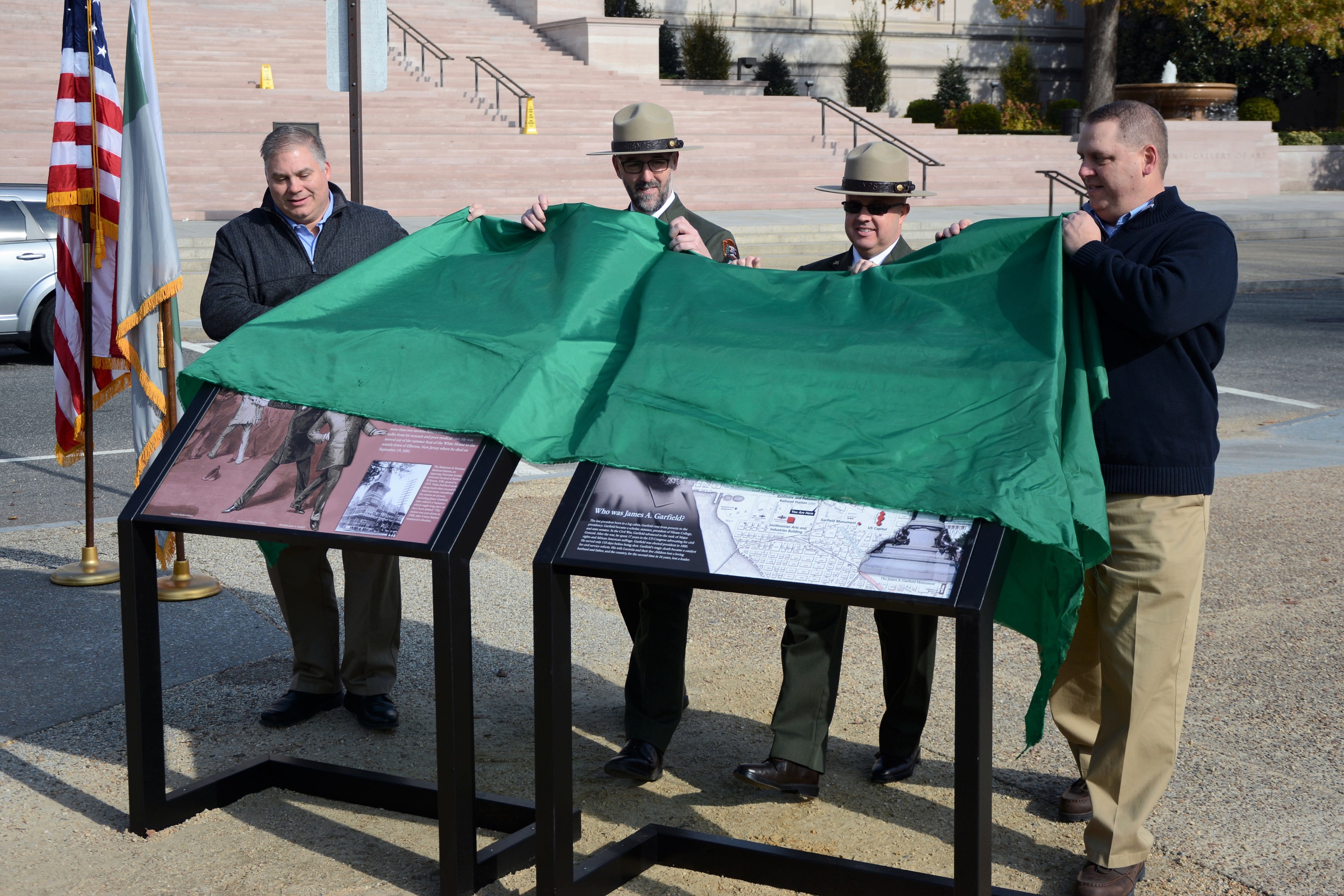
That changed on Monday, when the National Park Service unveiled two new interpretive signs near the National Gallery of Art. The first explains Garfield’s life, and the second focuses on his untimely death in Washington.
The 49-year-old President had only been in office four months when he decided to take a trip to New England to escape the swampy summer heat. Right after he arrived at the Baltimore and Potomac rail station on July 2, 1881 to catch his train, an unstable attorney named Charles Guiteau shot him with an ivory-handled pistol.
Garfield developed a terrible infection and died Sept. 19.
The Baltimore and Potomac rail station is, of course, no longer there. The building and tracks were demolished in 1908 during a redesign of the National Mall, and the National Gallery of Art’s West Building now stands in its place. The changes to the urban landscape complicated the process of building a proper memorial.

The James A. Garfield National Historic Site worked with the Park Service on the project. Garfield’s descendents were also on hand for Monday’s unveiling, which was timed to coincide with what would have been his 187th birthday.
Garfield is only assassinated president w/ no marker at site of shooting. We're working to change that w/ authors, historians, filmmakers, etc., including @candice_millard, @HC_Richardson, @AZapruder, @Apograph, @NationalMallNPS, @LouisPicone, @HistoryDean, @ViralHistory, others. pic.twitter.com/3n6ALjNCP8
— James A. Garfield National Historic Site (@GarfieldNPS) January 24, 2018
“We look forward to millions of visitors learning about our 20th President and his unfortunate and untimely death at the hands of an assassin,” said Park Service spokesman Brent Everitt.
Visitors can find the waysides just south of the National Gallery of Art’s West Building. They will remain there until July 2, 2021.
There are already official markers for Abraham Lincoln in D.C., William McKinley in Buffalo, New York, and John F. Kennedy in Dallas, Texas.
This story originally appeared at WAMU.