 Mikaela Lefrak
Every month or so, a group of mostly white-haired (or no-haired) old timers meets in a hotel ballroom for lunch, iced tea and nostalgic talk of the good old days.
This is the Association of the Oldest Inhabitants of the District of Columbia, the city’s oldest civic organization. It’s been around since 1865, and its 300-plus members include prominent historians, retired bureaucrats, and members of D.C.’s oldest families.
But the association — AOI, as it’s known — isn’t some stodgy old timers’ club.
“It’s changed from this kind of elite, little clique to really be a welcoming, all-inclusive organization,” said former AOI president Bill Brown before the group’s recent luncheon at the Capitol Skyline Hotel in Southwest.
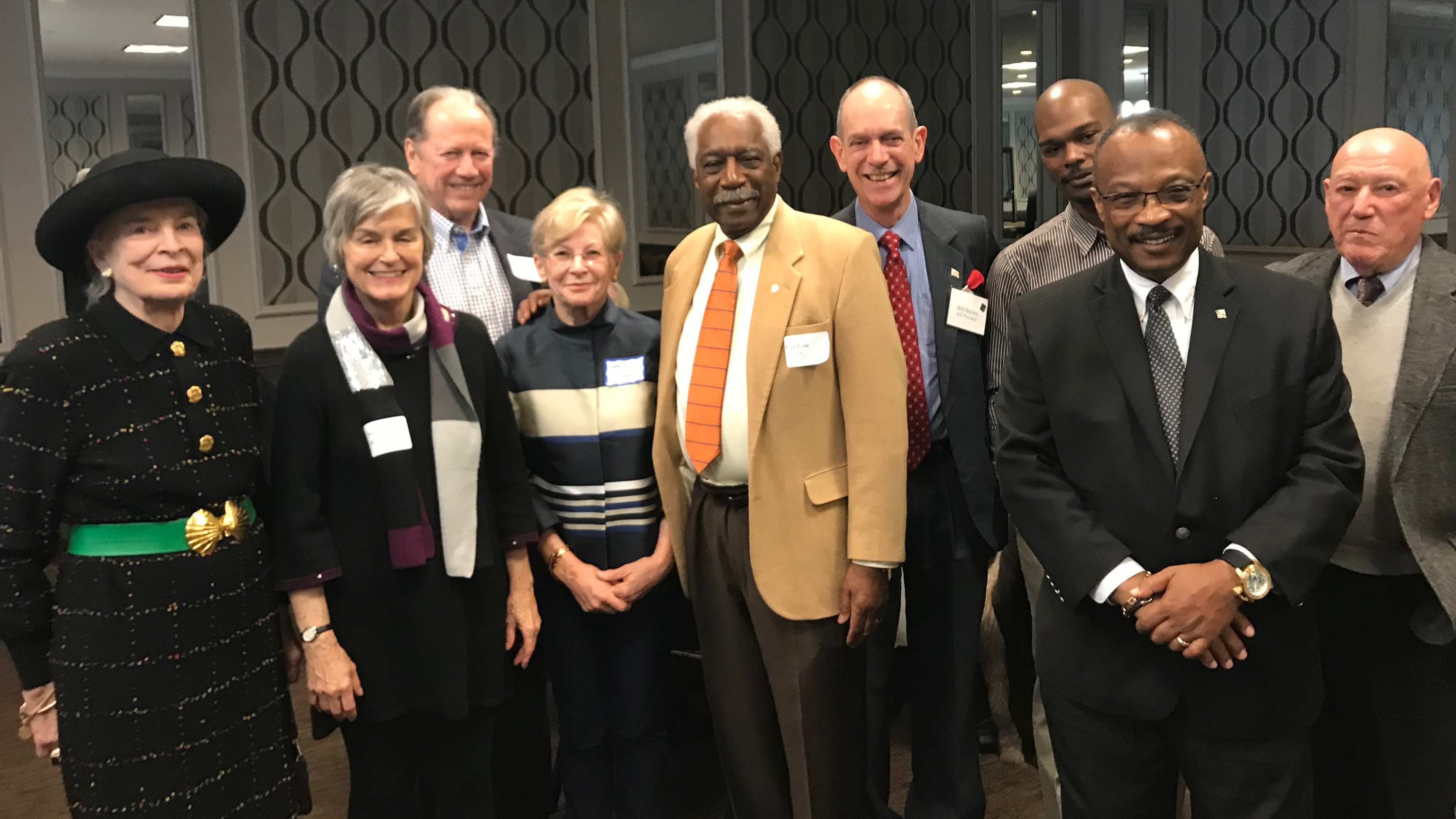
Members of the Association of the Oldest Inhabitants of D.C., including current president Jan Evans (far left), board member Carl Cole (center), and former president Bill Brown (third from right).Courtesy of the Association of Oldest Inhabitants of D.C.
The group got its start when 31 businessmen and politicians banded together right after the Civil War to make sure the city didn’t change too much amidst the influx of veterans and freed slaves. Brown called it “the original historical society” — they advocated for preserving the city’s original street grid as it looked under the L’Enfant Plan, and, later, helped build a memorial on the National Mall to D.C.s World War I veterans.
And for decades, the group remained all white and all male. A group of African Americans eventually formed a parallel organization, the Association of Oldest Inhabitants of D.C. (Colored), that focused on advocating for desegregation and social justice issues. It disbanded in the mid-1900s.
These days, AOI is much more inclusive and diverse.
For one, you only have to be 40 years old to get in. You also have to have lived or worked in D.C. for at least 20 years, or be descended from people who did. And if you don’t meet those qualifications, you can still be an “associate member” — you just can’t serve on the governing board. Annual dues are the price of a tank of gas: $20 per year.
(AOI has struggled to grow its membership, but Brown said he would never advocate for a name change to attract a younger cohort. “I’m not going through the paperwork rigamarole or anything else to change the name of the organization after all these years,” he said in true preservationist fashion, before ordering himself a Bloody Mary at the bar.)
The group underwent a particularly modern development earlier this month. It elected its first female president, Jan Evans, the granddaughter of legendary D.C. brewmaster and AOI member Christian Heurich. Evans, 86, was the organization’s first female member when she joined in the early 1980s.
During AOI’s most recent luncheon, Carl Cole, a longtime member and the former commissioner of the D.C. Commission on the Arts and Humanities, expounded on the joys of being a part of the group.
“Look around the room,” Cole said as he pointed to his wife and other friends. “Look at the diversity. A lot of us are more than just members of an organization. There are a lot of personal relationships here.”
Cole’s family has been rooted in the Southwest Waterfront neighborhood for 160 years — about as long as AOI itself has been around. While the city’s rapid development has led to concerns over gentrification and racial and economic divides, Cole believes that AOI’s success proves that the city can indeed come together.
“It gives you a special feeling,” he said. “And we’re open to everyone who wants to come in.”