Rachel Kurzius
Update, 5:15 p.m.:
Despite the unanimous support of the local Advisory Neighborhood Commission and Ward 2 Councilmember Jack Evans, the resolution to call the D.C. block where the Saudi embassy resides “Jamal Khashoggi Way” will not move forward at the D.C. Council next session.
Evans says that he spoke with Council Chairman Phil Mendelson about the legislation, and Mendelson told him he would not move the bill. The D.C. Code mandates that no public space be named after anyone who is still alive or who has been dead less than two years. Khashoggi was murdered this October. Supporters of calling the block of New Hampshire Avenue NW between F Street and Virginia Avenue “Jamal Khashoggi Way” wanted an exception to this law.
“The law is the law, no exceptions,” Evans characterizes Mendelson as saying. Evans says there’s not much he can do about the decision. “It’s the chairman’s prerogative—we’re stuck.”
Mendelson’s office confirmed that he would not be making an exception to the law. “He adheres to that law strictly,” says director of communications Lindsey Walton.
Original:
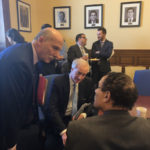
The Advisory Neighborhood Commission meeting for the area representing Foggy Bottom and the West End on Wednesday night included a number of speakers who generally don’t make their way to the hyperlocal government body, including a representative from the Committee to Protect Journalists and people talking about what a murdered columnist’s death has meant for the aspirations of the Arab world.
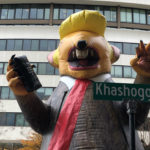
They were there to speak in favor of a measure to create a symbolic designation for Jamal Khashoggi, a journalist who U.S. intelligence determined was murdered at the orders of the Saudi crown prince, on the block where the Saudi Arabian embassy sits—the block of New Hampshire Avenue NW between F Street and Virginia Avenue. The resolution passed unanimously, with one commissioner who recused herself.
“These are things we don’t normally see at the ANC but it was very powerful,” says William Kennedy Smith, ANC 2A’s chair and the commissioner who represents the swath of New Hampshire Avenue NW that includes the Watergate Complex and the Saudi embassy. He co-introduced the measure with James Harnett, who represents nearby 2A08.
ANC commissioners are non-partisan volunteer representatives who more frequently tackle neighborhood-level issues like liquor license applications, zoning questions, parking, and more. While District agencies don’t have to listen to ANC recommendations, they do have to give them “great weight.” ANCs can also initiate proposals for the D.C. Council to take up, like introducing a proposed designation of an alley or street name.
Smith says that the biggest question the ANC wrestled with on this resolution was “whether we were stepping too far out of our lane” to wade into international politics. The local vote happened on the same day that the Senate called for an end to the U.S. involvement in the Saudi-led war in Yemen, intended as a message to both the Saudis and the Trump administration’s response to Khashoggi’s murder.
But a couple of factors persuaded them that they were acting appropriately: Khashoggi lived locally, worked with The Washington Post, and was known by many people who reside within the ANC; his “particularly brutal and egregious murder” was determined by the Central Intelligence Agency to have been ordered by the Saudi crown prince, and the embassy representing that government “happens to be in our ANC”; and the broader dialogue about the relationship between people in power and the press has both local and international implications, Smith says.
“The ANC was very justified in stepping forward in making this statement, both to honor our neighbor and also to honor the values of our free speech and free press that we care about,” Smith says. The resolution was also inspired by a petition that called for Jamal Khashoggi Way “to be a daily reminder to Saudi officials that such behavior is totally unacceptable and as an expression of Washington’s unstinting support for freedom of the press.” It currently has more than 8,000 signatures.
Smith reached out to his councilmember, Ward 2’s Jack Evans, prior to the vote, as well as the Khashoggi family (through The Washington Post), the Saudi embassy, and the U.S. State Department.
Evans, to whom the resolution is addressed, supports the measure, according to spokesperson Joseph Florio, and is currently looking into the legislative process to bring it forth. According to the D.C. Code, “no public space shall be named in honor of any living person, or in honor of any person who has been deceased less than 2 years.” However, the Council has made exceptions to this in the past, like Frank Kameny Way and Jerry Moore Plaza, both of which were dedicated when the honorees were still alive. Florio says that the designation would arrive at the council in the new session, which begins in January.
Smith says that the Khashoggi “family members we heard from indicated they were pleased with the initiative. We did not hear a response from either the State Department or the Saudi Embassy.”
The major concern Smith heard from constituents was that it might impact maps or navigation, but honorary names are “not something that will cause inconvenience or hardship or expense to the city or to neighbors,” he says. Honorary names do not replace the official street name. The street outside the Russian embassy, for instance, was renamed after murdered dissident Boris Nemtsov earlier this year, but the embassy continues to use the same Wisconsin Avenue mailing address.
Smith isn’t concerned that the ANC will damage Saudi/U.S. relations. “When your ally acts in a manner that is inconsistent with your values and inconsistent with your beliefs, you take steps to let them know that,” he says. “That’s been missing from this dialogue and that’s one of the reasons why the ANC needed to step forward.”
Previously:
ANC Will Vote On Naming Saudi Embassy Street ‘Jamal Khashoggi Way’
This post has been updated with comment from Councilmember Jack Evans.