 Rachel Sadon
The District is getting a new stream of revenue: millions of dollars collected in taxes on digital purchases. A key vote on Tuesday will determine how that money gets spent: on lowering commercial property taxes, funding homelessness services, or other priorities.
D.C. Council Chairman Phil Mendelson and Ward 2 Councilmember Jack Evans have proposed using those new funds to cut taxes for large commercial properties. A first vote on their bill sailed through the legislative body last month on a 12-1 vote. But the Internet Sales Tax Amendment Act of 2018 will come up for a second vote on December 4, and Ward 1 Councilmember Brianne Nadeau is spearheading a last-minute effort to direct much of that money toward homelessness services and affordable housing instead.
The Supreme Court cleared the way for jurisdictions to tax internet sales this summer, ruling in the 5-4 Wayfair decision that online retailers should not be entitled to an “an arbitrary advantage over their competitors who collect state sales taxes.”
A handful of large digital retailers have already begun collecting local taxes (most notably Amazon), and some small companies would be exempt from D.C.’s tax, but it will still result in a significant influx of cash. The city’s chief financial officer estimates that the legislation will fill the District’s coffers with upwards of $24 million a year once fully enacted in fiscal year 2020.
Mendelson and Evans have proposed using those funds to lower the tax rate on commercial properties that are worth over $10 million, dropping it from $1.89 to $1.85 per $100 of assessed value.
That would restore the tax—which was one of several raised earlier this year to help pay for dedicated funding for Metro—to its previous rate.
“The government ought not to be about the business of raising taxes unless it absolutely has to, and we were very quick to raise taxes in the budget that we adopted in June because we were committed to raising funds for Metro,” Mendelson said at a press briefing on Monday. “We have the opportunity to reverse that increase. That’s all that is being proposed and that’s what we ought to do.”
He pointed to recent increases in funding for permanent supportive housing, saying “we’ve substantially increased funding for affordable housing and homelessness … It’s not like we’re not doing anything in that regard.”
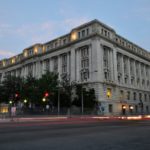
But advocates and social services providers have been lobbying hard at the Wilson Building to use the funds to address homelessness.
“As D.C. continues to prosper, it’s so rare that we get a new funding stream like this. It provides a wonderful opportunity to lift up people who are struggling with housing instability,” says Jesse Rabinowitz, the advocacy and campaign coordinator for Miriam’s Kitchen. “I firmly believe that budgets are moral documents. They can back up their commitment to ending homelessness, or serve wealthy corporations.”
Evans pushes back against that idea. “This whole mantra that we’re giving rich people a break is not true. We’re just putting it back to where it was,” Evans says, adding that tenants often are often the ones paying commercial property taxes rather than owners. “[The rate is] the highest in the region by far… it’s important to keep it competitive.”
He tells DCist that he and Mendelson always intended to lower the commercial property tax rate back to its original level when funds became available, though it is not clear if that agreement was ever made public. Evans was not able to point to a specific statement that had been made on the record.
Other activists note that the D.C. Council has already weighed in on what should be done with internet sales tax revenues.
Back in 2013, when it appeared that Congress might pass legislation allowing states to collect such funds, local legislators passed a bill that would direct half of the revenues to funding for Metro and the other half to homelessness services. Mendelson and Evans’ bill repeals that act.
“The Council thought about this well before it became reality. They said ‘let’s spend it on something the community really needs,'” says Ed Lazere, the head of the D.C. Fiscal Policy Institute, who wrote an op-ed on the matter last month. “We recognized as a community, as a council, that as a gentrifying city with these needs that we should use growing resources to reinvest. Now what the Council is considering has nothing to do with reinvestment.”
Nadeau plans to introduce an amendment that would reduce (but not eliminate) the tax decrease on commercial property taxes and use the remainder for permanent supportive housing, the DC Local Rent Supplement Program, and relief for nonprofits struggling with stormwater fees.
“For me, it’s about choices. If there’s another $25, $30, ultimately $40 million coming in a year to the general fund, for me the highest priority is human services,” Nadeau says. “The path is providing housing … This could be a game changer.”
Taxing internet sales would also bring in about $14 million in fiscal year 2019. Under the current version of the bill, that one-time revenue would be directed to the Commission on the Arts and Humanities. Nadeau’s amendment would split it between arts funding and community schools grants.
Mayor Muriel Bowser has not yet responded to a request for comment on where she stands on the bill.
This story has been updated with comment from Jack Evans. Martin Austermuhle contributed reporting.