Words like Wonk Cat, Lau, and Vex might not mean anything to some, but, to many D.C. college students, they’re a way of life.
Students use terms like these almost daily in Facebook meme groups for local universities. American University (where I’m a student), George Washington University, and Georgetown University have some of the most active pages. Using images, videos, text, or an online interaction that is copied with slight variations, these groups poke fun at their respective colleges, but also serve as forms of community and discussion.
Other D.C. schools have different ways of sharing their memes. While there hasn’t been a post on Howard University’s Facebook meme page since December 2016, the school has a strong Twitter presence for meme posting. Catholic University has a Twitter account, too.
A co-founder of AU’s meme group, senior Aleisha Bynum, serves as an admin for the group, which started in April 2017 and now has over 6,000 members. “So many people are a part of it because you get to connect with other students from campus and it’s a good way to de-stress,” Bynum says. “College can be really stressful and you can feel alone at times, and this is a really easy way for everyone to come together.”
Stephanie Yuan, co-founder of “georgetown memes for non-conforming jesuit teens,” says that the group allows students to have “a space where they can engage with content that is relevant to them and that they can emphasize and sympathize with.”
Groups like these first popped up in 2016, with the original starting at the University of California Berkeley. The group, named “UC Berkeley Memes for Edgy Teens,” now has over 188,000 members and typically sees about eight posts a day, according to the group’s Facebook analytics. Now, Facebook meme groups can be found for most universities, including Ivy League schools (like “Harvard Memes for Elitist 1% Tweens”) and giant state schools (such as “Swampy UF Memes for Top Ten Public Teens”).
These groups are meant to be fun, but there have been consequences of meme posting. In June 2017, Harvard College rescinded admission offers to at least 10 Class of 2021 prospective members after the students posted sexually explicit memes and messages that targeted marginalized communities in a private Facebook group chat.
With that in mind, the D.C. universities’ groups all have rules with the same premises. Don’t post a meme if you didn’t make it—and make sure to keep it related to your school. As American University’s group, “AU Memes for Red Line Disenfranchised Teens,” puts it, “Original AU specific memes are the best ones. At least put the effort of shmooping an AU logo or hat into the meme.”
“Now, people work really hard to create elaborate memes that are unique to American University and its culture, and we get dozens of new posts a week from new people,” Bynum says. “It’s really blown up and become this huge thing.”
All groups mention that discrimination in any form isn’t tolerated and admins have the right to block users and delete posts. “RESPECT. You learned this in kindergarten—hopefully you also learned the other 5 pillars of character,” Georgetown University’s group, “georgetown memes for non-conforming jesuit teens,” says in a post stating the rules.
And, of course, all of this comes with a disclaimer. “The opinions shared in memes do not reflect that of the admins,” George Washington University’s group, “GW memes for Canada Goose™ wearing teens,” says in the description. Georgetown’s also warns group members that, “We are not responsible for any consequences that may incur as a result of your memes.”
In each group you’ll find students serving as the admins and moderators, enforcing guidelines and dealing with any potential disputes.
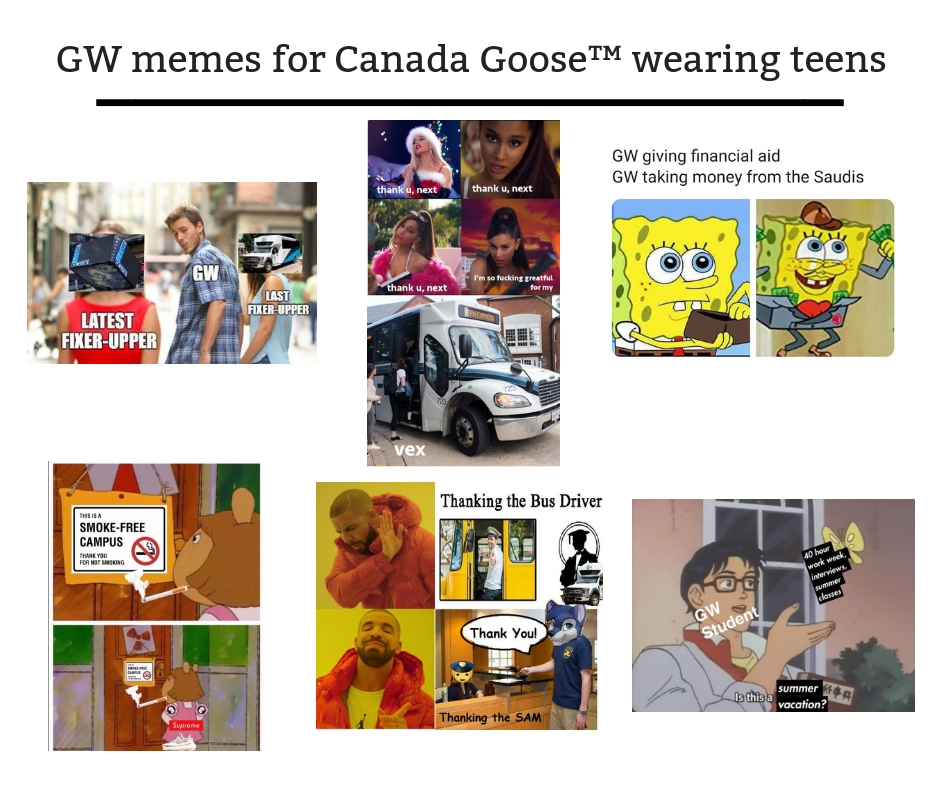
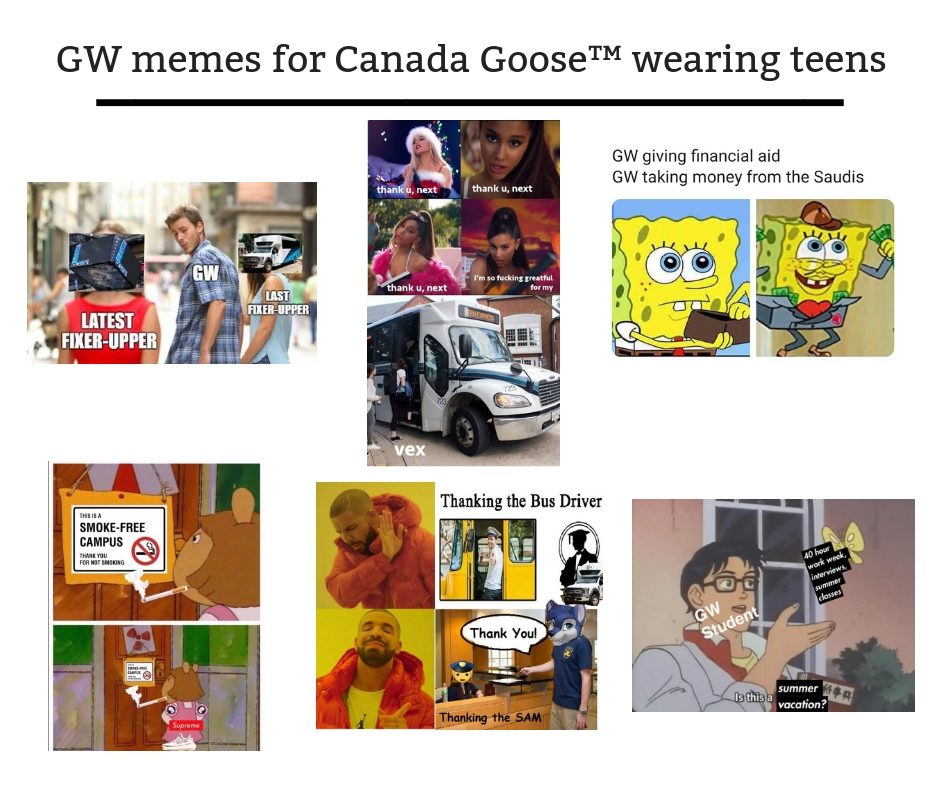
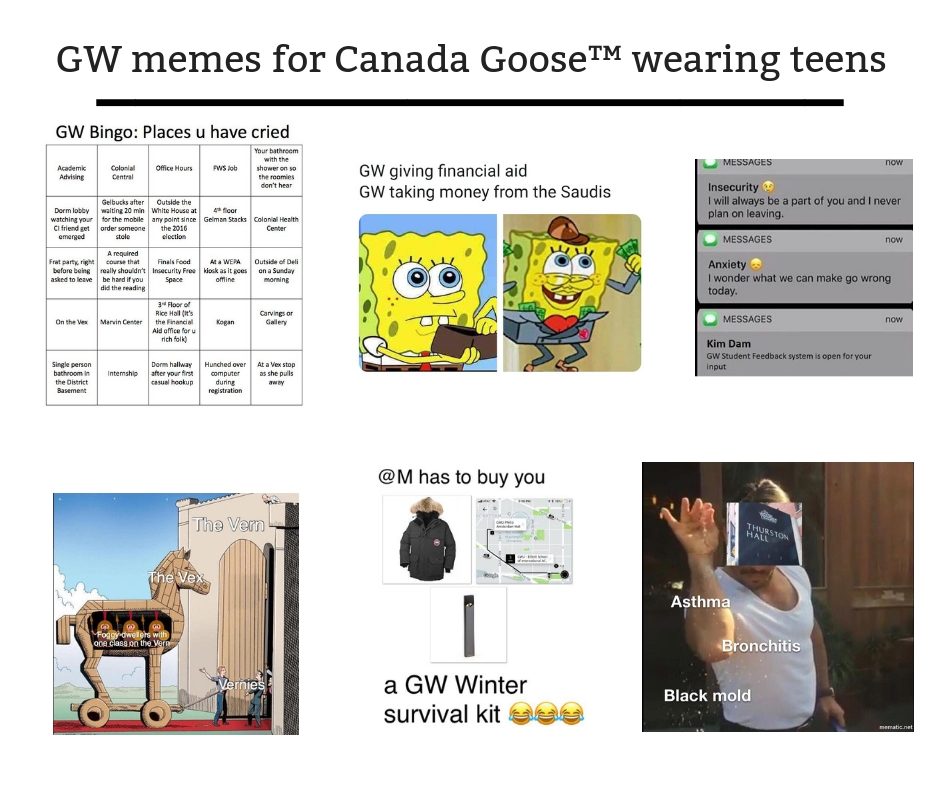
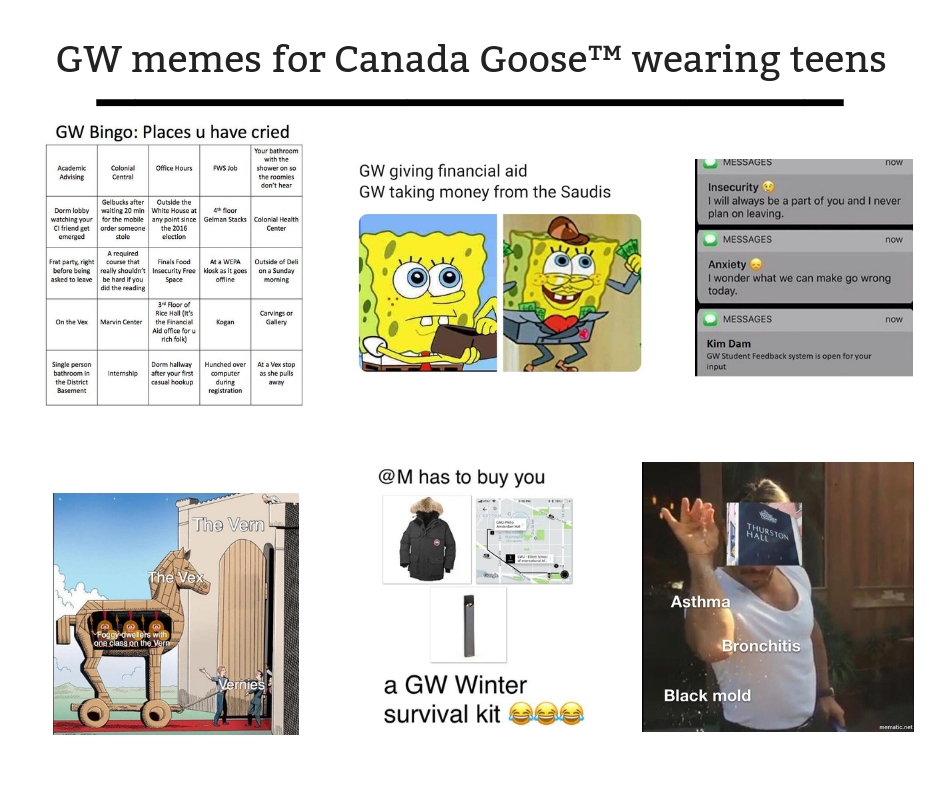
While each university has different inside jokes and cultures, the meme types all are similar. Generic memes like the jealous girlfriend, Ariana Grande’s “thank u, next” lyrics, Spongebob, D.W. from Arthur, Drake in the “Hotline Bling” music video, and “Is this a pigeon?” can all be turned into university-specific memes with some editing.
It’s not just the meme types that are similar—it’s the comment section, too. In any group, you’ll find students tagging their friends and writing “lmao,” “me,” or “true.” Though most comments are brief, good memes can earn hundreds of comments. Facebook likes and reactions are more abundant. Most posts have at least 100 likes or reactions across all groups. Memes that really strike a chord can have upwards of 700 likes or reactions, while ones that seem to miss the mark will have as few as 20.
To Bynum, a quintessential AU meme has to deal with how the majority of the student population is from New Jersey, famous alumna and possible Russian spy Maria Butina, and the stray cat turned school mascot, Wonk Cat.
“I think our memes are a lot more political than other meme groups, mostly because a good chunk of this school is studying International Relations or Political Affairs—it’s kind of inevitable that political statements trickle into our meme content,” Bynum says. “Also, we love to make fun of ourselves and how we all think we’re like, foreign policy experts or revolutionaries or something.”
Bynum is also a member of other university meme groups, and says AU’s meme page is special because it allows students to voice their opinions and it can even serve as a newsource for the campus. News, like a rat discovered in Megabytes, an on-campus deli, was first posted on the meme page. Multiple memes about the Wonk rat (a joke about the university’s “wonk” marketing campaign) spawned from that one post. Now, the deli is closed for the foreseeable future.
With more and more members being added everyday, Bynum says the memes of the group are becoming more and more specific to AU.
“It’s a way to be creative and have fun, and it’s an easy way to voice your opinion or bond with your colleagues over a certain aspect of life at AU,” Bynum says. “I think people really enjoy that.”
“AU Memes for Red Line Disenfranchised Teens,” also has posts ranging from their mascot Clawed Z. Eagle, an October campus fire, and the rat found in campus restaurant Megabytes. Additionally, posts about campus study habits and dining options are heavily represented. The group is the only private Facebook group of the three. GWU and Georgetown’s are public.

For Georgetown University, topics for posts include campus internet outage earlier this year, thoughts on dining options, closed walkways, and finals week lifestyle. The group has the second highest membership, with over 13,100 members. The Princeton Review ranked this group seventh in their top 10 meme group list.
“I think the main purpose is to meme about relevant issues,” Yuan says. “I think a lot of the memes tend to be simple observations students try to connect with.”
Yuan agrees with Bynum that many of the memes have a political bent. “I think Georgetown students tend to be a lot more politically and socially conscious,” Yuan says. “I think this is reflected in other D.C. university meme pages and I think we have a little bit more wokeness because we are in D.C.”
Just like the AU page, Georgetown’s has its share of rodents. Yuan adds that an icon that rose from the meme page is the Wisey’s rat, a rodent found in a popular Georgetown deli.

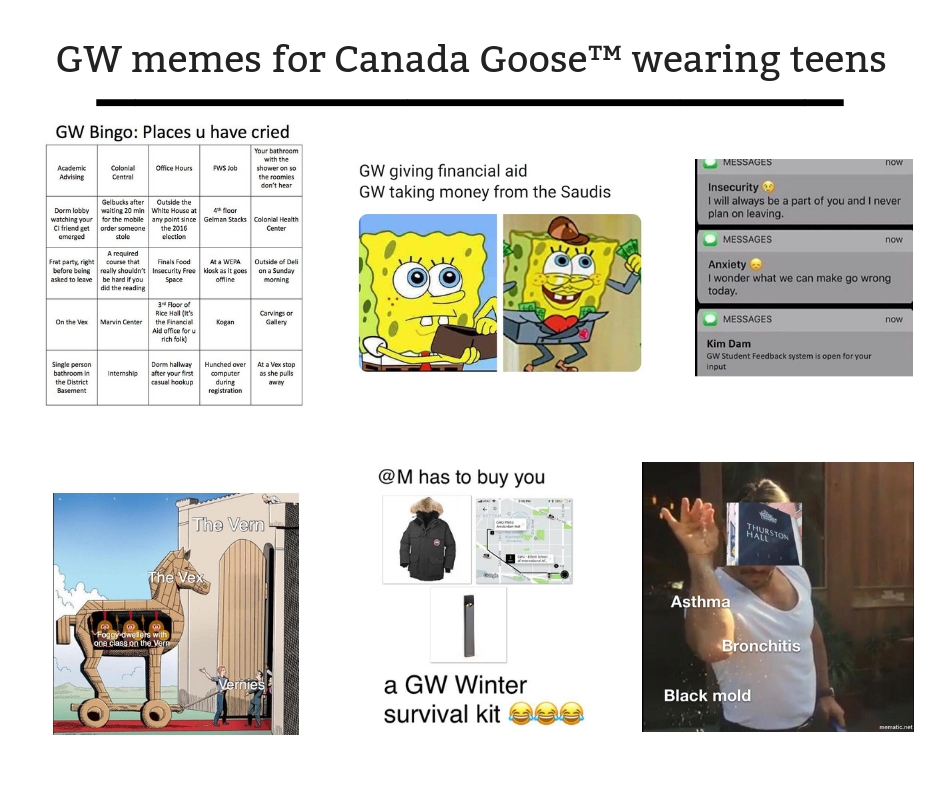
“GW memes for Canada Goose™ wearing teens” is the biggest university meme group in D.C., with more than 13,800 members. It recently posted the jealous girlfriend meme to highlight shoddy campus resources after issues with the Vern Express bus, or Vex, were closely followed by the the basketball stadium scoreboard collapsing. Living on a smoke-free campus, and the ups and downs of being in the center of D.C. are other points of discussion. Another hot topic hit the scene in late October, when GWU was determined to be the top recipient of Saudi Arabian money in the past six years.

With tons of issues affecting students’ lives everyday, the meme page serves as a megaphone to talk to fellow members of the student body, Bynum says.
“If someone has something to say, all they have to do is make a meme and post it to the page and hundreds of people know about it and are talking about it instantly,” Bynum says. “Everyone has a voice and a platform.”