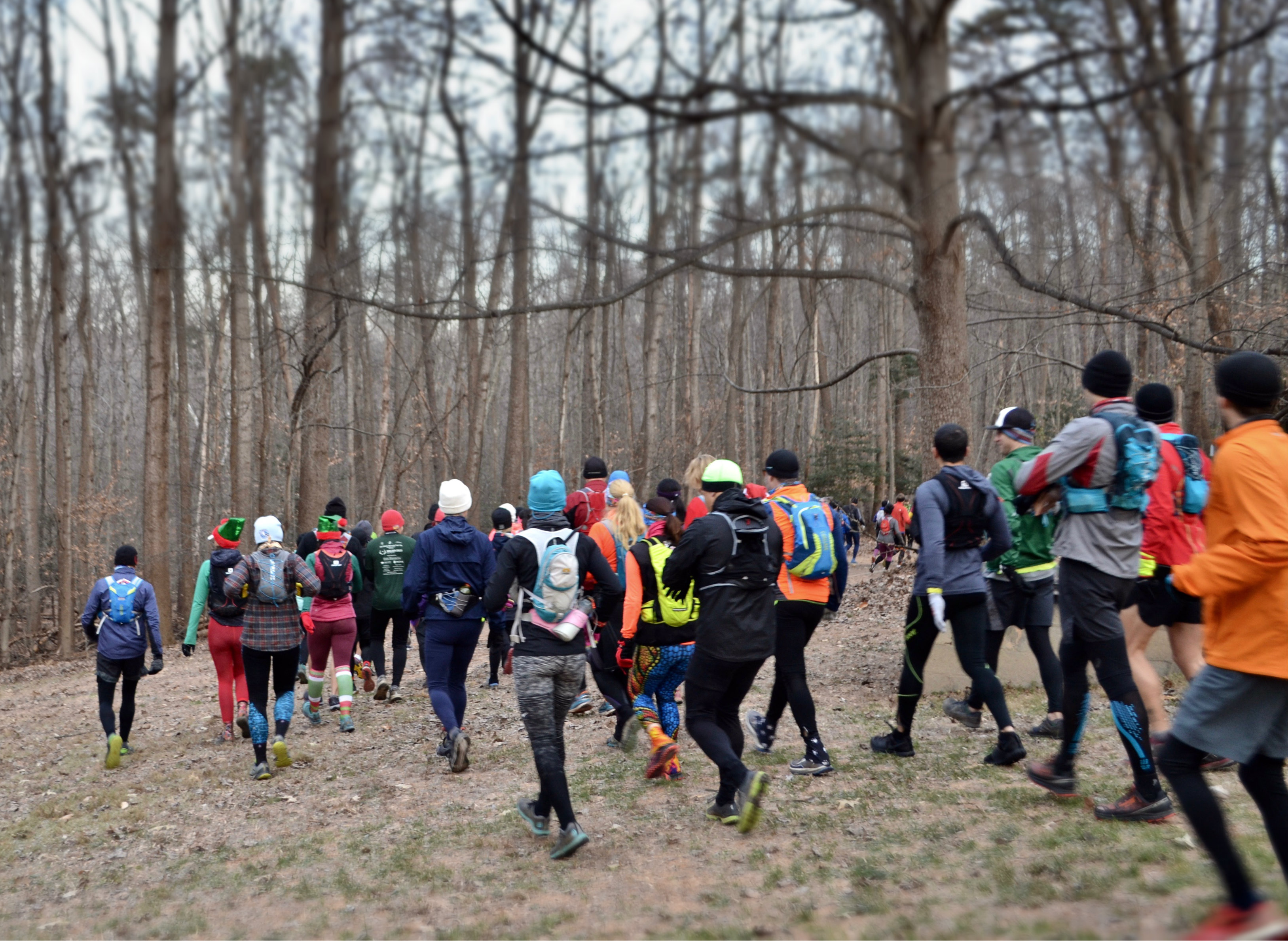
Our legs are cramping. We’re hungry. We’re barely halfway through the Magnus Gluteus Maximus 50K footrace in northern Virginia. “This isn’t bad!” says Laura Schroeder joyously, who by then has been running for over three hours on the 31-mile course.
She’s not being sarcastic.
According to local race directors—and bolstered by anecdotes from local runners—ultramarathons are becoming more popular in the D.C. region, and hear me out: They are not as bad as you think and they are not just for elite athletes.
An ultramarathon, or an ultra, is generally considered any footrace race longer than a traditional marathon of 26.2 miles. Given their length, they are often held on trails—as opposed to asphalt, the terrain-of-choice for many shorter races—which offer less pounding and more geographic variety to the participants. The sport’s propagation in the D.C. region is led by running clubs like the D.C. Road Runners Club and Virginia Happy Trails Running Club and coupled with more expensive races by companies like The North Face and Solomon.
In this way, the D.C. region is not unique: mirroring the numbers in the Mid-Atlantic, participation in ultrarunning is rising throughout the United States.
“It’s become more popular across the country,” says Ultrarunning magazine editor Amy Clark. Nearly 90,000 people completed an ultramarathon in 2015, compared to just under 13,000 in 2000. Whether or not these numbers sustain themselves is uncertain, but for now, trails seem to be experiencing an ultrarunning boom.
The ultrarunning scene began popping up in the area about three decades ago, largely as an offshoot of the long-distance backpacking and hiking scene. Today, athletes and non-athletes alike are trying out ultrarunning, bringing an influx of runners and races in the region.
Michael Strzelecki of Maryland, who has run around 120 ultramarathons, started ultrarunning in the late 1980s and has seen the growth of the sport and the variety of people it attracts. He says one of the primary motivations for runners when he began was the pure joy of just being outside.
“You can do a five- or 10-mile hike in a day, but you can go run a 50-mile race and see 10 times as much area in the same day,” says Strzelecki. “And you have these people that just love that. And they just have the spirit and they want to go explore in the mountains.”
Now, even as people are coming to the sport from spaces beyond the hiking scene, most still carry with them a deep enjoyment of the outdoors.
Some runners were inspired to start ultrarunning through bestselling books like Dean Karnazes’ Ultramarathon Man and Christopher McDougall’s Born to Run. Some participants are road marathoners who became injured from running for too long on hard pavement. Others are just looking for a way to relieve stress. Some want to see how far they can physically push themselves—and still, others had never considered themselves an athlete before stepping foot on a trail.
About a year ago, Kelli Rostowski began entering ultramarathons after feeling burnt out from triathlons. She’d heard about the scene through word-of-mouth and she hasn’t stopped since. “It’s a very welcoming community,” she says. “I am faster on the road than I am on the trail, but that doesn’t matter.”
Her sentiment is shared among many participants. Sure, there is a still a desire to cross the finish line sooner rather than later, but just starting the race is the goal for many runners. This means that there is less pressure to shave seconds off of your time every mile and instead just have space to appreciate the trail.
The Magnus Gluteus Maximus 50K in Hemlock Overlook Regional Park was put on by the Virginia Happy Trails Running Club, and was advertised as a free event, with “no awards, and no wimps.” This was the 27th year the club has held this free race and it shows no signs of slowing down.
I met the race director, Katie Keier, before the start of the event in a brick lodge that doubled as the race center. Even in the early morning, Keier’s enthusiasm for the sport was infectious.
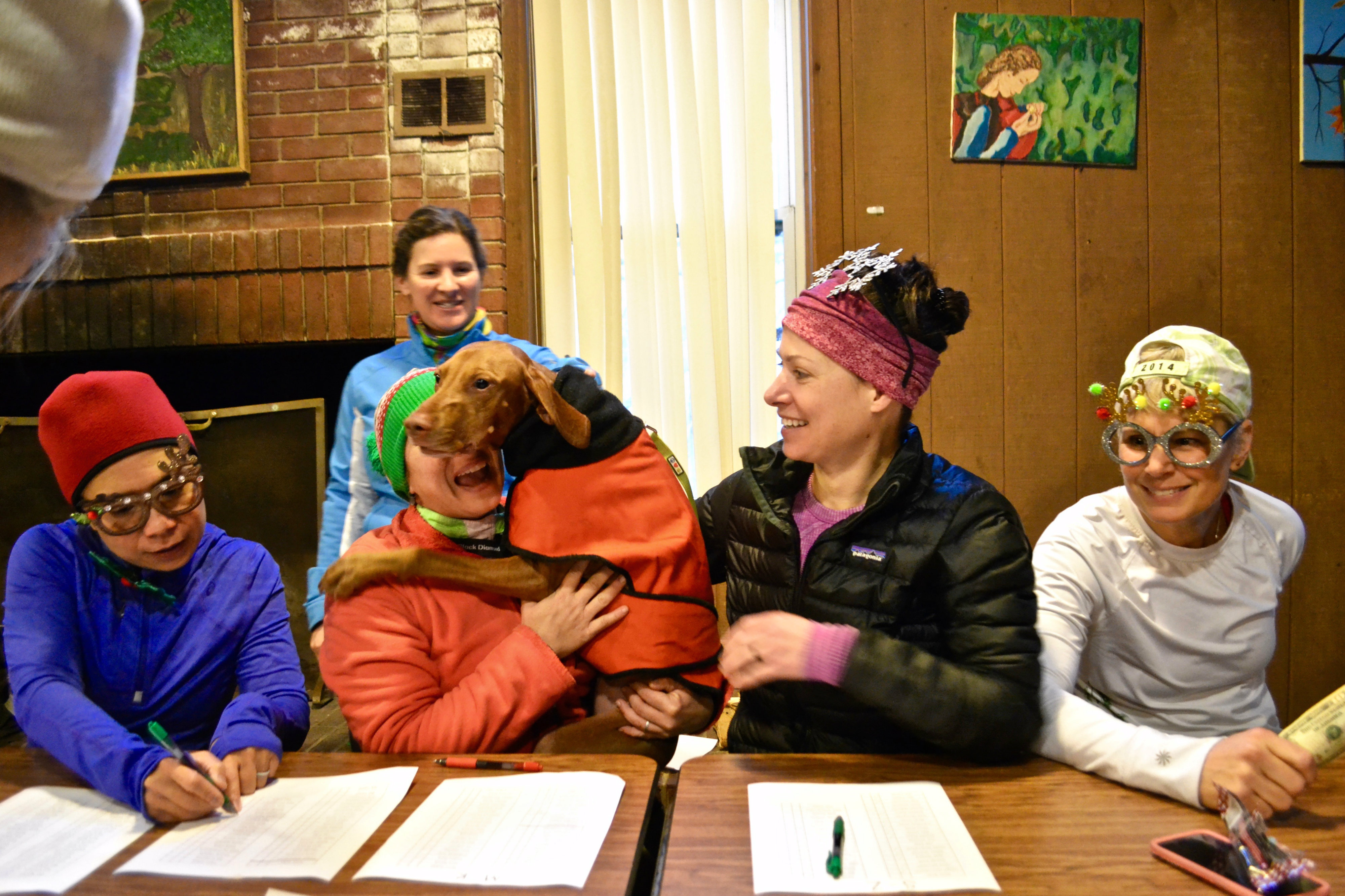
“I run these races because of the people,” she says, gesturing out towards the room filled with excited runners preparing for the day. “When you push your body and mind to these places, it creates friendships like no other. It’s a special thing.”
The sport can be an extreme test of physical and mental endurance—it requires participants to be reflective of how their own body reacts to different challenges, and it humbles everyone.
You can run. You can walk. You can rest for a few minutes at bountiful aid stations set with tables along the races that offer fuel and encouragement for passing runners (at the Magnus Gluteus Maximus 50K, I was offered everything from Gatorade to tequila to personalized quesadillas). You don’t even have to finish if you’re not up to it. What’s important is that you move your body and enjoy the day.
Some participants train for these types of races six days a week and others sign up for the events on a whim, in varying degrees of physical shape. In the Virginia Happy Trails Running Club race alone, registrants were as young as 12 and as old as 71.
The growing popularity of ultrarunning in the region also means that there are more race directors putting on the events. On the other side of the District, Bart Rein organizes a spread of trail races across the year through the Baltimore Road Runners Club, including the springtime Gunpowder Keg Ultra. Despite the physical toll of these races, not to mention the risks, “people are gravitating towards them,” he says.
If you sign up for a race, your body will still need to carry you for at least 31 miles, and it’s not going to do it without your help. Runners need to hydrate without putting them at risk of over-hydrating. They need to eat enough calories without getting sick. They need to pace themselves while hitting the cutoff times.
“Every person in the sport of trail running and ultrarunning is chasing something,” says Strzelecki. “It may be finding peace and solitude, dealing with addictions, notoriety, street cred, seeing how far their body can go. These are things people have been chasing forever, but with the emerging popularity of the 50K race and with so many ultras now being conveniently located near population centers, more runners (and non-runners) are finding that ultras are a perfect platform to chase what they are after. Some will find it, and others will not. The sport is not for everybody.”
The same sentiment keeps coming up in my conversations with runners: the idea that most ultramarathon participants are willing to cede to the sport’s absurdity. You have to be kind of illogical to run for hours on end; anyone who wants to be to be illogical is welcome to join.
This joke, combined with a meditative, intangible, peaceful element to the sport seems to keep participants coming back. Being on your feet for the better part of a day (or sometimes longer) is both a deeply personal endeavor and one whose success relies on hundreds of external elements from the encouragement of fellow runners to the fuel (and tequila) at aid stations. Experiencing the emotional highs and emotional lows that every ultra requires builds friendships; overcoming challenges builds community.
What stands out the most in the growing ultra scene is the simplicity that many participants value: there are rarely any awards for first, second, or third place. There aren’t many races with finisher medals. There are rarely any free commemorative shirts. The material items are fun, but it’s not why most runners lace up their shoes before the start. After the finish line, participants don’t often ask each other how fast they finished the race. They discuss what they enjoyed about the course and how they felt.
As ultramarathon participation, at least for the time being, continues to grow, runner after runner I spoke with cited their hope that this simplicity—or ‘purity’—of ultrarunning remains true to the community.
“The sport makes no sense,” says Keier, as she smiles and organizes the beer and pizza for the endorphin-filled 50K finishers. “And yet, we keep doing it.”