Natalie Delgadillo
Here’s something most everybody living in D.C. already knows: This city looks very different today than it did in the relatively recent past. In the last 10 to 20 years, large numbers of newcomers have dramatically changed the landscape of the District, transforming neighborhoods and pushing native Washingtonians into the surrounding suburbs or out of the area altogether.
But how much has the number of native-born D.C. residents really changed? Where do native Washingtonians live, and where do residents from elsewhere? How have the shares of newcomers-to-natives changed from neighborhood to neighborhood?
We have some answers, thanks to a new analysis from the D.C. Policy Center. The share of D.C.-born residents has stayed between about 20 to 32 percent since shortly after the Civil War, when the District saw a huge population boom, according to the report. At the start of the 20th century, the percentage of D.C.-born adults living in the city was nearly 33 percent. That share dipped sharply in the 50’s and 60’s to about 20 percent, and then increased again in 1990 and 2000, when it was back up to about 31 percent. The most recent data from 2013 to 2017 suggests another slight dip to 28.6 percent native-born adult D.C. residents across the city.
But that doesn’t tell the whole story. It also matters where these residents live, and how that has changed over time. See the below map:
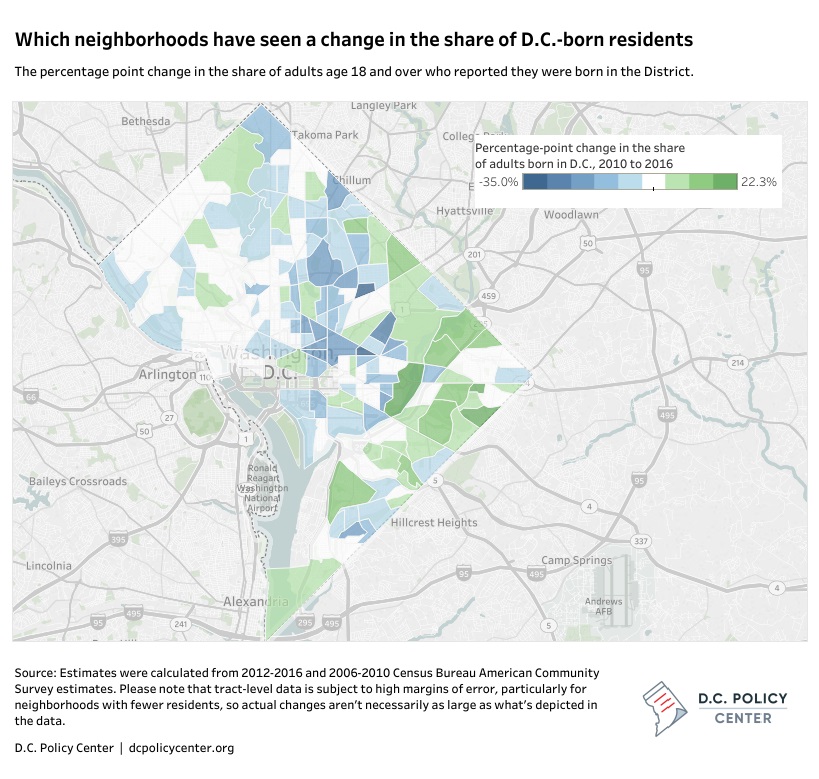
The squares in blue denote a loss in native Washingtonians, and the squares in green show a gain. There are mild losses throughout the District, but the most concentrated losses are in the Northeast quadrant, particularly around Trinidad and the H Street corridor. The biggest gains in the share of native Washingtonians are in Southeast, though there are also some pockets in Northwest and Northeast.
These gains are likely a result of the increasingly stark division of populations in the District. Native-born Washingtonians are increasingly living in Wards 7 and 8 in Southeast, and leaving other parts of the city. There are basically zero native Washingtonians living in some pockets of Northwest, like Foggy Bottom, while part of Southeast are approaching 80 percent D.C.-born adults.

This division is both geographical and racial—a majority of D.C.-born residents living in the city are black, and so are a majority of the residents living in Southeast. The transplants have changed the city’s overall racial composition, so that as of 2011, D.C. was no longer a majority-black city. (It’s also worth noting that this study does not count people born in Maryland or Virginia hospitals as native Washingtonians.)
Change across the city will almost certainly continue, and in some cases accelerate, in the next five years. It’s unclear what that will mean for the percentage of native-born Washingtonians living in certain neighborhoods and living in the city as a whole.