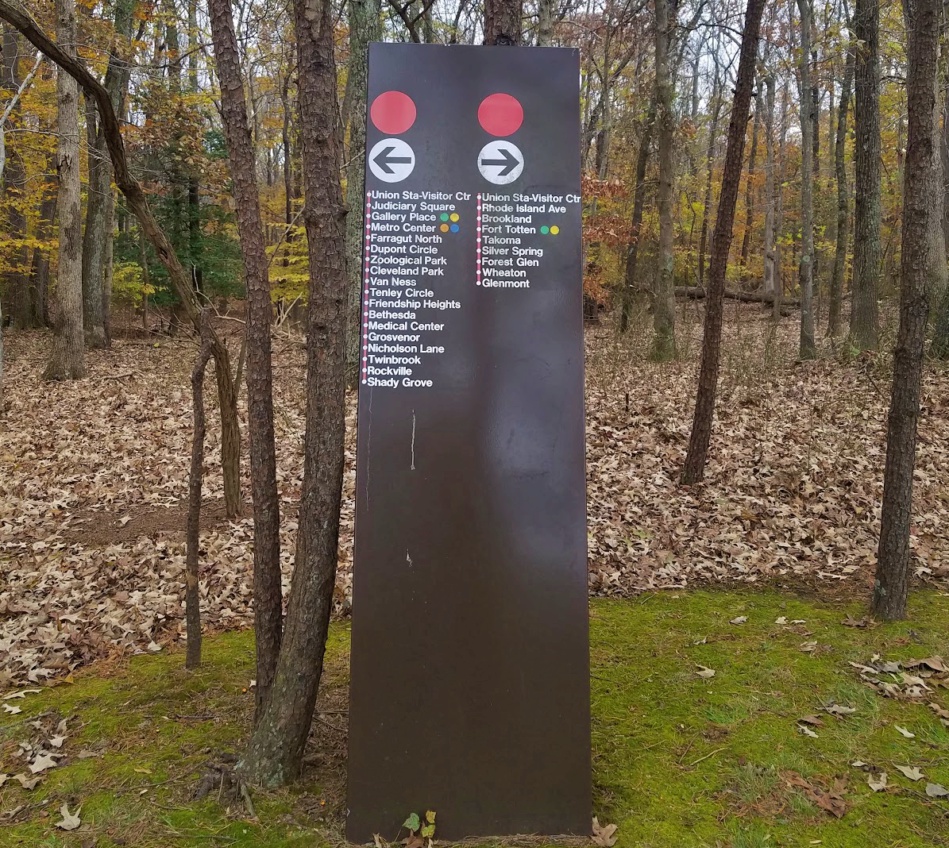
While visiting relatives in Accokeek, Maryland, for Thanksgiving, Jane Lyons made a surprising discovery: leaning against a tree in her uncle’s backyard was a full-sized Metro pylon sign.
It looked exactly like the ubiquitous signage that riders can find at Metro platforms across the system. Lyons told DCist that it is made out of metal and has fasteners on the back that could’ve affixed it to a post. According to her uncle, it was already in the backyard when he bought the home in 2002.
Lyons took to Twitter to try and learn more about the sign, which included outdated names for various stations, such as “Union Sta-Visitor Ctr” instead of Union Station; “Zoological Park” instead of Woodley Park-Zoo/Adams Morgan; “Tenley Circle” instead of Tenleytown; and “Nicholson Lane” instead of White Flint. Given the placement of “Union Sta-Visitor Ctr” at the top of the station list in both directions, it appears to have been intended for a platform at Union Station. The backyard relic also does not list the New York Avenue station (now NoMA-Gallaudet U), which opened in 2004.
The station names listed date back to the original mid-1970s plan for Metro, before the system opened in 1976. Many were updated by 1982, including Union Station, Woodley Park, Tenleytown, and White Flint, according to Metro spokesperson Dan Stessel. That timeline puts the likely creation of the Accokeek artifact at pre-1982. Stessel also speculated that it may have been a prototype for the directional posts at Union Station, likely created before the opening of the Metro system in 1976.
When Metro first opened, the only line in service was the Red Line and just a handful of stations had been completed. While much of the overall design of the system was finalized before opening day, it would be years until the rest opened. Many original promotional materials, including system maps, included the original station names seen in Lyons’ uncle’s backyard. Over time, signage throughout the system was updated to reflect the new names.
Zachary Schrag, historian and author of The Great Society Subway: A History of the Washington Metro, placed the creation of the sign between March 1975, when Shady Grove was added to the system plan, and August 1979, when Woodley Park and White Flint were renamed. Like Stessel, he also thought the artifact may have been a prototype.
Some of these original pylon signs have been found in stations in the past. In 2009, a DCist reader spotted a sign at the Farragut North station that included all of the original system names, just like those listed in the Accokeek backyard. A Metro spokesperson explained that updated panels had been affixed to the original Farragut North sign as the system evolved, but they somehow come off.
If Farragut North once held a relic from Metro’s early days, is it possible that the artifact in Accokeek was ever in service? The fact that the sign includes fasteners seems to suggest that it could’ve been more than just a prototype. A 1976 photo taken by Metro shows a pylon sign at Union Station, though it shows only the stations that were in service at the time.
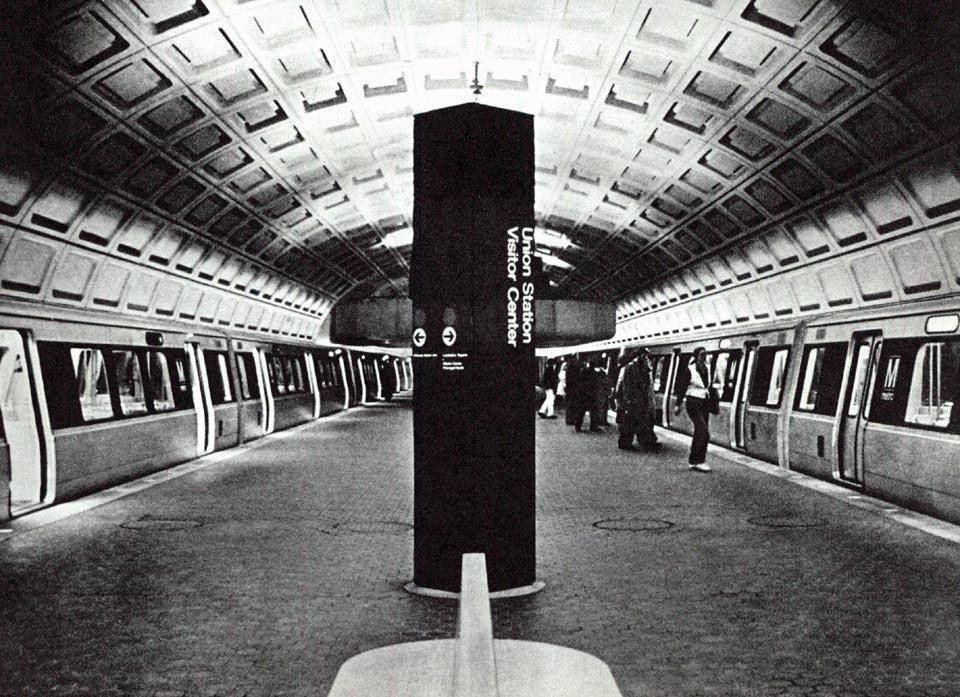
Could it be that the full list of Metro stations was covered up by a panel in the 1976 photo, as the outdated names had been overlaid on the station list found at Farragut North in 2009? It’s possible, says Matt Johnson of Greater Greater Washington. As for the directional post Lyons found, Johnson speculated it “may be a demonstration sign that was used before the system opened, or it could be a part of an original pylon from Union Station that was disassembled.”
While it is not possible to know for certain if the sign ever saw service at Union Station, it is likely that it is between 40 and 43 years old.
How the sign ended up in a backyard in Accokeek, however, remains a mystery.