Martin Austermuhle
Alexa, what does it take to fly a helicopter in Washington’s airspace?
If Jeff Bezos were to ask his popular virtual assistant that very question, he might end up stumping her. But Amazon’s lawyers are probably hard at work trying to find out, chasing after one of the quirkier asks made by the internet retailer when it agreed to build two new campuses in Long Island City and Crystal City: a helipad at both.
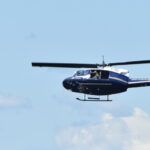
Amazon has enlisted the help of government officials in both places to navigate what’s known to be a thicket of regulations that came after the Sept. 11 terrorist attacks. There are local, regional and federal restrictions and obstacles that severely limit — if not outright prohibit — commercial helicopter traffic in the airspace above much of the Washington region, especially around downtown D.C.
Some helicopter pilots, aviation experts and elected officials have their doubts that Amazon will ever be successful, but they also concede that if any company could get through the red tape, it would be Amazon.
“I wouldn’t be surprised if they told them, ‘Hey, you just have to fly out of [Reagan National Airport],’” says Seth Clute, the chief operations officer and chief pilot at Monumental Helicopters, a Maryland-based helicopter tour and charter company. “But then again, Amazon as an organization has a different level of political capital. And so it seems like they are willing to work with them on getting things done where historically other organizations or businesses haven’t been able to make that happen.”
Restricted Airspace
Don Scimonelli remembers what Washington’s airspace was like in the heyday of corporate helicopter travel. He’s the chief operating officer at the South Capitol Street Heliport, D.C.’s only heliport.
“We had 40 major corporations that were using the heliport,” he says. “You’re talking about American Express, talking about Pfizer. Talking about Honeywell Aerospace. You’re talking about Fortune-50 corporations. Time is money to them, and their executives were working on the aircraft.”
Helicopters flew in three to five times a day, landing at a 56-year-old helipad located right along the Anacostia River only a few blocks away from what’s now Audi Field. And it wasn’t just senior executives using the helicopters, says Scimonelli. It was also engineers, lawyers, accountants and IT specialists.
“It was… the people who were actually making the money move. They were the ones that were coming in here,” he says.
All of that changed on Sept. 11, 2001. While Scimonelli was able to work with federal authorities after the terrorist attacks to design waivers for certain helicopter pilots for the new restrictions imposed on the use of Washington’s airspace, security-conscious officials pulled back on those completely after 2003, leaving the South Capitol Street Heliport with no corporate helicopter traffic at all.
Those officials, says Scimonelli, “went after corporate aviation like we were the dregs of the earth. We were like Al Qaeda operatives.”
The post-Sept. 11 airspace above Washington has become a layer of restricted zones, each with their own set of rules and regulations. The closer you get to downtown D.C., the more the restrictions ramp up, says Clute.
“To start off with, every pilot within 60 nautical miles of DCA — Reagan National Airport — are required to undergo awareness training online, and then within 30 nautical miles, you have what starts the D.C. special flight rules area,” he says. There, flight plans have to be filed ahead of time and pilots have to be in constant communication with air-traffic controllers on the ground.
Once you’re within 15 miles of DCA, the flight-restricted zone begins, which requires approval from the Transportation Safety Administration and Federal Aviation Administration. Within seven miles of DCA — which would include Crystal City — the vise tightens even further.
“There’s still a waiver process for getting access to the airspace, but now you’re also required to have a police officer onboard the flight and the flight requires a letter of support from a local state or federal government organization,” says Clute.
Emergency medical helicopters and news helicopters have a streamlined permitting process, but the majority of helicopter use in the Washington Metropolitan region — 51.2 percent, according to a 2005 report from the Metropolitan Washington Council of Governments — remains police- and security-related.
Amazon’s Helipad, Grounded?
Amazon hasn’t provided many details as to why it wants a helipad in Long Island City and Crystal City. In a statement, an Amazon spokesperson would only say that the company wanted to start discussions about a possible helipad as early as possible.
“We are still in the early days of the project, so we don’t have specifics about how the helipad will be used at our new headquarters. We included it in our negotiations in order to look around corners and prepare for the future, and also to be fully transparent to the public,” said the spokesperson.
But Amazon may find itself confronted with more and more corners to peek around before it sees a helipad anywhere in the distance.
“It’s complicated on many levels,” says Christian Dorsey, vice-chair of the Arlington County Board. “Let’s just assume that all of the federal agencies said it was possible and that they would be in support of it. We’d then have to have some sort of a public process to consider a zoning ordinance change to allow it to happen. And I don’t have enough information at this point to say that that’s something that I would support.”
Dorsey says that given the concerns expressed by residents in D.C. and Northern Virginia over noise caused by planes flying into DCA, he expects similar complaints to dog Amazon’s pursuit of a helipad in Crystal City.
“At this point, it is a company asking for something and asking to explore something, which is their right. But I am not in a position to say that’s going to be a part of their path in Arlington at all,” he says.
Debate in New York over Amazon’s proposed helipad there has been intense. Earlier this month, members of the New York City Council bashed the helipad, calling it a perk snuck in by company and state officials to allow Bezos to fly in and out of his new campus.
Local critics similarly see the proposed helipad in Crystal City as a broader representation of what they worry will be an unfriendly corporate neighbor.
“If Amazon manages to get the helipad despite all these various complications that the county board says will prevent it from happening, that’s a really clear sign about how much power Amazon really has. And that should make us very concerned,” says Roshan Abraham, a leading Amazon critic with Our Revolution Arlington.
For Don Scimonelli, Amazon alone is beyond the point. He’d like to see private corporate helicopters allowed back into Washington’s airspace.
“There’s companies out there that may need a specific item delivered quickly or an executive needs to get to a place to really quick,” he says. “Yes, we can do things with secure encrypted systems and all that stuff, but it’s always going to be the human being that needs to go and sign that piece of paper.”
This story originally appeared on WAMU.